Patients…!

2nd/3rd May

After a short sleep we awoke to some tentative sun.

Breakfast was served outside the front of the little hotel, a good vantage point from which to watch the world go by. They did a yogurt, fruit, honey and nut combination served in a glass, as well as fried eggs and toast, served in no particular order.
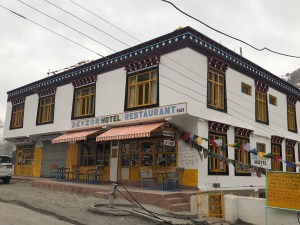
I was by now beginning to feel pale and not at all interesting. Anil arrived. “How are you?” I could not lie. “Rubbish actually.” “Ok. Let’s go to the hospital.” I put up a faint protest, but in the end we walked the short distance to the medical centre.

In UK the word ‘hospital’ conjures up images of pristine floors and shiny surfaces. Living where we do back home we are blessed with an enormous medical complex which is all car parks and plate glass windows.

This could not contrast more highly with where I found myself now: a small low concrete building, very dark on the inside, with a few directions to various rooms eg Out Patients and in an adjacent building, Emergency. A few people were hanging forlornly around Out Patients, being told the doctor was not there yet. Ever quick to cut to the chase, Anil steered us straight over to the Emergency department. We ascended one floor. There appeared to be one guy on triage as well treatment, a few nurses, and a couple of wards. The walls were painted dark green and there was a pervading smell of carbolic. I glimpsed the ‘women’s’ ward. It was a suite of iron bedsteads parked closely together, on which languished ladies in various conditions, attached to drips. It was not heated and the only light came from outside, dazzling, in contrast to the dingy walls.

In between the women’s and the men’s wards was the triage room, for which we queued. There must have been further wards down the corridor as I heard some terrible deep coughing coming from someone who sounded clearly in bad shape.

Within minutes we were beckoned in. “What brings you here today?” The doctor on duty looked Tibetan and spoke excellent English. His manner was very calm and ordered. Anil attended to assist in any translation needs but possibly also just to see what happened! A detailed history and vitals were taken. To my great relief everything was fine, including no fever and oxygen saturation levels at 92% indicating that hanging around at 3,500m was not presenting any problems. “You are coping very well with the altitude” he said, “but you have inadvertently eaten something which has given you this infection. You must take these.” He wrote me up for three days of ciprofloxacin and some anti spasmodics.

The whole thing only took ten minutes. Anil and I then went downstairs to the dispensary, which was tucked away behind a tiny hatch. We posted the prescription through it, and minutes later the hatch reopened and the exact amount of medicine popped out, just in its foil wrapping. “How much?” I asked. “No charge,” came the reply. I was staggered.

I was so grateful. It took a couple of days, but by the end of Thursday, I had a tiny bit of appetite and was able to down some chicken which stayed put. Marvellous!

Thursday 3rd May

The weather was definitely turning cold. Grey wispy clouds swirled low beneath the mountain tops and a few snowflakes came and went. We were very glad of the layers we had packed ‘just in case’.

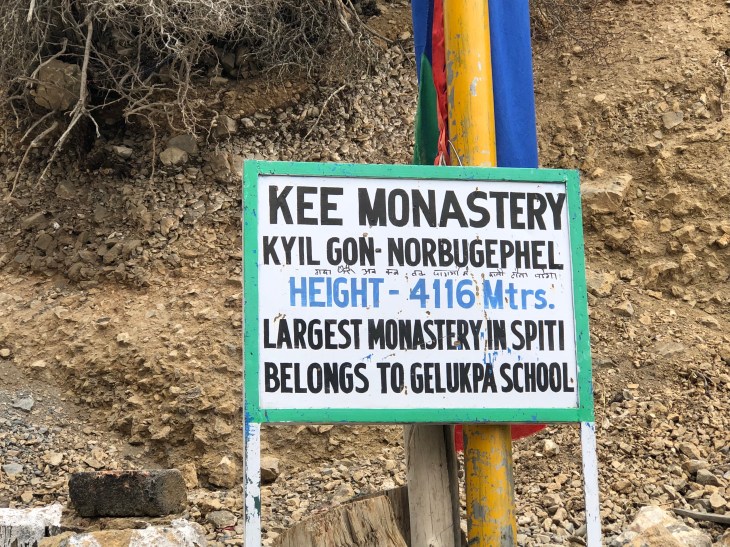
In the afternoon, to escape the confines of the hotel room, I went with Jeremy and Anil to visit Key Monastery, a relatively short distance away. Our tour co-ordinator, Mukesh, also jumped in and joined us.

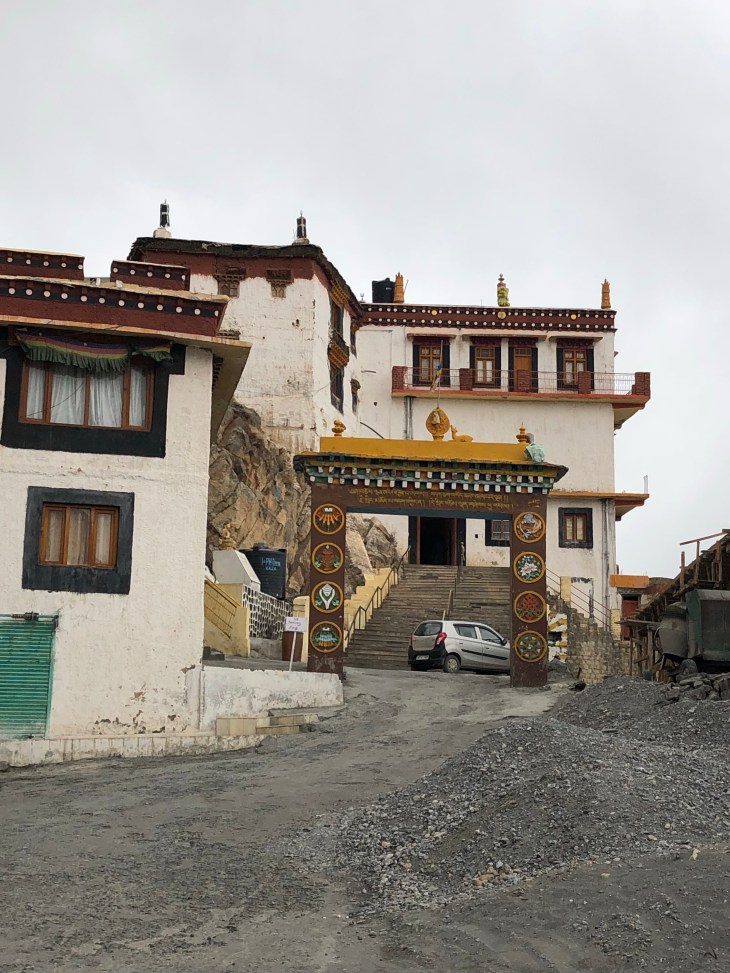
Key was set impressively high up the valley, with a large gate at its entrance.

We were greeted warmly and shown around. A large candle was burning behind a glass.

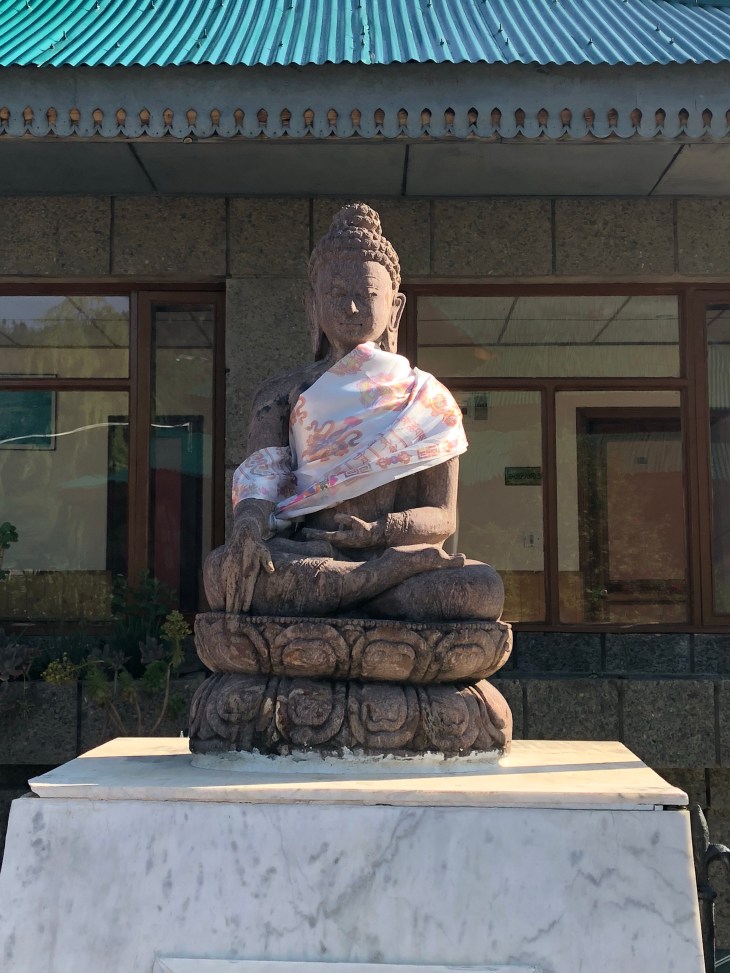
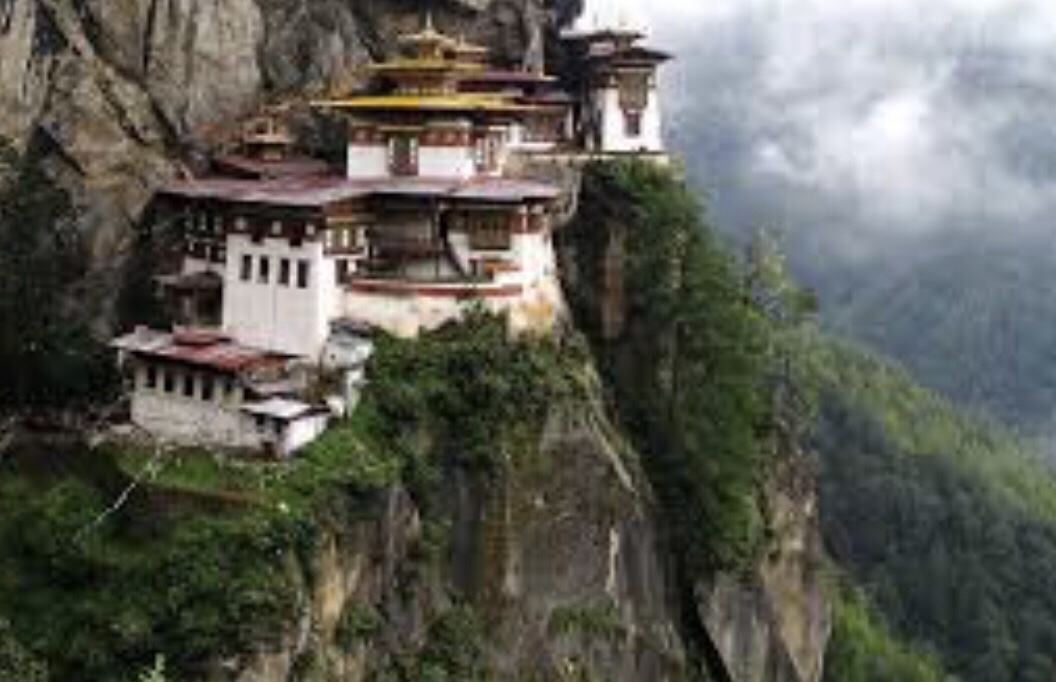
Again, no photographs were permitted on the inside, but we recognised the familiar pattern of rectangular inner temple sanctums as well as there being a large communal prayer hall, adorned with frescoes and cloth hangings, Buddha reigning at the centre. We experienced all the usual amazement at the sophistication of this ancient construction, (a thousand years) combined with the simplicity of the buildings, at such a great height.

Life in Spiti was raw, and devotional for these monks. What a privilege it was to observe in this far flung place.

We returned to a chilly Deyzor and enjoyed a late soup.

Moving Monasteries

Tuesday, 1st May

We woke to brilliant sunshine, attempting to burst in from behind the blackout curtains. The Tum was fragile and nursing itself. But, as ever, the thrill of the light and bright blue sky swept those things aside.

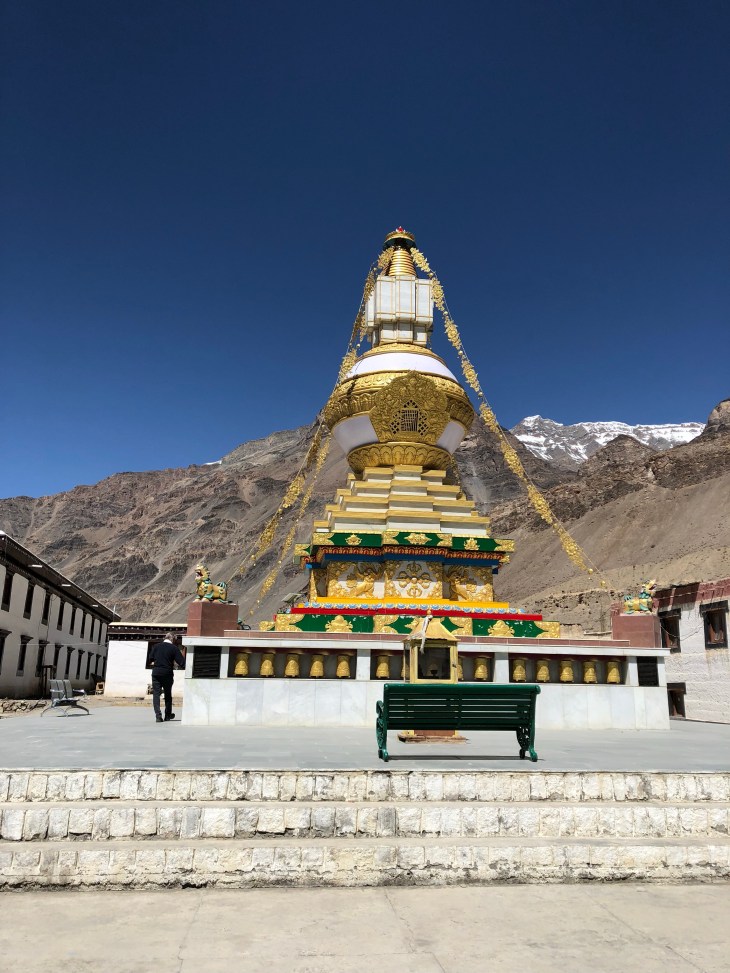
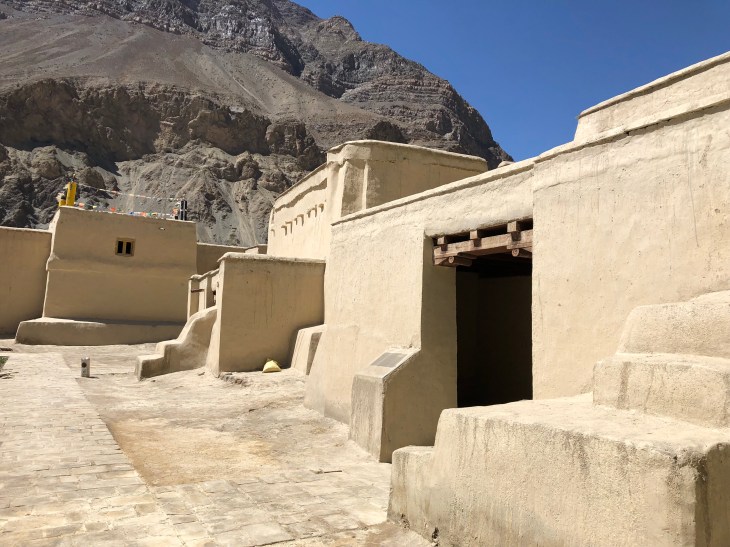
After a good fruit breakfast and some egg we ventured forth to Tabo monastery. It was only yards down the road.

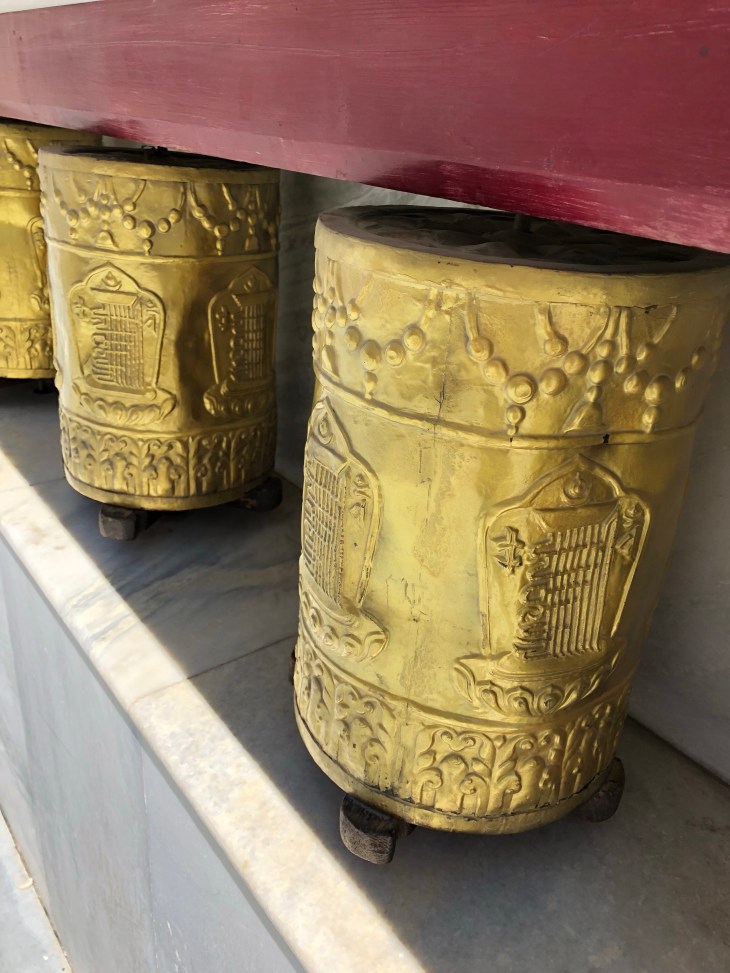
As we entered through the gate, there were prayer wheels to the side. I gave each one a turn and thought of particular people.

The monastery was a collection of pale creamy coloured mud made temples, which were unlocked for us by local monks.

The first we visited seemed very dark at first but then the eyes adjusted and shafts of light illuminated the frescoes from a square sky light above. Greatest visibility was said to be at 4pm once the sun had moved round (or the earth rather!) The delicacy of their intricate patterns was breathtaking. In the middle of the building sat a large Buddha and on the walls there were coloured mud carvings of Boddivistas – incarnations of Buddha. There was an enormous amount of decoration. No cameras were allowed so I cannot illustrate the tremendous artistry and dedication that had gone into creating that holy space.

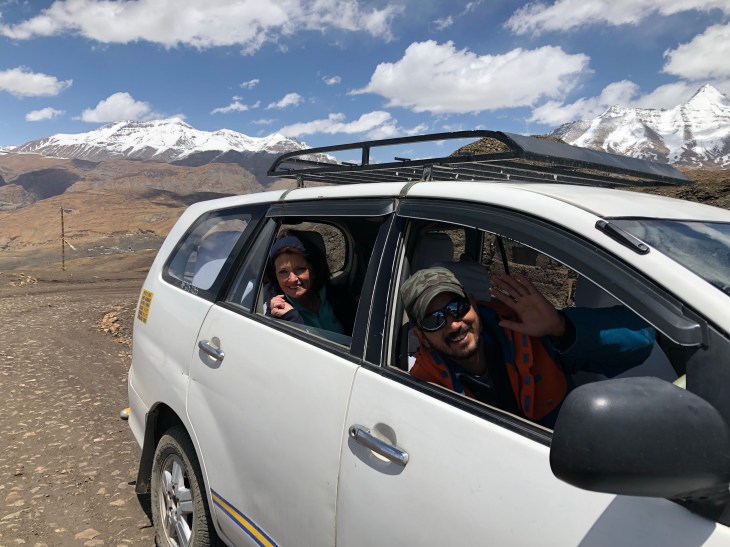
Later, as we pulled away from Tabo in the Toyota, Anil selected a playlist of thoughtful Tibetan style music that put us into a meditative frame of mind.

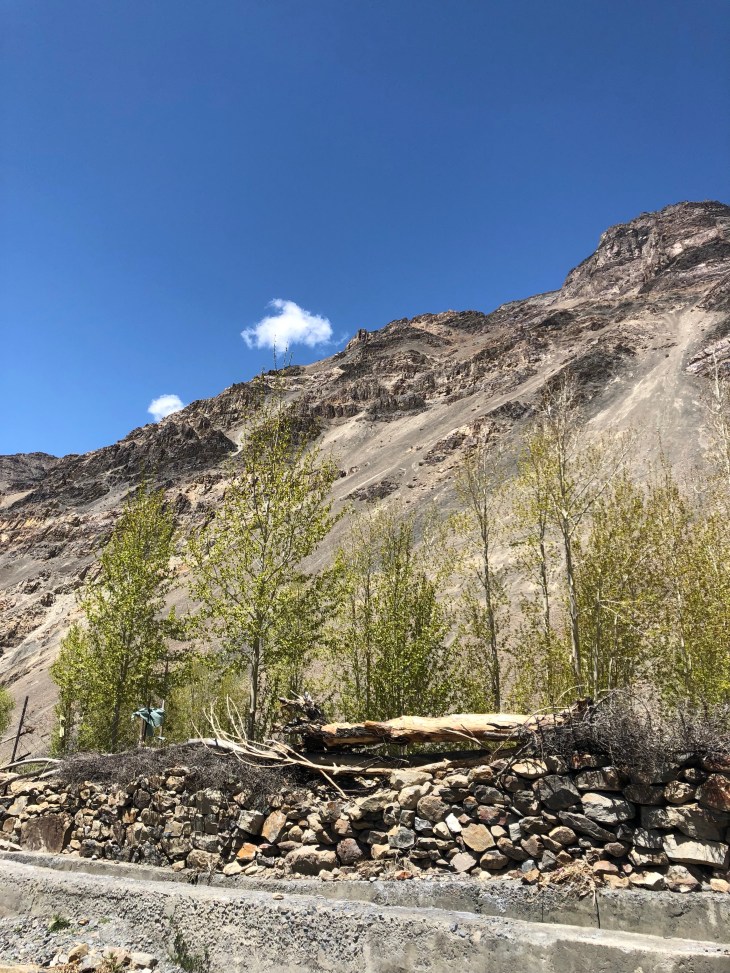
After so many assumptions about Spiti Valley being nothing but bleak and barren I was humbled by the beauty of it in the morning sunshine.

Next stop was Dankhar: first a walk up to the lake and then to the monastery.

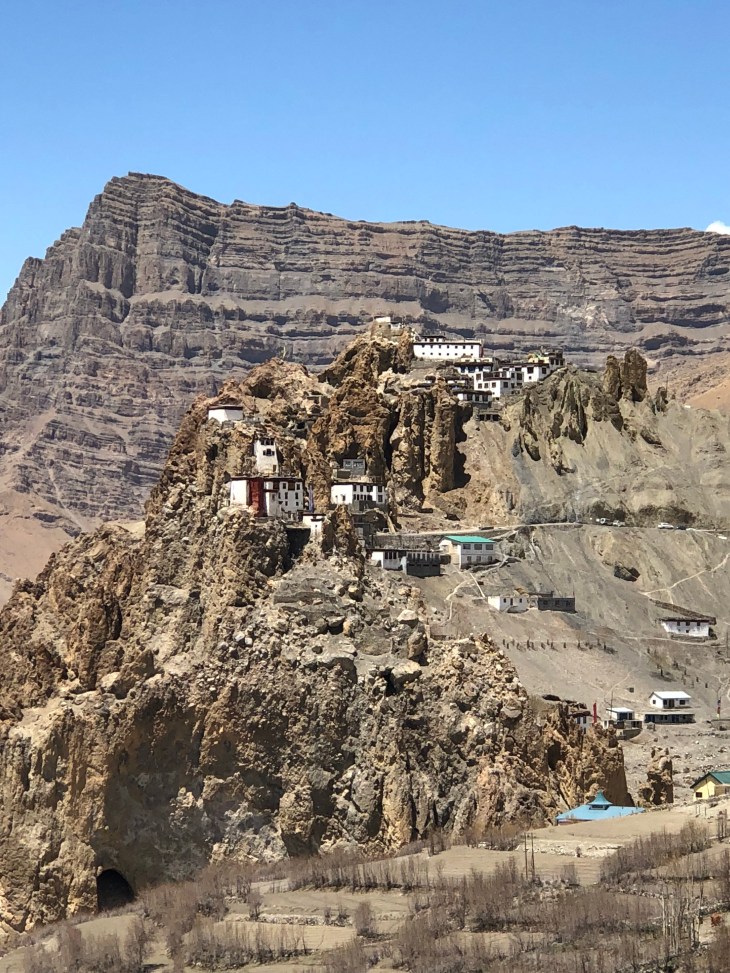
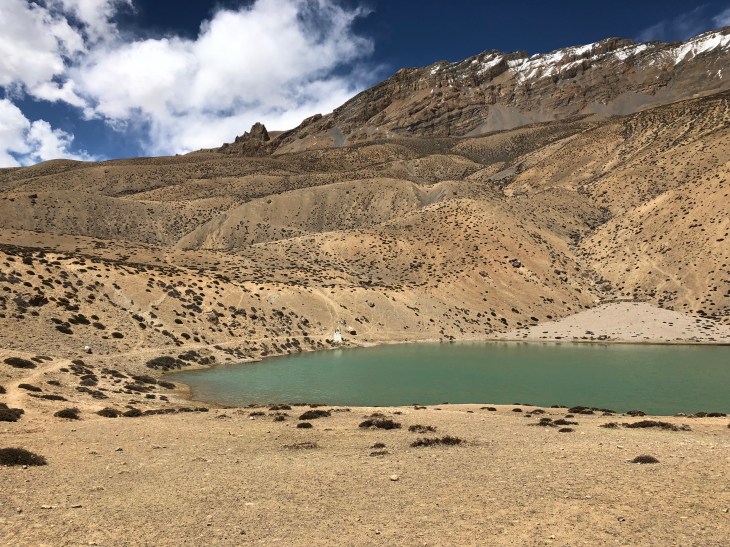
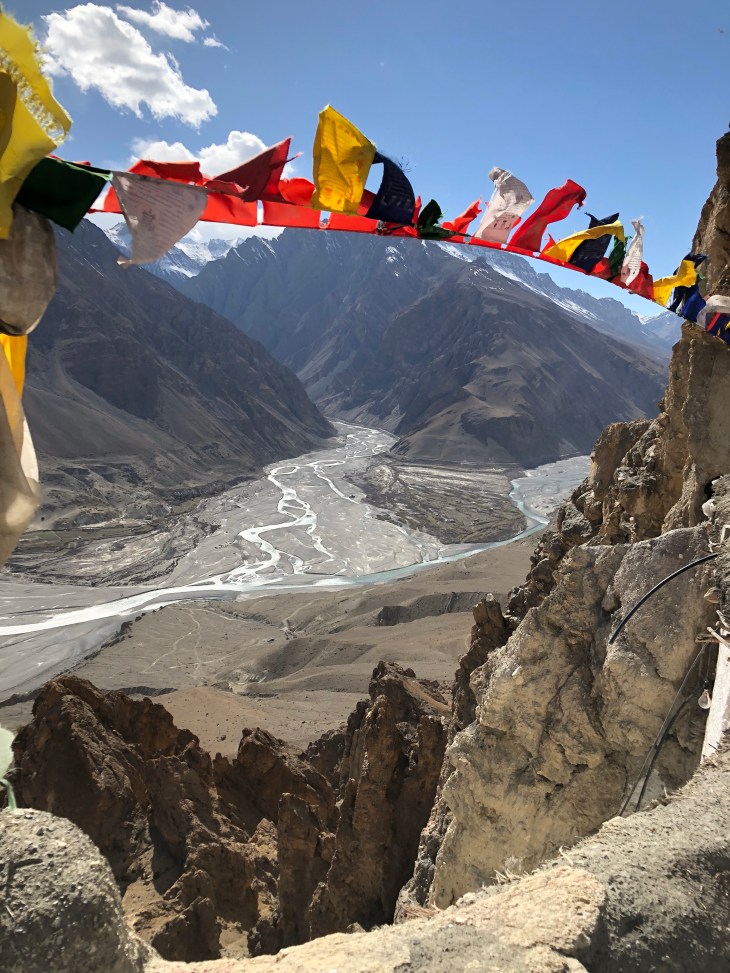
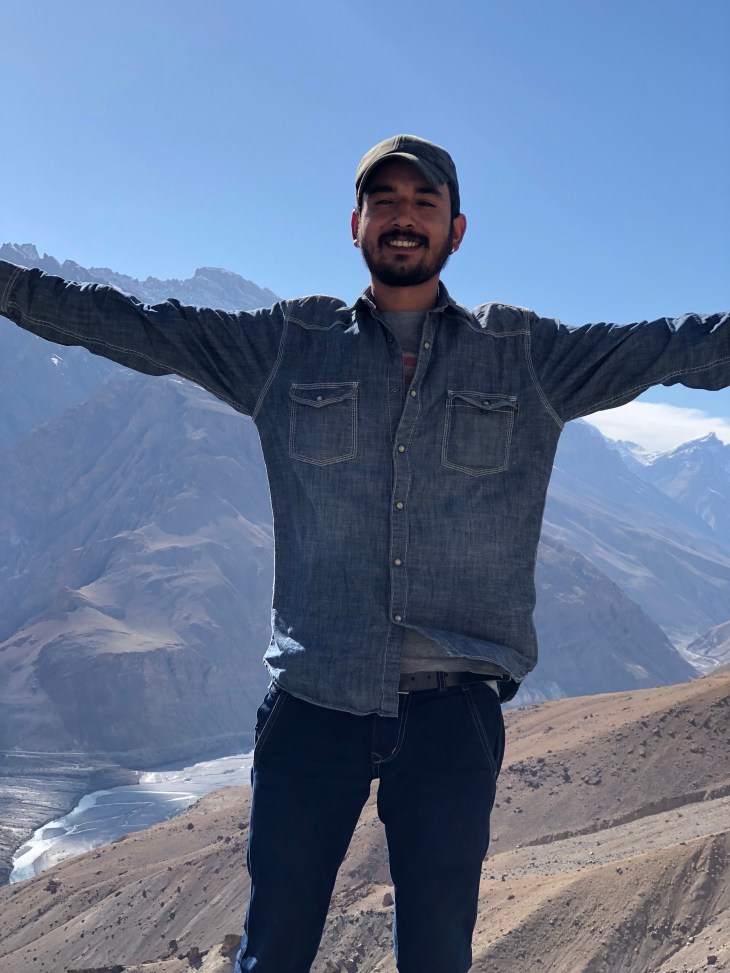
Dankhar Monastery sits high above the valley floor, commanding views for miles. How they built it a thousand years ago without vehicles or cranes is a mystery – but then all the monasteries up there are mysteries. Today we were going to challenge ourselves with a walk up through the thinning air to Dankar Lake at 4140m. It was pitilessly hot. Anil showed us how to walk slowly at this altitude, taking small steps and leaning forward as if portering. I was slightly nervous about it but we took our time and caught our breath every so often, and got to the top without any problems. Views, needless to say, were breathtaking..

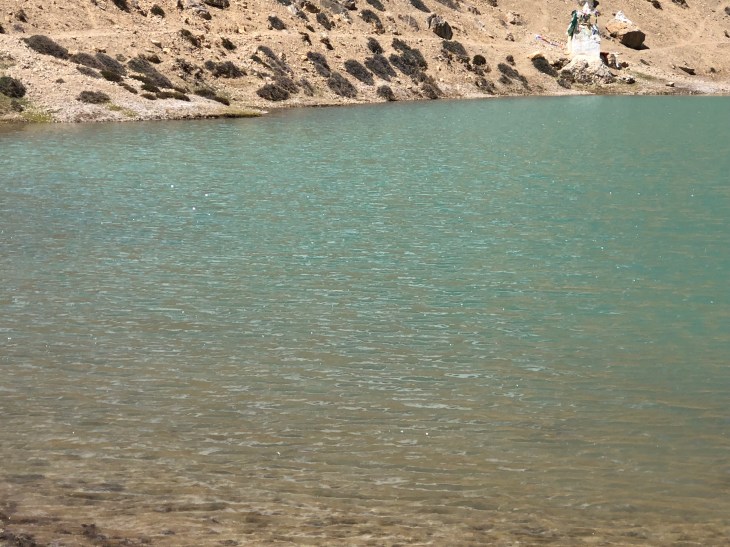
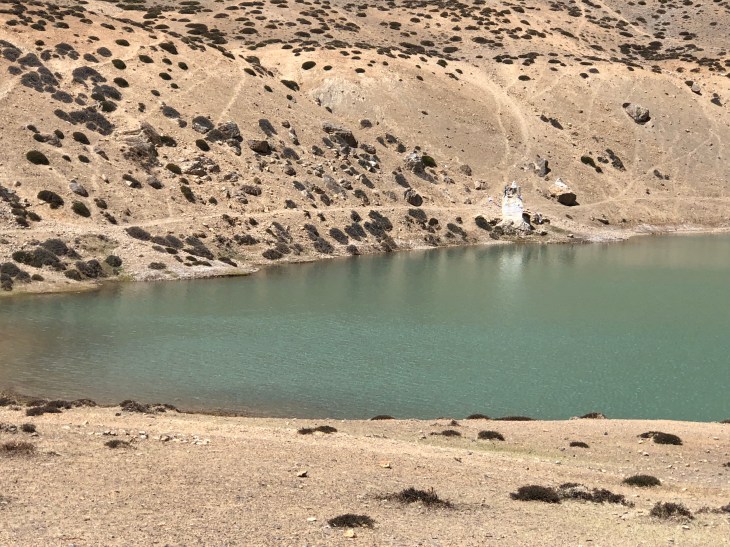
As we left the steep path and onto the plateau where the lake is situated, we felt peaceful if a not a little triumphant. No one had keeled over or suffered. The lake itself was a pale turquoise oval sitting in a bowl of sand coloured rock. Nearby, stood a shrine, which Anil circled three times in a clockwise direction. I followed suit. The peace and beauty were transporting.

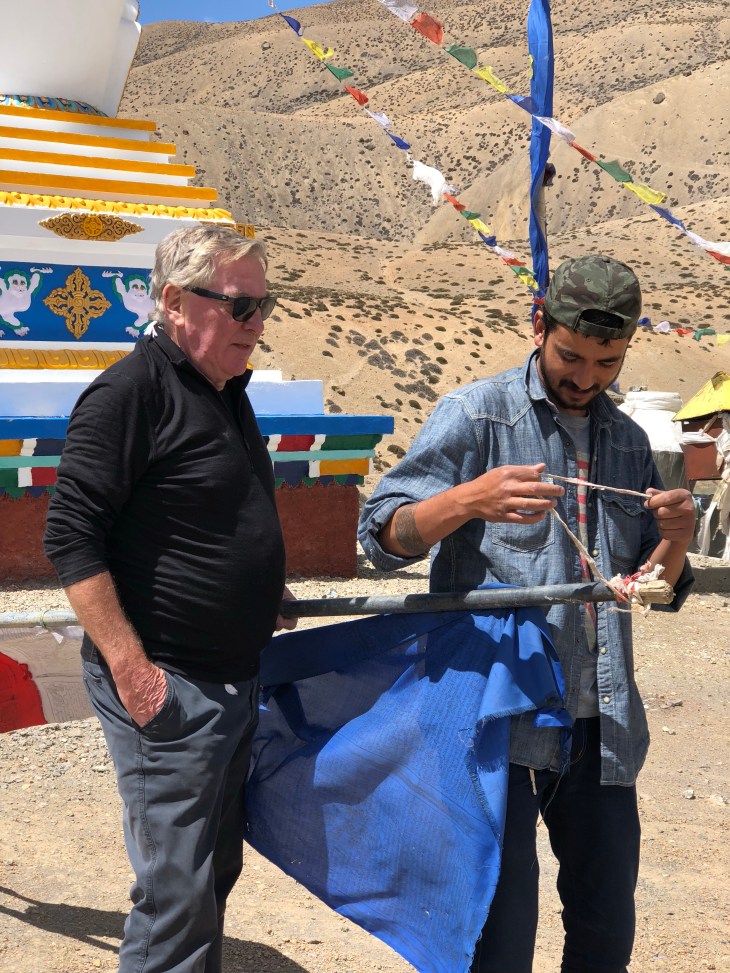
Here you can see Jeremy and Anil trying to fix a fallen flagpole.

They made a good attempt but unfortunately it fell back down again as we were leaving.

I went and dabbled my fingers in the lake. It was so cold it almost burnt the fingers.

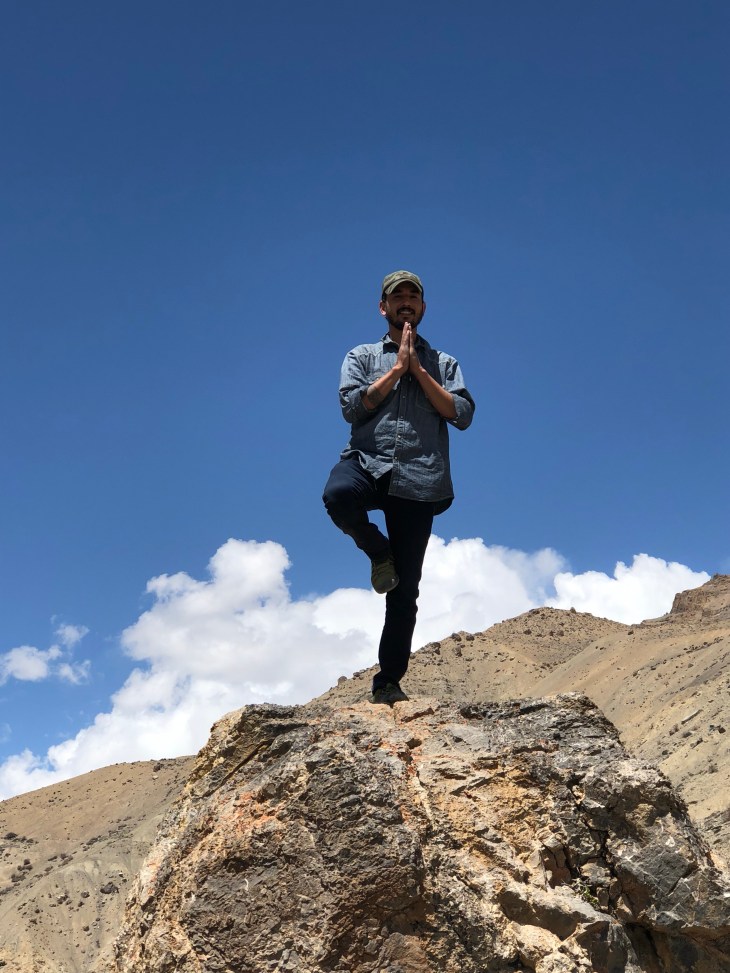
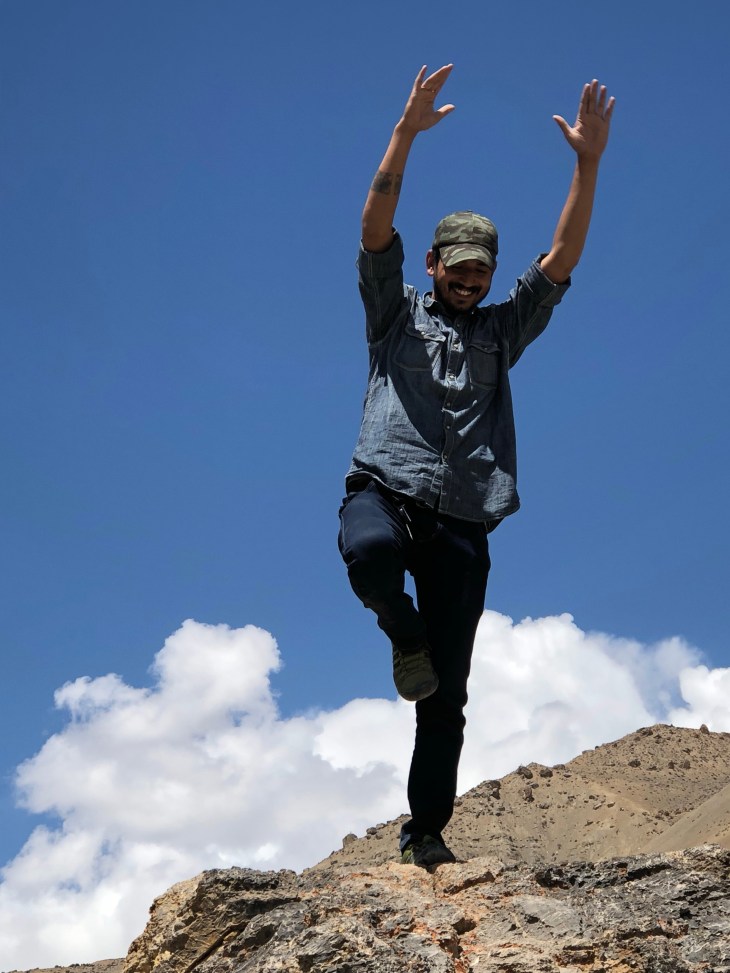
There was a certain amount of bravado on the way down – Anil perching in Yogic pose on a very high ledge. Jeremy and I did our best..

Anil faithfully collected some litter on the way down and we then made our way across to Dankhar village, for something to eat.

Unfortunately however I couldn’t. Tum not cooperating at all. Instead I had a lovely honey lemon ginger tea which was very restorative.

We left Anil to chat with friends while we went over to the monastery. This was another extraordinary building built at different levels into the side of the cliff, with a whole collection of little inner temples. It was another good test of resistance to vertigo as we looked out of the windows and eventually stood on the roof!

We were achieving lots of firsts that day: highest lake, highest monastery and highest village visited so far.. and the weather was magnificent.

Next stop en route to Kaza, was Lalung. Anil was keen to take us to another remote village and see a tucked away temple. This involved more precipitous driving but by this time we were becoming enured to it. There didn’t seem to be anyone around but after a time a little old lady appeared, a nun, to unlock the temple’s secrets to us.

Like the other temples, this was rectangular and dark on the inside but intricately decorated, much of it undamaged despite its tremendous age. The reverence the nun had for the place was palpable, but she was full of smiles and chuckles, chatting amiably to us from her almost toothless mouth. She was not shy of being photographed but highly amused to see her own face. She radiated warmth and before we knew it we were all exchanging hugs. I held her little brown hands. They were warm and strong.

I don’t know why but I felt like crying when we left.

The day was wearing on, so we had to get back on the road to our next resting place: Kaza. The bendy roads continued and were lost in stupefied exhaustion, looking forward to getting there, staring out of the windows.

Eventually we reached the Deyzor Hotel in Kaza. Unbeknownst to me That Thing which I had been battling with was now about to take hold. We were shown to a nice corner room on the first floor but everywhere felt cold. There was no heating and no fire downstairs.. Electricity was also variable and not there when you needed it. I attempted to have a shower but the solar power hadn’t warmed the water much and there was the usual problem of the raised drain and whole room becoming flooded if you used the shower head. I must say it was a struggle that evening as we adjusted to the new place, the colder weather and feeling tired.

We had a chilly supper downstairs in our coats and a shawl and then hastened to bed where we were at least accorded some hot water bottles.

I then passed a fitful night doing battle with Whatever It Was.

Travelling hopefully…..

Follow my blog with Bloglovin

The Road to Tabo

Monday 30th April

Bursting with Tulsi’s fuel filled breakfast, we left the chill of Kinner Camps by 7am to begin the long leg up to Tabo, the site of a thousand year old Buddhist monastery.

It had been a short night, broken eventually by the 6am cuppa. As Anil pulled away in the Toyota we rolled around quietly in the back of the car, allowing the day to dawn gently upon us. We had 150kms or so to make in order to reach Tabo. But first we needed to obtain our permits for entering an area so close to Tibet from an office in Reckong Peo. What none of us had quite appreciated was that the day had been declared a public holiday and that the permit office was likely to be closed…. Anil revealed this cautiously to us as we drove along. Instant questions and concerns attempted to flood our minds, but Anil’s prior knowledge and bouncy optimism held sway. “We will see,” he declared, and got on with the driving.

We arrived in a sunny Reckong Peo by 9am. No one at the permits office. Anil had done some diplomatic telephoning as soon as he realised we might have a problem, and tracked down one of the officials. There was going to be a Buddhist festival that day and the relevant official would be attending it. Anil suggested that we went along too while we waited.

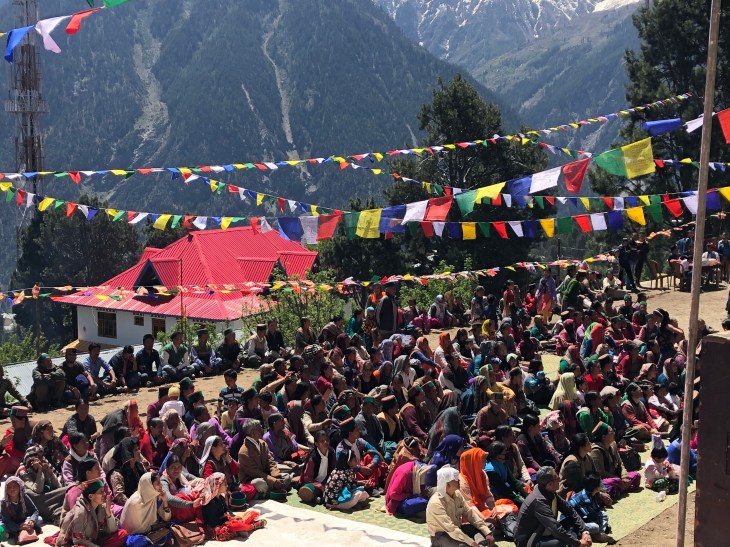
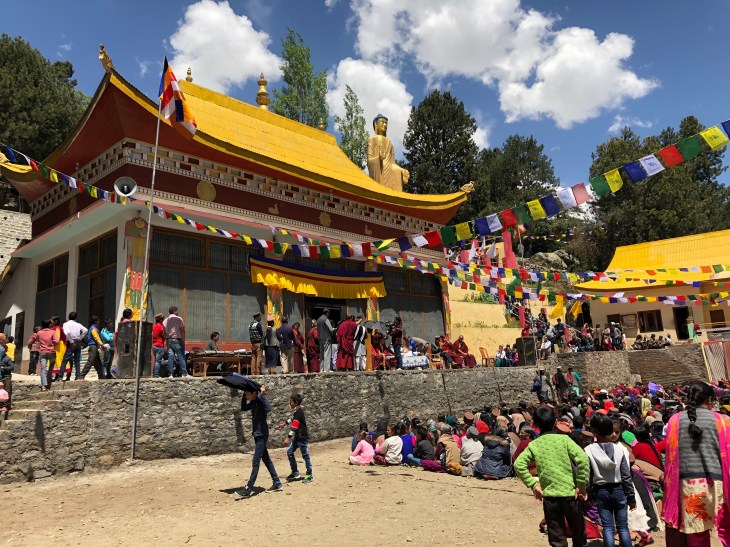
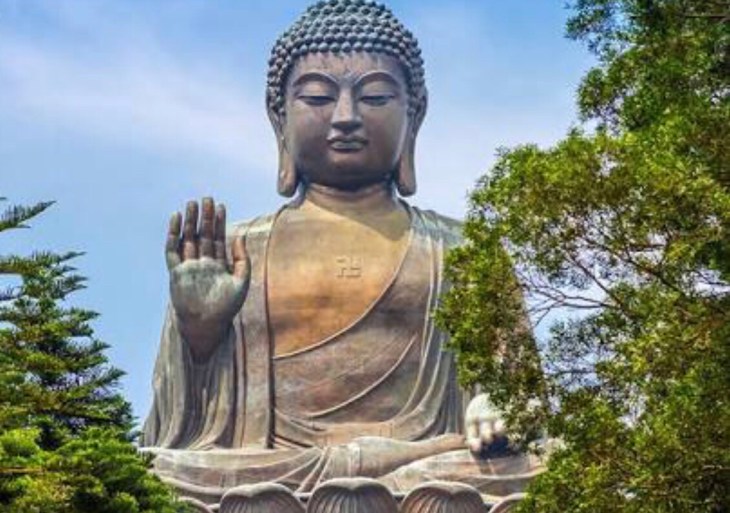
It proved to be a glorious sight – a crowd of people seated happily on the ground in the sun, watching a group of children perform for some Buddhist dignitaries on a dais at the front. We beheld a sea of reds and yellows, against the glistening backdrop of the Kinner Kailash mountain range, and all overlooked by a mighty golden Buddha. Anil and I walked round it three times in a clockwise direction, as is customary, muttering the Buddhist chant ‘o mane pad me hum’. Then to my embarrassment he yanked out his mobile phone and was suddenly making a little ‘Facebook Live’ transmission, involving me, to share with all his friends. But it was so enthusiastic and for the happy purpose of sharing a lovely event, that I was happy to be swept up in it all. We then just stood and gazed at the whole event..

I was captivated by these little faces, who coyly agreed to being photographed.

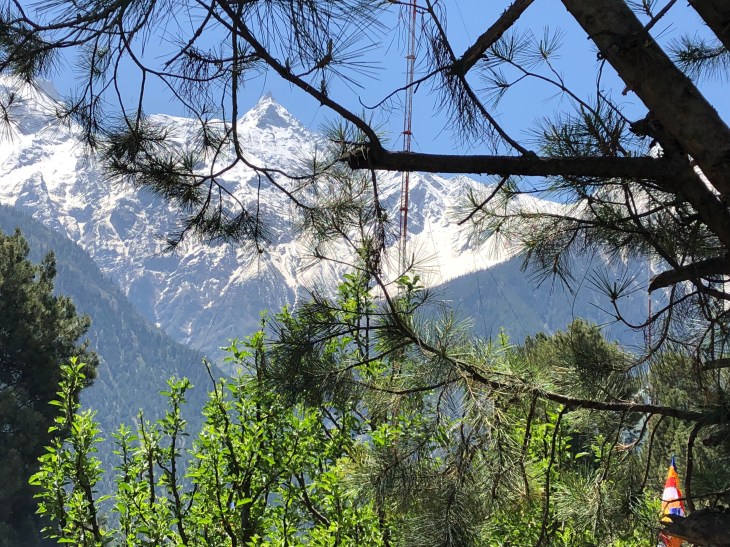
Reckong Peo itself had a real mountain feel about it – a good many of the neighbouring peaks standing at over 6000m. It was the closest we had felt to the Himalayas so far.

After a time we left the festival and bumped into the official we needed to open the permit office. He was extremely affable, thanks to Anil’s negotiations, and in due course we were ushered into the relevant office to begin the lengthy process of getting the permit.

This began with tea. Then came the form filling, followed by hours of waiting, literally. Another official had to drive 50kms in to Reckong Peo to inspect and stamp our forms… As we sat and waited it became very hot, and we lay around like overheated dogs, almost panting for refreshment. Anil was despatched to find food, and later returned with containers of delicious momos and some ‘hot sauce’ for dipping. Boy did they taste good!!! Then, there was more waiting and desultory conversation with some other permit hopefuls, also in the office.

Very eventually, five hours after arriving, we were granted our permits. Those in hand we jumped in the back of the Toyota and started on the drive to Tabo. It was already 3pm.

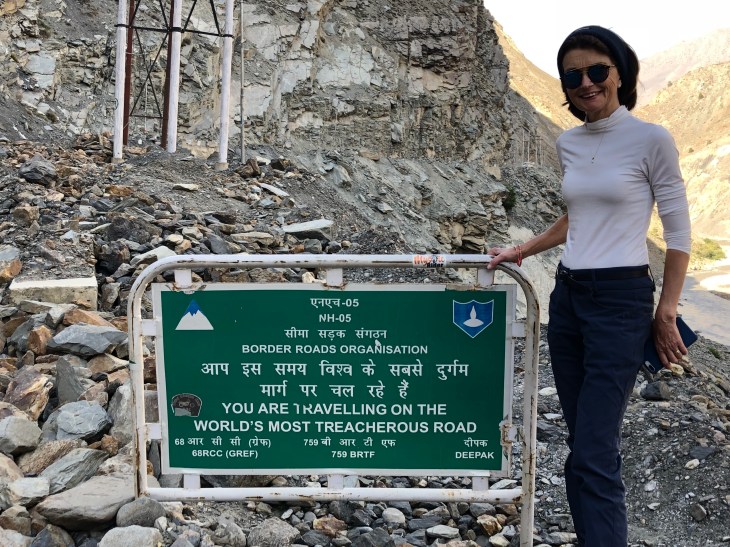
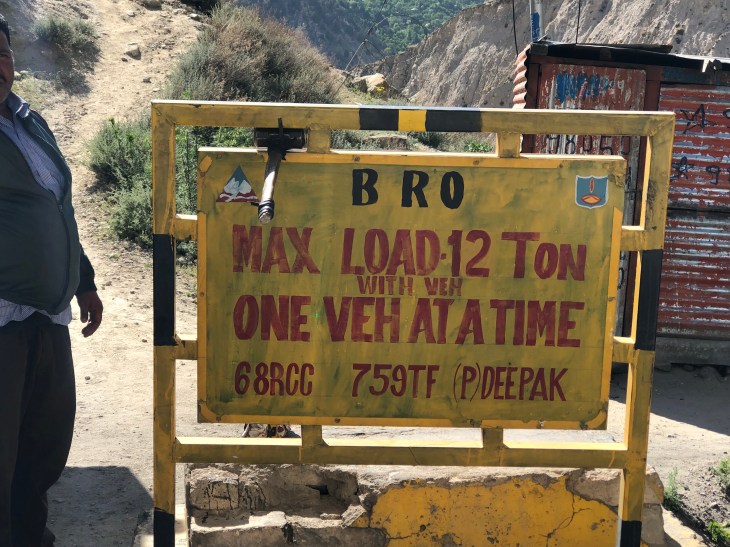
Little did we know quite what lay ahead. Let’s just say it was a ‘rocky road’, a good portion of which was unmade. We were jiggled, bumped and whirled like the ingredients in a magimix until there was no point in resisting any of it anymore. The whole journey was going to take at least five hours, plus or minus potential landslides. One had to gear one’s body and mind accordingly. This road sign spelt it out!

At one point we crossed a clattery bridge but somewhat gingerly..!

The day was wearing on. I was racked by gathering fears about continuing in the dark. Should we do so at all? Should Jeremy go and sit in the front and be a second pair of eyes for Anil to help spot boulders etc??? It was also a ‘shooting stones’ area, and anything could drop on us. But somehow I couldn’t speak. Anil was concentrating hard. Casting doubts on the journey or his driving would not build confidence, or trust. Plainly at one with his vehicle, he was already doing really well. Then, as if to bring more energy to the job in hand he put on some music. It was playlist of blasting sound (heavy metal) and pounding tracks; Metallica, Guns and Roses, Foo Fighters, you name it, not the sort of thing one might ordinarily just sit down and listen to. But here it was perfect. Anil could have been a tank driver. He said gleefully, “I like to drive in the day.. but I also love to drive at night! We felt like an heroic little band of adventurers, strapped into our cockpit, heading bravely towards the vast chasm of Spiti Valley.

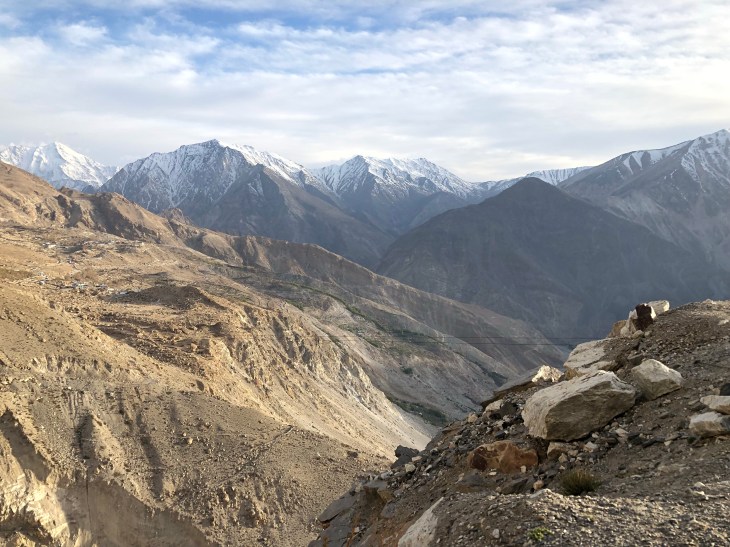
At long last, the worst of the unmade road ceased. The peace of the tarmac gliding under the wheels was balm to our battered behinds. In addition, having been crawling through twilight murk lower down in the valley, we began to climb. Gradually we were rejoining the day, as the sun became visible again until suddenly the beauty of the place was revealed: snow caps still adorning the brown rock of the mountains, and the widening floor of the valley opening out the path of the snaking river, thousands of feet below. On we climbed, up the narrowing road, round bend after bend. Anil timed our zig zags perfectly, never straining the engine, allowing her to accelerate as we dropped a gear without any effort. It was so steep at times he told us he was ‘tacking’ across the road just to keep the momentum going.

One of our tracks was Led Zeppelin’s Stairway to Heaven. It couldn’t have been more appropriate.

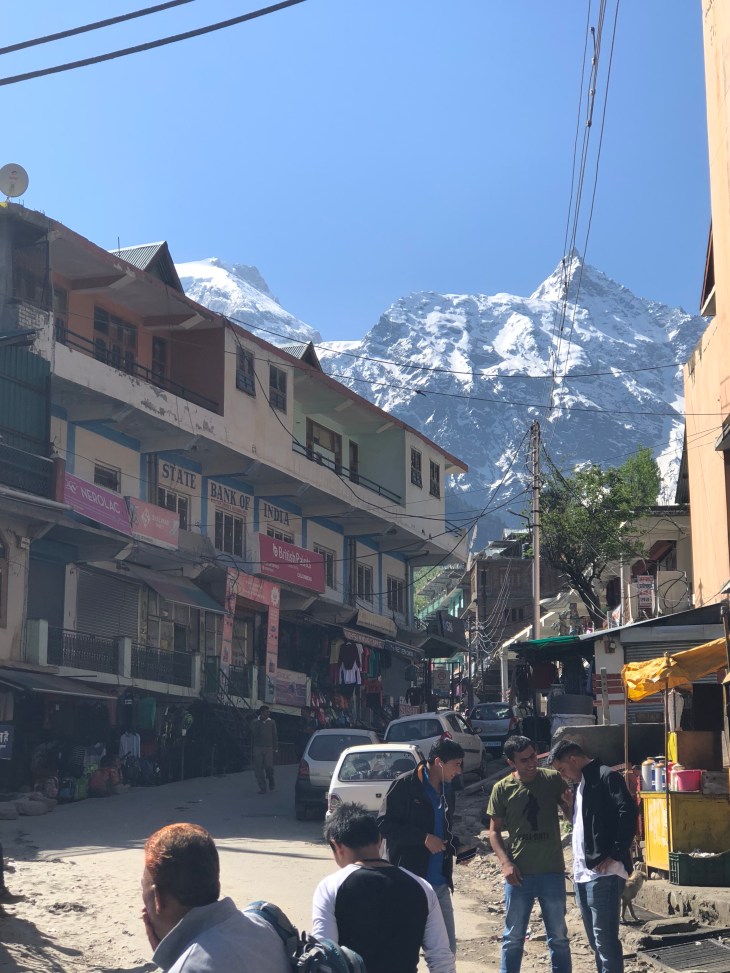
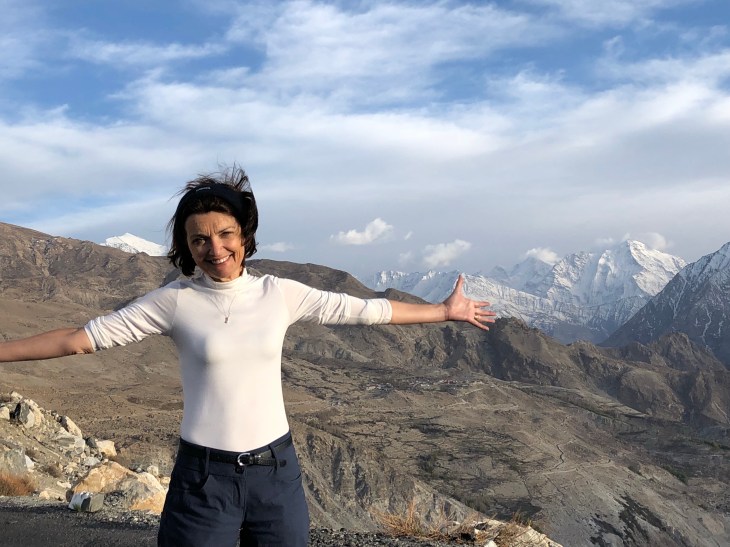
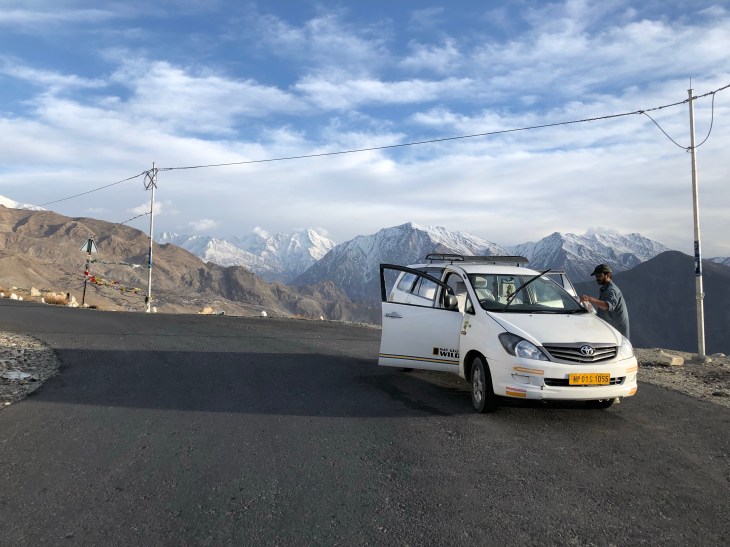
Out we popped at 3,500m, near a village called Nako. It felt as though we were on the roof of the world. We stopped the car and literally inhaled the valley, embracing the entire scene. It was wonderful to step outside. We had not seen any other cars for hours.

After many joyous breaths we began a long descent back towards the valley floor. Amazingly, despite the five hour delay, we were making good progress. At around 8pm, road weary but triumphant, we pulled up outside our next resting place: The Maitreyor Hotel.

I was looking forward to a hot shower and unwinding. Something I had eaten was just beginning to alert me to its presence. My Tum (that inner voice) felt indefinably uncomfortable.

We received a warm welcome, but the hotel was very cold and starkly lit. Entering the our bathroom I noted the typical projecting shower head into a room with no shower tray and a (raised) drain into which one had to sweep the flood of water. A bucket and jug were positioned beneath a tap. Stripping off in the cold and turning on the tap, hot water came there none. It was a sad moment. I did the best I could and got hastily dressed in rather more clothing. Perhaps I could have a beer or something. Beer was there none. Oh. Wine? No mam, sorry. We returned to our plumbing issue. Jeremy managed to round up the nice man on reception who then came and played with a complicated set of levers beneath the geyser. There was no electricity either so we were on solar power hence the complication. This presented untold challenges for new visitors such as ourselves. The gentleman eventually managed to turn something the right way and hot water became possible, but by this time I had dressed and was hungry. Jeremy enjoyed a quick hot shower, paddling out of the resulting lake in his flip flops. We went downstairs and ordered dinner. We were the only guests. The starkness of the overhead lighting, the silence and the lack of heating lent a bleak air to the place, but the food when it came was good. We got up at the end. “Would you have any hot water bottles?” “No mam”. Oh. Bed socks and thermals again. Never mind. Fortunately the bed was large and comfortable. I dived under the sea of the duvet, in search of oblivion. But even this was elusive thanks to the ominous Tum.
Kinner Camping

Baspa Valley ~ A taste of the outdoors

Sunday 29th April

Rocking and rolling our way back down that infamous stretch of unmade road we rejoined the main Hindustan Tibetan highway towards the Sangla Valley.

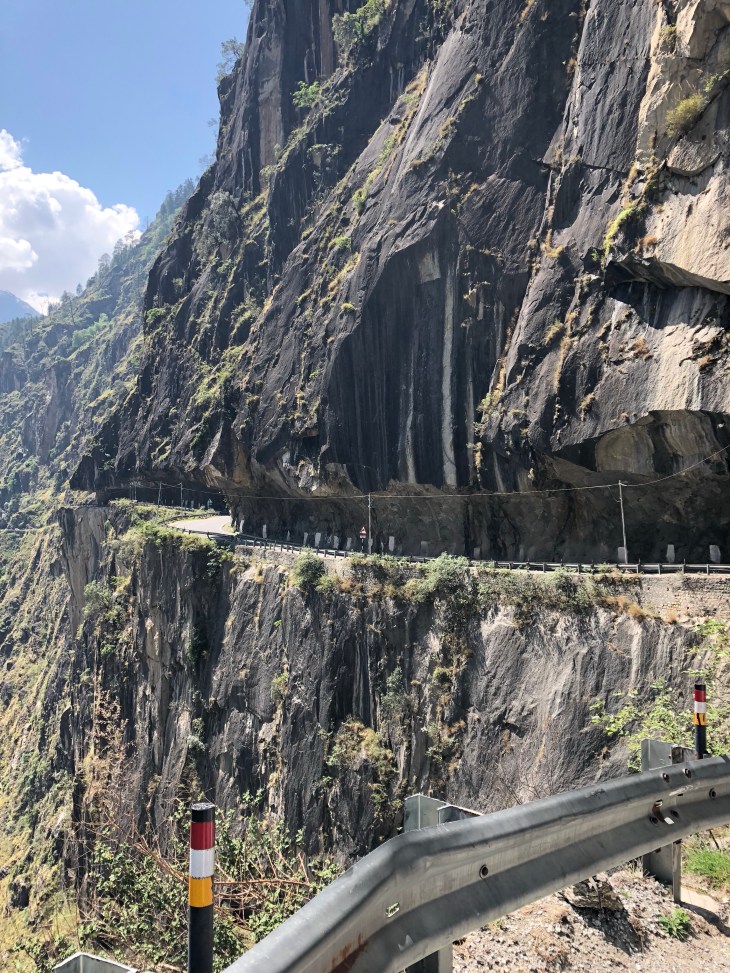
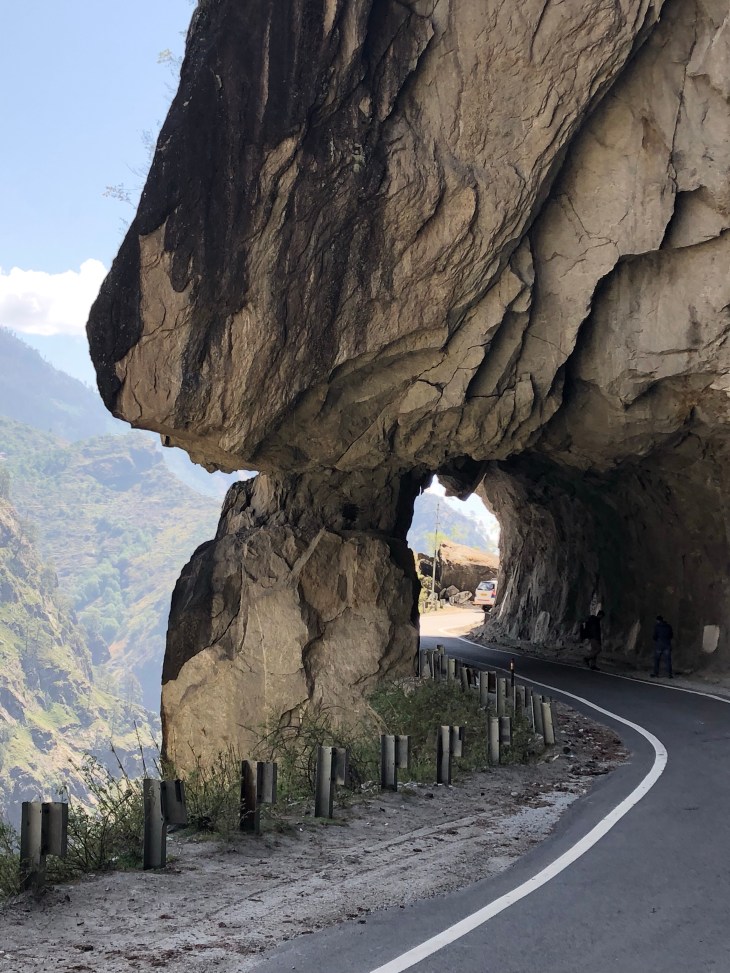
The road had been cut out of the side of the mountain. We watched incredulous as the rock loomed over us in a half tunnel. How did they manage to blast it, we wondered, without bringing it all down on top of them…?

Supports for crash barriers appeared to be in place though not always the barriers themselves. Occasionally, there were car sized gaps in even those. It was best not to look too closely. We were gaining height and the drop to the valley floor growing greater by the minute. Anil patiently waited whilst we squealed for him to stop so we could take photos….We could not always afford to linger however, lest we were hit by ‘shooting stones’.

Here you can see a road cut into the rock on the other side of the valley, much further down.

The scenery took our breath away.

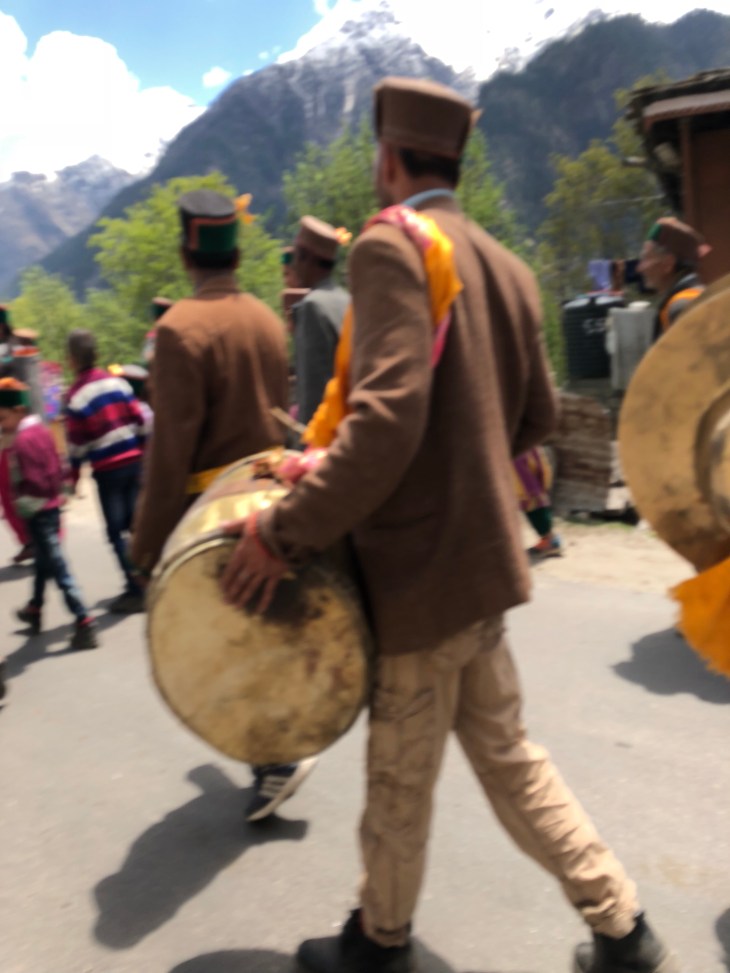
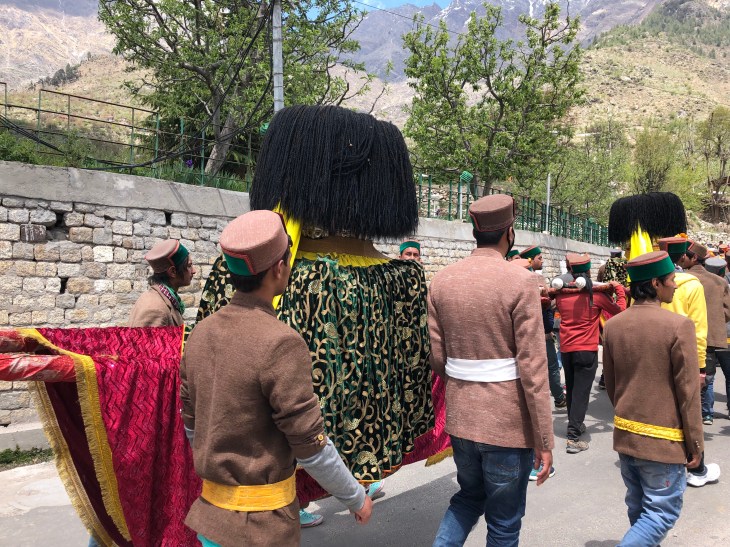
Arriving later at Sangla, we found ourselves amidst an annual procession of the Hindu and Buddhist deities combined, carried along between poles, their bizarrely shaped cylindrical effigies bearing long fringed black tassels which swung about like hair. Drum beats, clashing symbols and horns helped the public walk in time along with the main band. Since we could not possibly barge through them all we got out of the car and joined in. From everywhere we were pressed with little sweets or dried dates as a symbol of welcome. It took a good three quarters of an hour before we could make much progress in the Toyota.

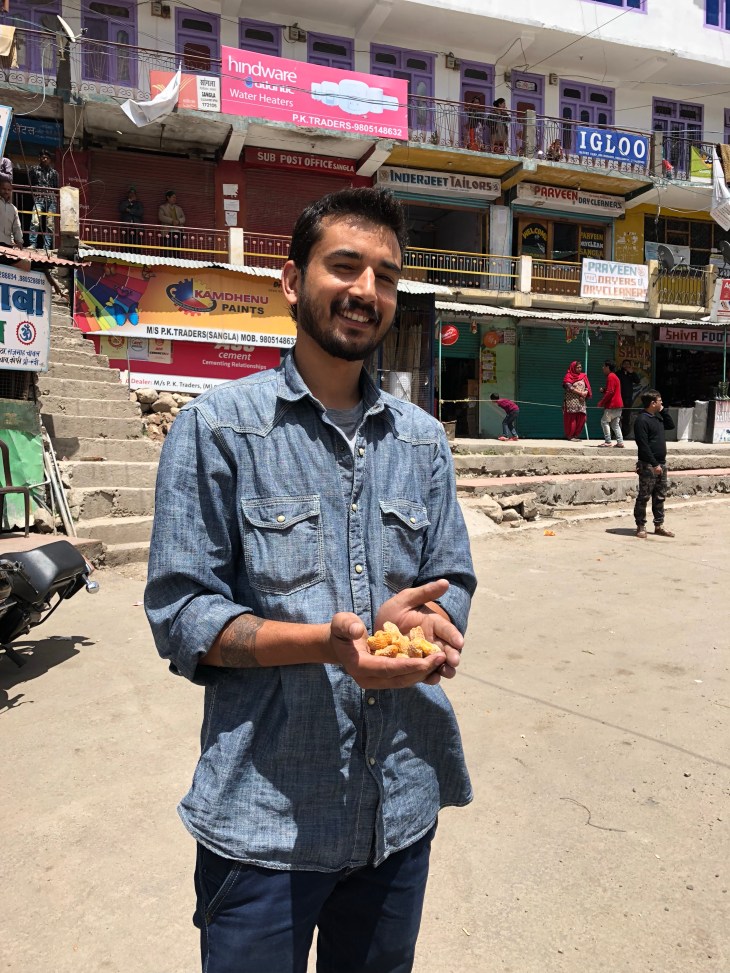
Anil was incredibly happy that we had chanced upon this festival. Here he is in holding some of the dates.

A while later we arrived in the Baspa Valley and found our next resting place: Kinner Camps. As ever, I was slightly taken aback by the steep access, which I will try and include here.

Kinner is a permanent outdoor encampment of large tents, each with beds and a loo/washing area ‘ensuite’ behind a curtain at the back. It all seemed very cosy on arrival.

After a welcome spot of late lunch in the main dining tent, we decided to walk rather than continue driving any further down the valley.

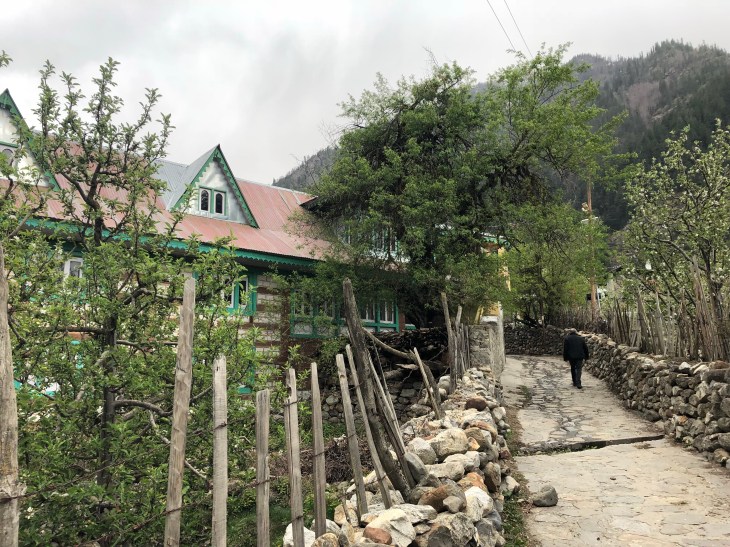
It was wonderful to stretch the legs. We took the path through the pines and across the river Baspa towards a village called Baseri – which seemed to have been frozen in time.. We crossed the river along a rickety bridge. I loved the noises and the colours of the river. It rushed furiously by in a great mountain torrent.

Baseri is so tucked away that our path was something of a highway. We saw several young men leaping downhill towards us, and then later toiling back with enormous loads of supplies on their backs. No one had an ounce of spare flesh on them.

In the village we encountered the same procession as in Sangla, the two deities still on their rounds. They emerged from the temple and were carried right round another building in the main square. The drum was beaten, cymbals clashed and a horn blown. Lots of people watched on the sidelines. Then someone appeared with some apple liquor and offered it to us. We slurped it out of our cupped hands. They were very amused that we drank it! Some lightly cooked flat bread was also proffered spread with butter. The whole idea was to include us which was kind.

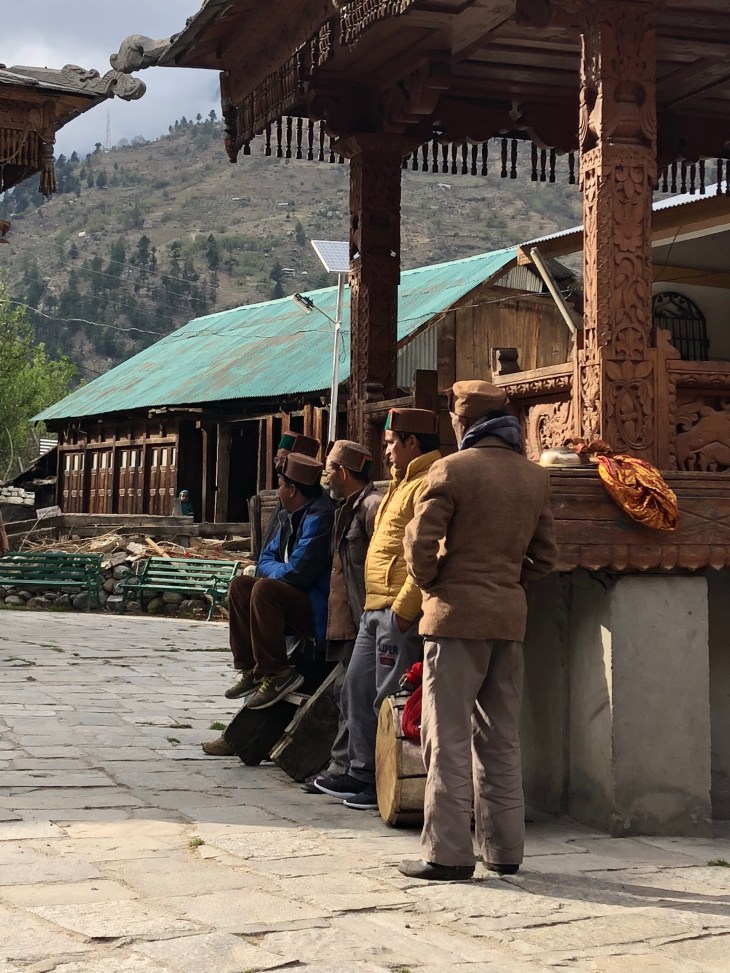
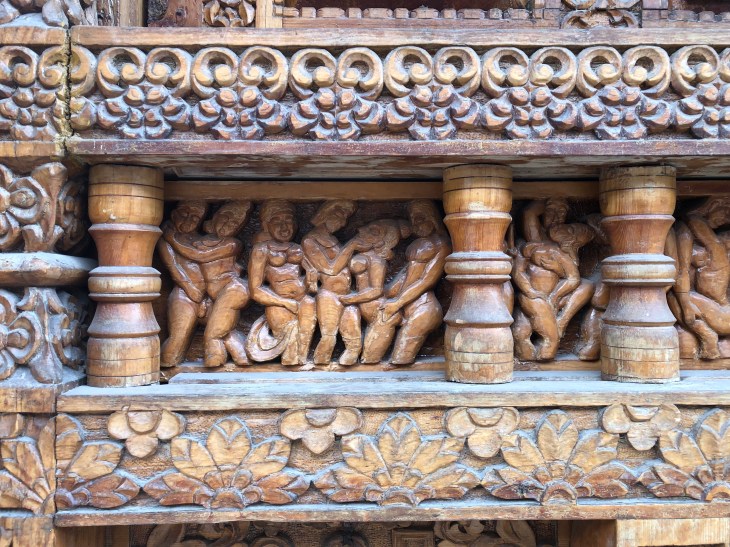
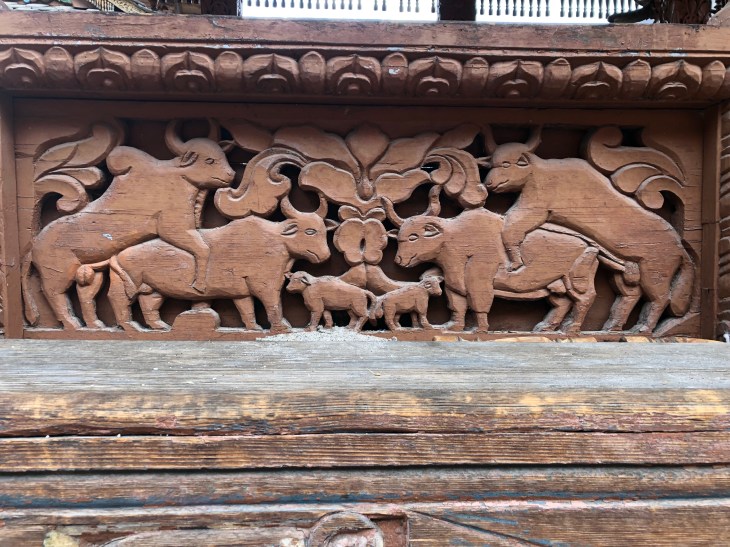
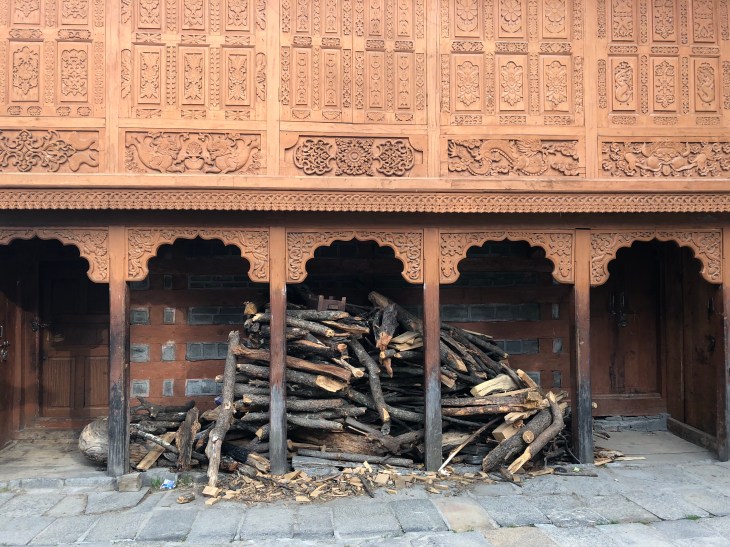
Unlike many places, the village was spotless, the only litter being the natural muck from cows etc. There were many well tended small orchards in which wheat was also growing. The colours were all soft greens and browns. There were a wealth of fine wood carvings, ornamenting the main buildings, depicting in some cases erotic scenes. Wooden carved spindles also hung from roofs in fringes. The detail in all of the carving was staggering.
It was a getting a bit chilly after a while, so we turned back.

It was going to get a good deal colder in fact! After having supper in the main tent we headed back to ours. The temperature had gone down to around zero by this time. Suddenly, taking off any items of clothing felt like torture, but off they had to come. After the fastest possible spruce in the bucket, I yanked on my thermals, piled on some pyjamas, a fleece and thick socks and dived under the covers. They had put a water bottle for each of us in our beds – the only source of outside heat. I appreciate this temperature barely approaches cold in relative terms, but my whole body convulsed with shivers for a while before slowing and warming.

We slept a little, but I woke early and watched the dawn glow through the canvas, longing for a hot drink. I was very pleased therefore when Tulsi, our friendly cook and host, popped his head round with some ‘bed tea’ at about 6am. Dressing and packing fast, we breakfasted in minus 1, on a veritable feast of fruit, eggs, cereal and toasted paneer (cheese) sandwiches. He even packed us off with some bananas. Just as well, as a long day was about to ensue!

Baptism of the Bumps

Sat April 28th – The Road to Sarahan

Having packed up and breakfasted royally, we met our new driver and Spiti Valley Tour guide, Anil. The most exciting final phase of our little Odyssey was about to begin.

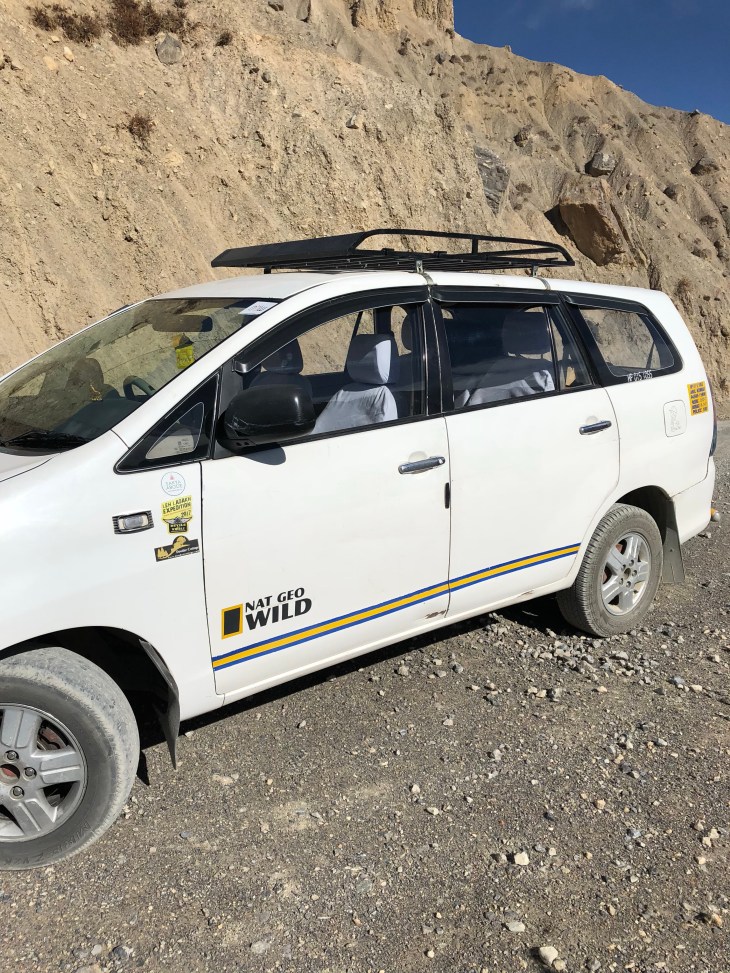
It was a sunny morning. Anil seemed a quiet and unassuming young man, but he drove with a lively air as we set off east towards the village of Sarahan. His vehicle, a Toyota Innova, bore the marks of many adventures and long distances travelled. Her suspension was soon to prove legendary.
Distances are not so much measured in miles or kilometres in India but in time and they are rarely short! Roads can be very unpredictable in terms of their surfaces, as well as who else might be driving along them. The main impulse is always to overtake, so it can make for some exciting scenarios. All I can remember that day is that we spent several hours travelling towards Sarahan, the first of which were uneventful.

Soon we were starting to climb. Jeremy was keeping an eagle eye on the route via our friend Google Maps, and all was going swimmingly, when Anil announced ‘Oh, road closed due to landslide, we’ll have to take another road. It’s a very bad road.’ We went past the expected turning and then took another sharp right up a steep track. It was deeply rutted and strewn with stones: little more than littered hardcore. The hillsides started to fall away sharply at its edges, apple orchards offering the only break in the long plunge down. The bucking bronco of all rides then began, winding up and up and ever more steeply with one hairpin bend after another swinging our bodies to left and right and our tummies up and down with alarming irregularity. There was no way of adjusting other than by adopting rag doll mode and hoping we’d be ok. Just when it was all feeling a little grim, Anil suddenly piped up “Complimentary massage, all included!” We laughed. All things come to an end, I reminded myself. Prayers were said. Unbeknownst to us there would be many more of these to come.. but this was a foretaste. The heavens crashed and it started to rain, and then more thunder. The clouds came down until it was like driving through fog. On and on we lurched and rocked, until suddenly we popped out, joining the normal road to Sarahan. It was only mid afternoon.
After some tea and depositing our bags at the government run Srikand Hotel, (see above) we thought we’d wander out and look at the Bimikhali Temple. https://en.m.wikipedia.org/wiki/Bhimakali_Temple The weather was terribly grey and dreary, with a light mizzle to make us feel at home.

The temple – a combination of Buddhist and Hindu – was a high structure on several floors with shrines within it. Its floors were carpeted in red and one was led round the inner shrines by a series of stair cases. Heads slightly bowed we hesitantly explored the entire building. No one was there and no one seemed to mind.

On entering the courtyard outside we had had to remove our shoes. The ground was wet and gritty underfoot, so it was relief to be treading on the carpet. The exterior wood carvings round the temple had been intricately carved.

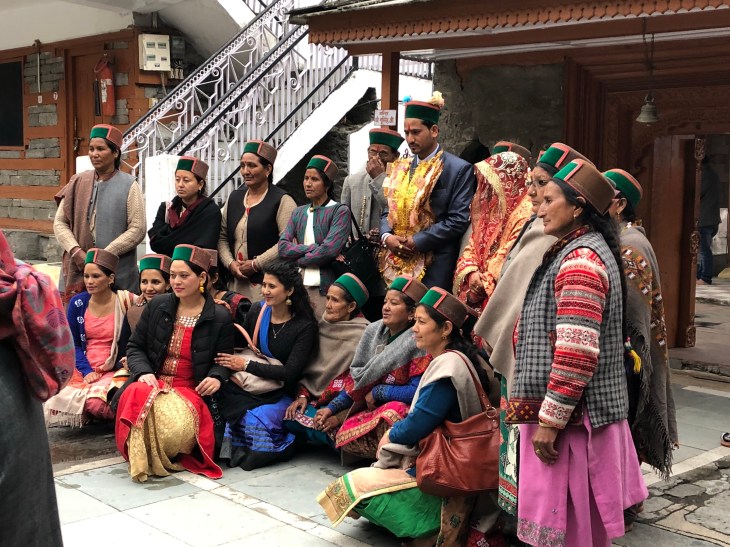
A wedding procession made its way through the complex. The relations were clad in traditional Kinnauri festive clothing, and everyone seemed very excited about the proceedings other than the bride and groom. Her face was almost obscured by a red and gold scarf and he stood solemnly by in his grey suit and cap, looking a little anxious. It was quite possible that until that day they had never met.

We have since discovered that even among the younger generation it is common practice for marriages to be arranged, and very often done simply in order that a young man may find someone to look after his ageing parents. The bride goes straight from living with her own family to living full time with his. It may seem an alien concept to some of us, but it is widely accepted by society there. This particular couple seemed quite happy to let us watch and take photographs before they proceeded to the temple.

During our time there we bumped into a softly spoken young man, (Anubhav) who had come to pay his respects to his father. He was very gentle mannered and friendly. It turned out he was heading back to our hotel, and he invited us to keep him company while he had dinner. It turned out the hotel had no rooms left so he was having to drive the long road back to his home in Chandigarh that evening (a good six hours or so). Having just come up a portion of that rocky road I did not envy him having to tackle it at night. Despite the impending journey however, he seemed very reluctant to leave us, sharing many things as well as asking questions and quietly helping to consume a couple of ‘Thunderbolts’ (lagers) whilst we chatted. A little later, all sides feeling as though they had shared generously of themselves, we parted the best of friends, and have been in touch since.

After a slightly chilly supper, we retired to bed, myself trying to ignore a dubious smell emanating from the pillows. The bathroom had also been rather a challenge, there being no shower partition, thereby entailing the entire bathroom becoming soaked on use of the shower. The film of water lying on the floor needed to be pushed towards the drain by a window wiper, although we didn’t grasp this tactic at the time. Instead we paddled around on deep cushioned flip flops feeling slightly uncomfortable about the whole thing.

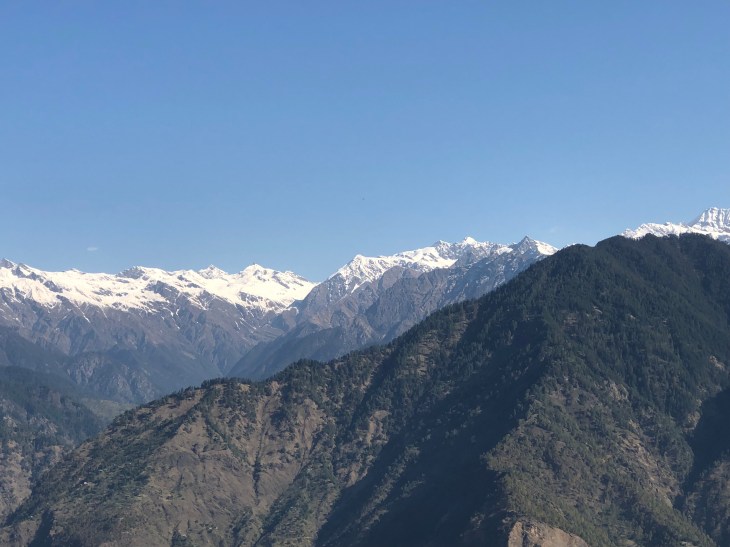
The night passed. What a pleasure it was the next morning to wake to the sunshine and a few mountains visible. What a difference the weather makes!

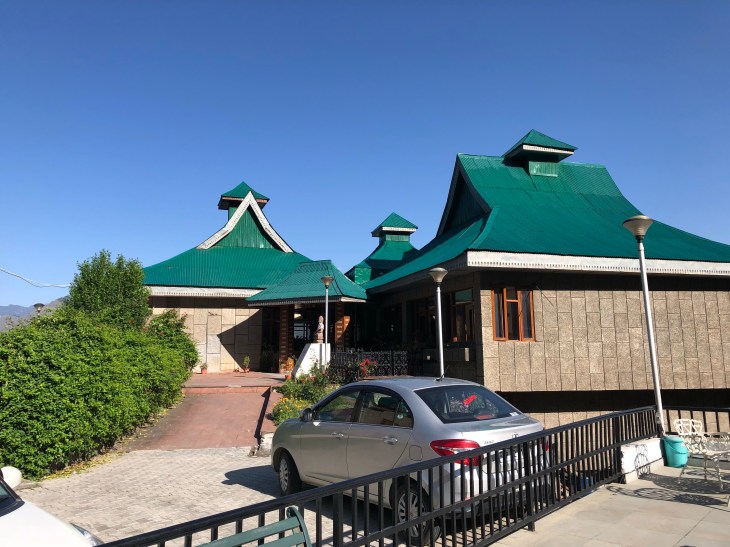
Even the slightly forbidding exterior of the hotel took on a friendlier appearance.

After breakfast, Anil appeared, fresh as a daisy, to whisk us towards Sangla and the Basapa Valley for a spot of glamping!

Regal Retreat at Shimla

Friday 27th April – Clarke’s Hotel

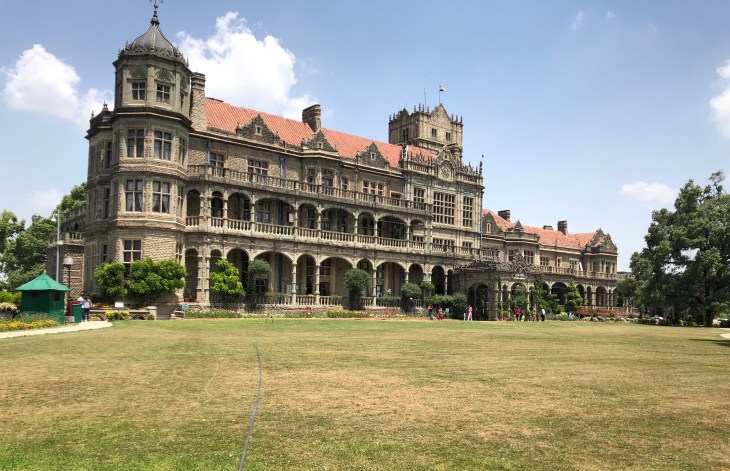
A sunny day dawned and we thought we would step out and explore a bit of Shimla. Destination? Viceregal Lodge!

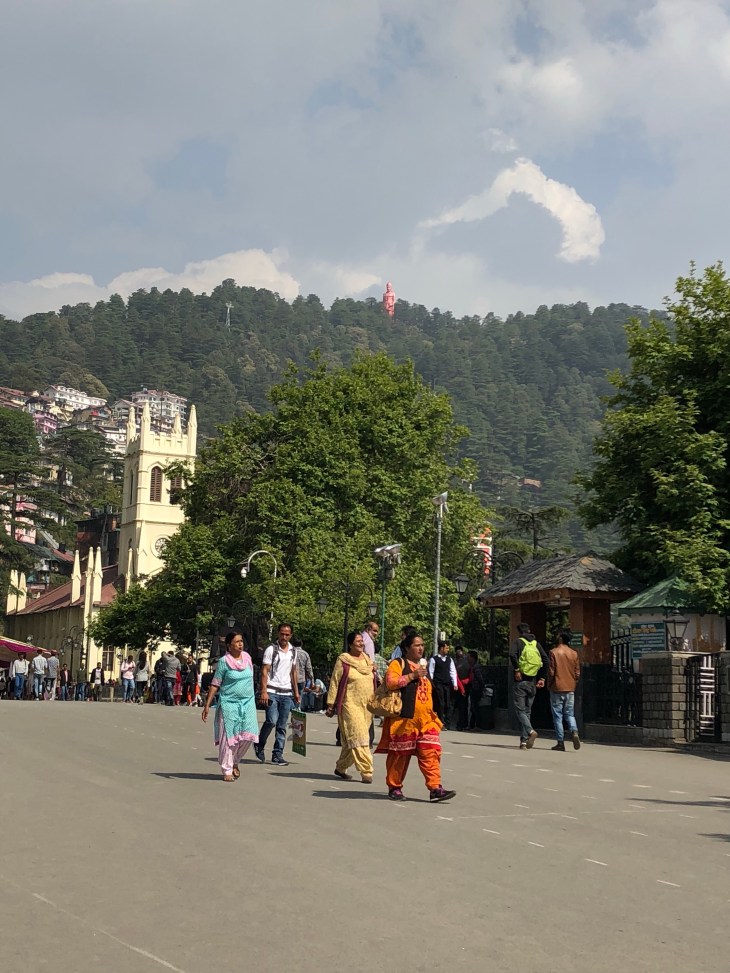
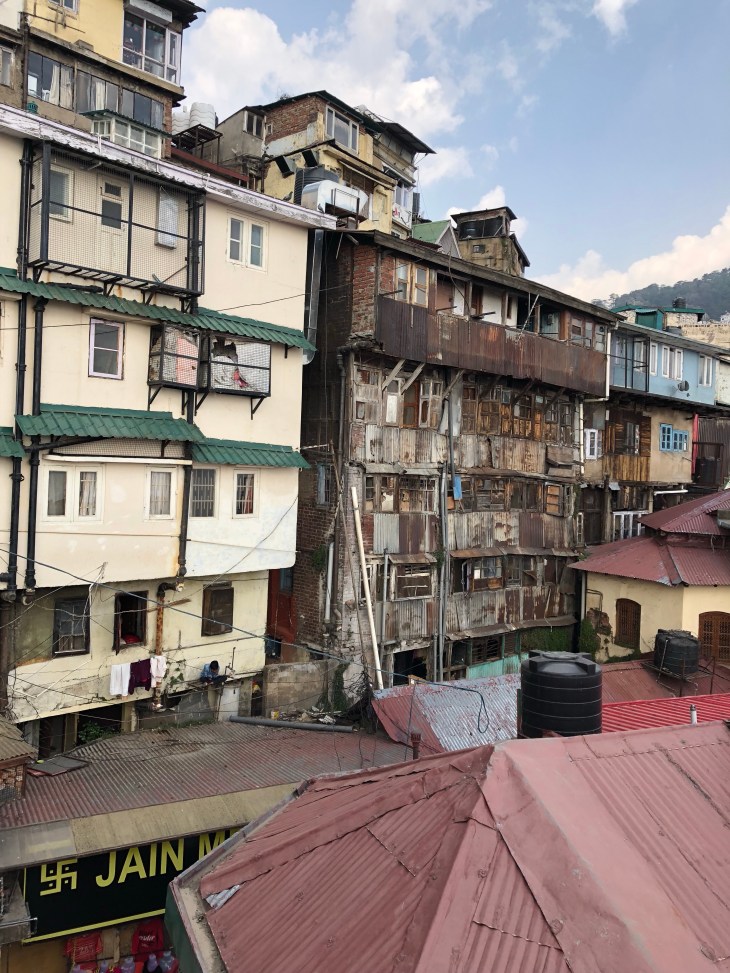
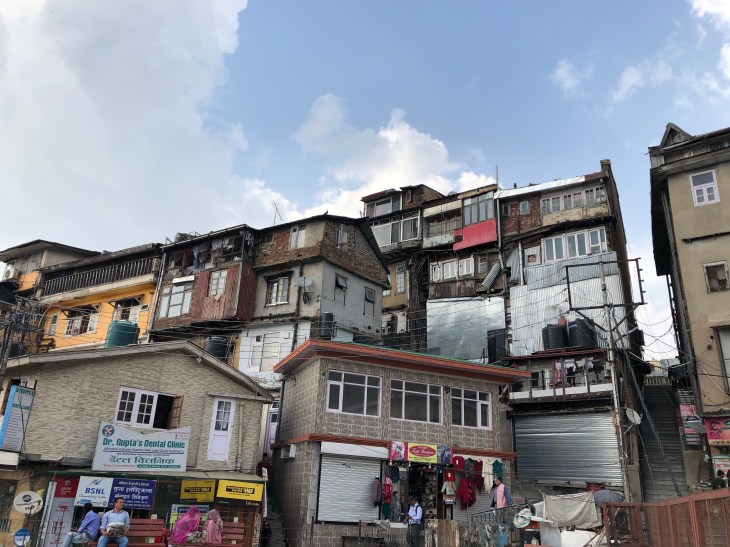
Old Shimla straddles a ridge at about 2200m, and retains many places and buildings from old Raj days. I expected it to be a small hill station town but this was far from the case. Shimla also gives its name to the whole district, as well as the town which is spread between the adjacent hills. The buildings spill down on either side of the ‘old part’ like scattered bricks in the most chaotic manner. Most project out vertiginously atop concrete stilts, overlooking yet more roofs and narrow streets.

‘The Mall’ is a broad area which runs along the ridge over which Shimla drapes itself. It would have been perambulated by ladies and gentlemen of the Raj, strolling along under parasols, or perhaps being drawn by rickshaw. Nowadays it has been pedestrianised, and you can still stroll along and enjoy views from such places as Scandal Point, the alleged scene of a little impropriety! For us that morning, it was a joy to be able to step out of the hotel without fear of glancing blows from drivers or motorcyclists or the loud jabs of ‘tooting’.

We gradually made our way towards Viceregal Lodge –

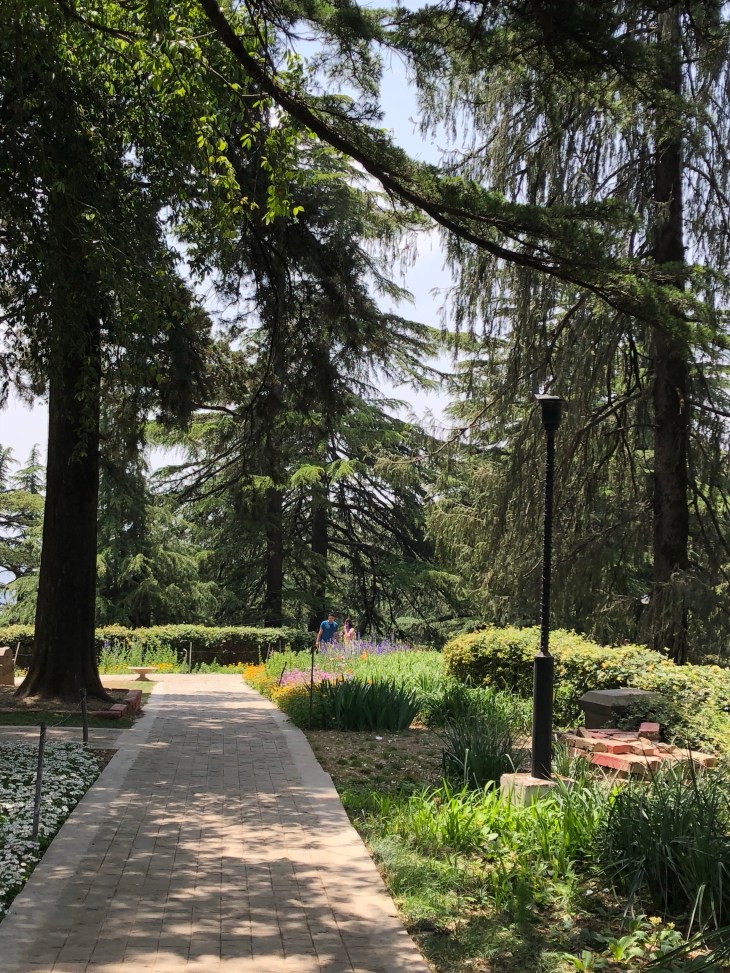
the summer seat of government for the British Raj. It was exactly like stepping into a piece of Scotland with the building’s greyish stone walls and extravagantly planted wild borders. It was built for Lord Dufferin (1888) and witnessed the discussions for the Partition of India in 1947. Here resided the British Viceroys, who each served for five years at a time, including Lord Mountbatten at the very end. Inside we took a short tour of the reception rooms, which had a cool feel; all lofty ceilings, elegant tables (including the one around which Partition was discussed) and impressive teak panelling. The gardens were lush and full of contained wildness in the planting.

The whole building had a gracious unfussy air so it wasn’t hard to imagine how grand yet comfortable it would have been to be a visitor all those years ago.

Cadging a ride back from our sister hotel, we were deposited lower down the hill at a two stage lift. It is connects different levels of Shimla for pedestrians. The lifts are only small so we had to queue. It almost made your ears pop going up so swiftly!

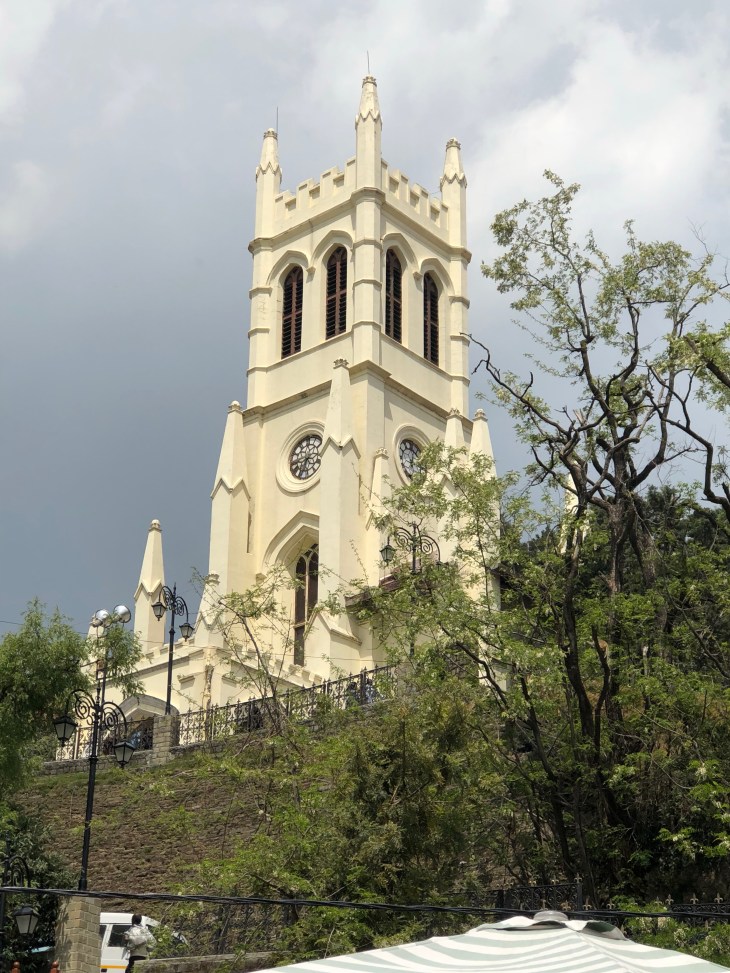
In the afternoon we took a look at Christchurch which was constructed around 1857.

It was very simple and airy, its faded cream walls contrasting with the mahogany pews and the bright sunlight pouring in from outside. It must have made the British feel at home as well provide some welcome cool.

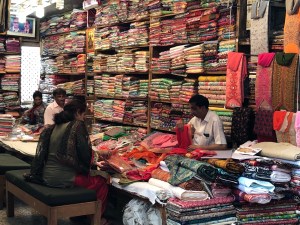
After strolling along The Ridge, we explored the market streets of Lower Bazaar and the Mall and did a mean deal on some leggings and a curta. I had been on the look out for something less mundane and ‘travelly’ and unexpectedly we found a tiny little shop stuffed with items. The general code is soft leggings for the ladies with a tunic top and diaphanous scarf. The leggings can be in cotton jersey or in the baggy yoga style, worn with sandals and anklets if you wish! I eventually settled on this:

There was also a veritable festival of shawls, stoles and pashminas for sale in one particular little shop I chanced upon; so many beauty full colours and designs, in reds and golds, or the softer taupes and pretty combinations of neutrals, and all carefully worked. There was also a great variety in texture, from a few slippery artificial items to varying grades of wool, silk and delicate pashmina. I felt like stocking up right there and opening a shop, there were so many beautiful things. Eventually I settled on a couple which have been accompanying us all the way round since.

There was anything and everything for sale in Shimla, items almost tumbling forth from the tiny shop fronts.

Near vertical steps reconnected us from Lower Bazaar to the Mall. Shimla wasn’t so built as ‘piled’ over the hillsides.

The streets were as narrow and chaotic as you can imagine.. also battered and labyrinthine.

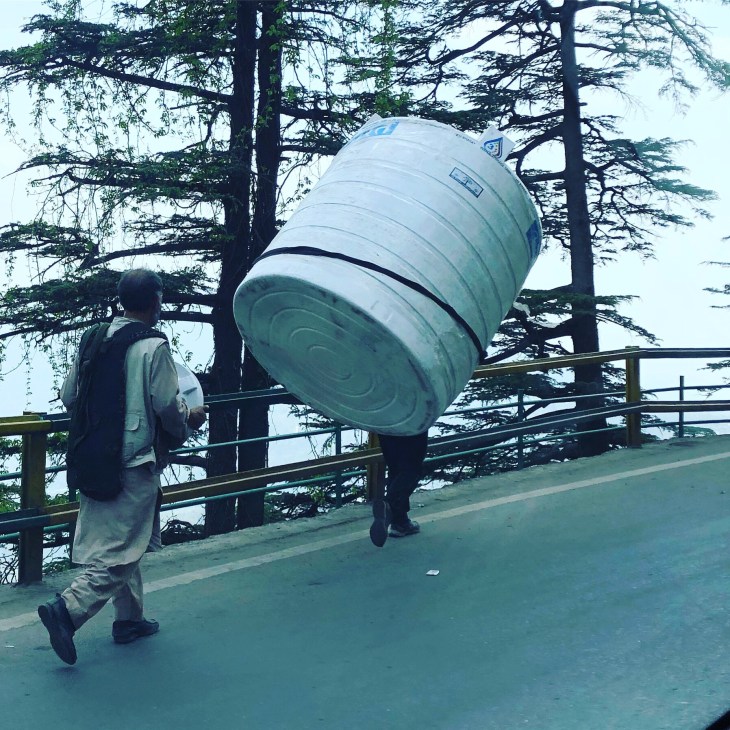
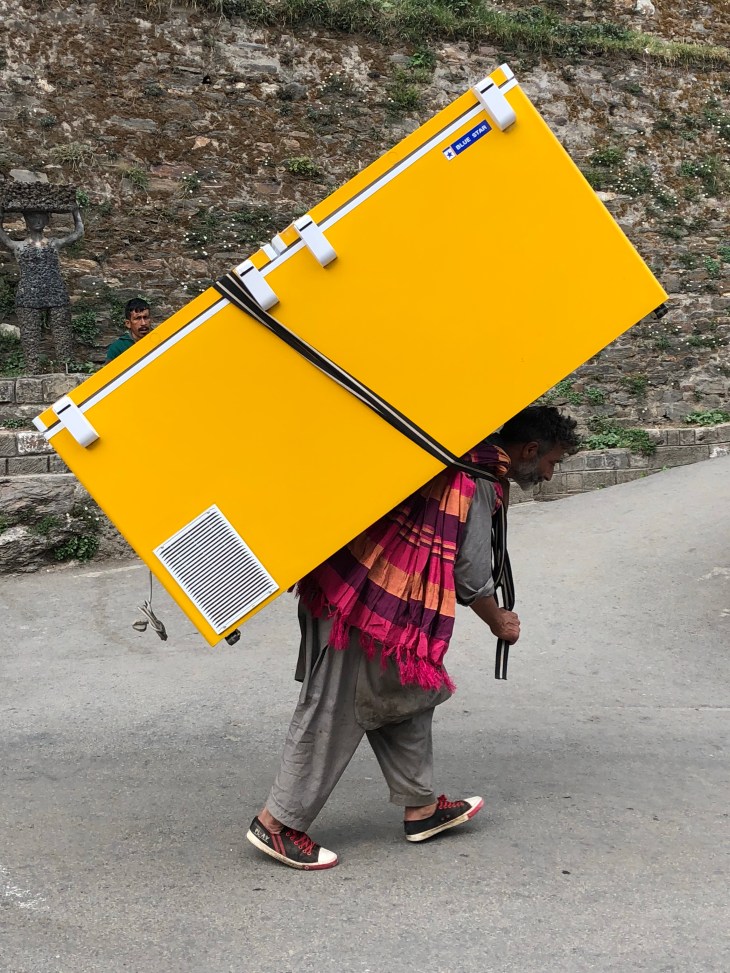
Everyone seemed to be either selling something or moving it. Enormous weights were borne along by spindle legged ‘coolies’ (porters), doubtless paid a beggarly few rupees, with the stoicism of human mules. We were aghast. I wondered what happened to their backs as the got older…

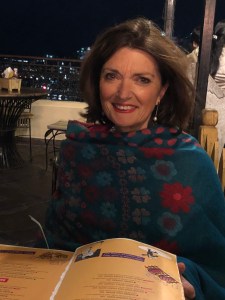
Going out for dinner in the evening, by way of a change, I proudly donned my new pink curta and biscuit leggings. But it had got cold, so I had to grab my blanky and swathe myself in that to keep warm. We had chosen a restaurant where there was a good Indian band playing, which also had a beautiful view, but to my embarrassment, everyone there was in western dress because it was considered to be so much more cool. “Oh well” I thought.. “that’ll larn ya’!”

“On the Slow Train…” Kalka to Shimla

April 26th

The big day had arrived.

We tipped out at Kalka station to pick up the Himalayan Queen (toy train) to Shimla. I know I keep mentioning this but the dry heat was infernal once again. The familiar dampness around the brow and scalp oozed forth within minutes.

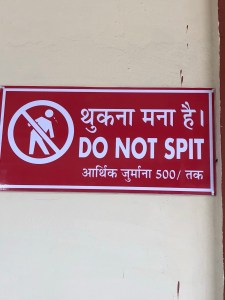
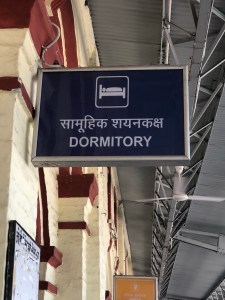
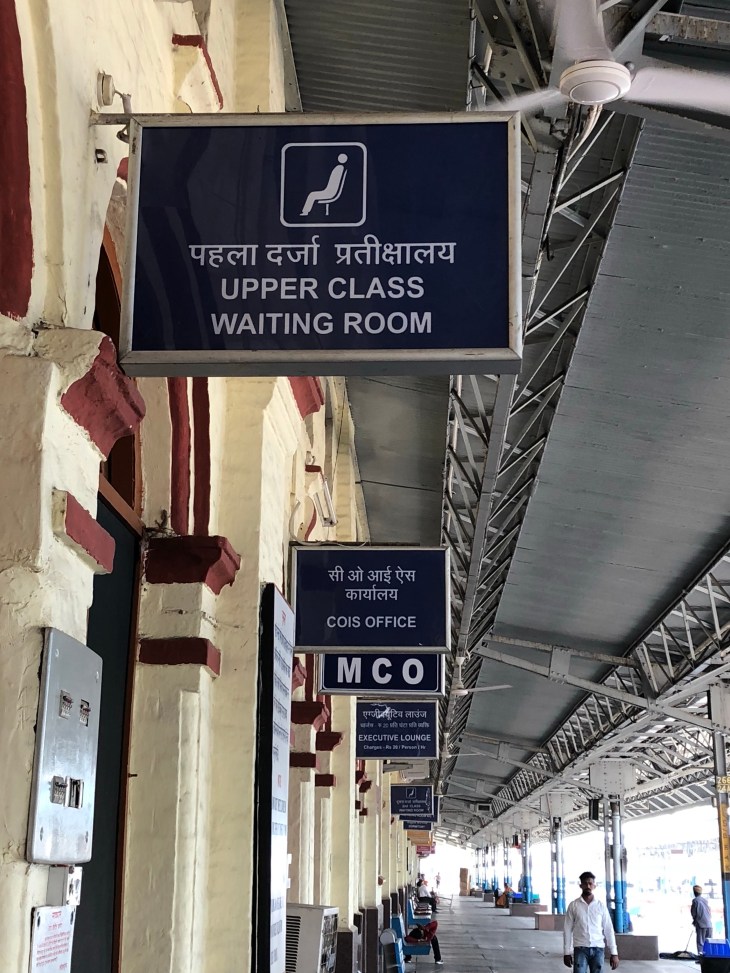
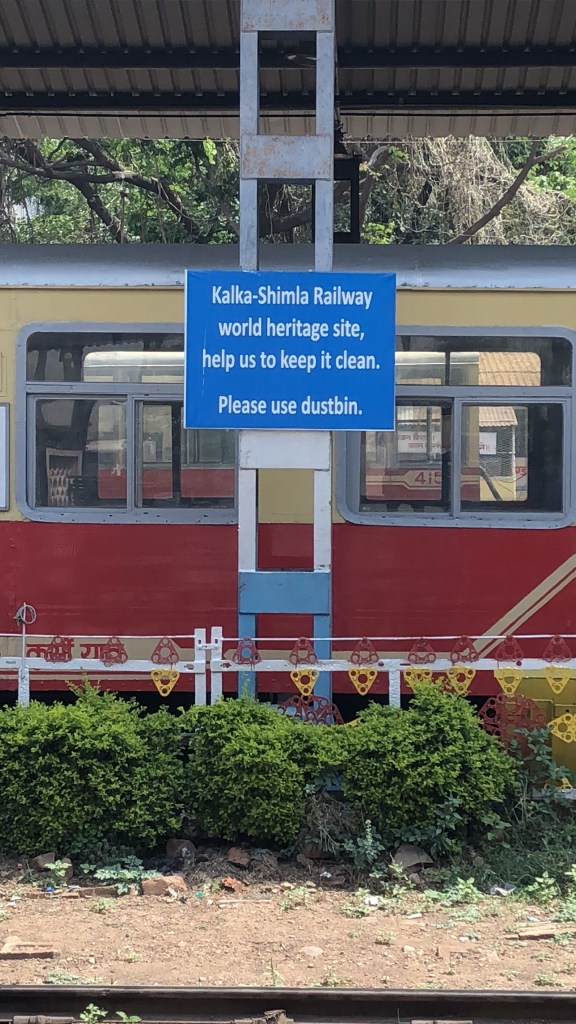
The Station was surprisingly clean. No one was lying prone on the platform, and there was no litter to be seen! An array of signs indicated who was intended to wait where! As well as few instructions…

We found our train and heaved our bags on board. However – it quickly transpired that this was not quite what Jeremy had been informed we had booked. As this was going to be a longish haul so we took the hasty decision to try and bail out and catch a similar one with slightly more comfortable seating but that required a brand new ticket. He shot off like a rocket to purchase another ticket (never a short process in India), leaving me to guard the bags and defend his current seat in case we couldn’t get another ticket). It was a pretty close run. The carriage was filling up fast and I was wedged behind gathering passengers and more and more luggage. With only minutes to go and me having visions of enjoying this ride on my own, I heard him shout “Phylli – off!” I elbowed my way out with what I could carry. Then somehow or rather between Jeremy and some other innocent bystander, all our stuff was heaved out through the window. In deep gratitude we left them a lunch we had bought for the journey.

And so began the long haul up!

Oops – sorry about the phone!

Our new train was just like the previous one, but with the benefit of padded seats, and some refreshment thrown in at the start. My padded seat had already endured some considerable service, and was suffering from something of a port list. I stuffed my fleece into the gap. We sat one behind the other on the ‘view side’.

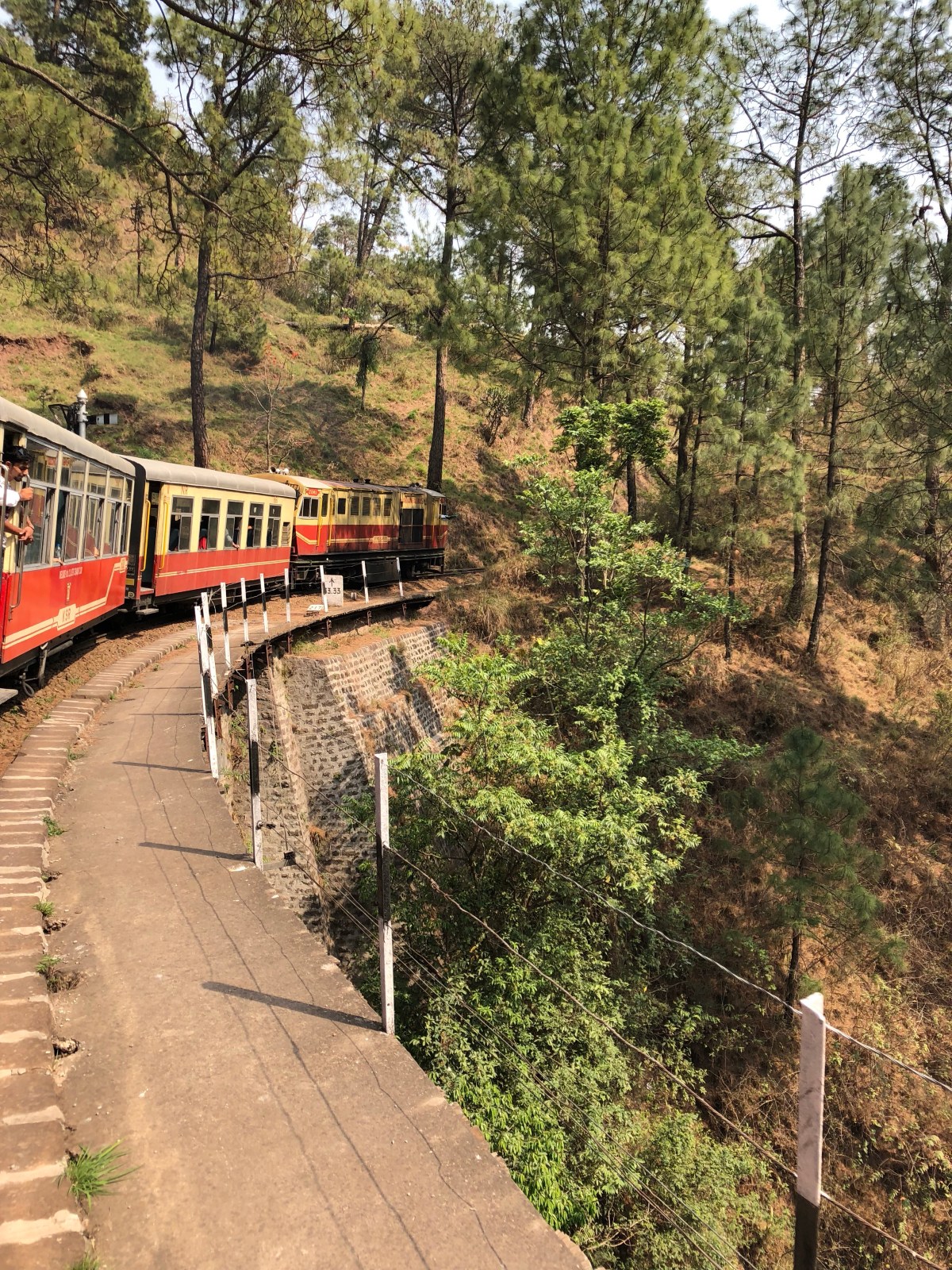
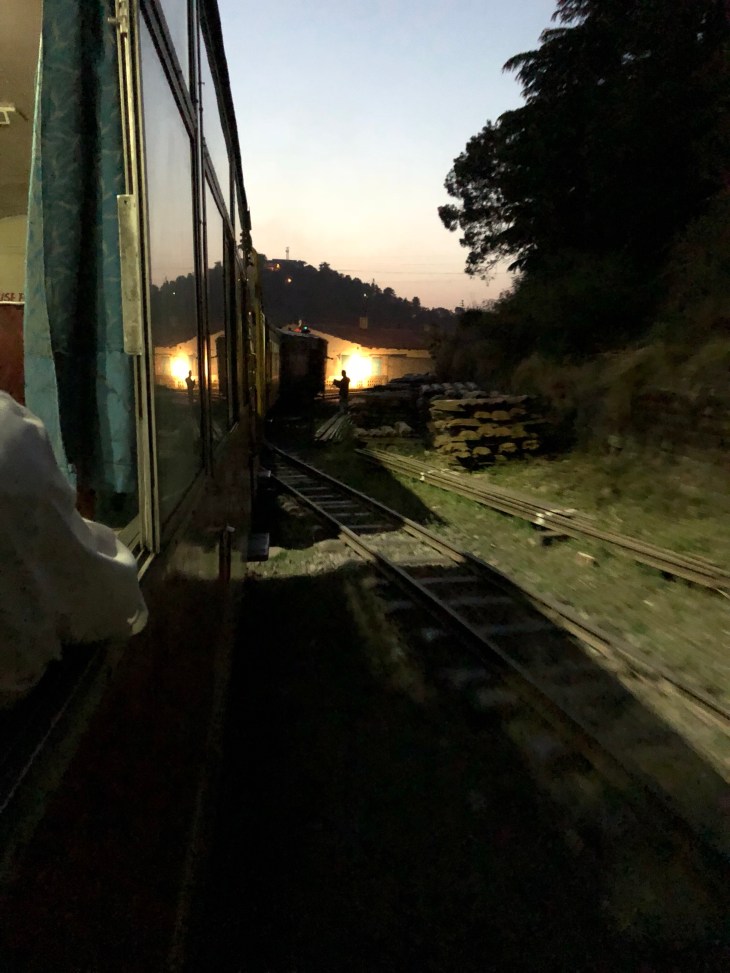
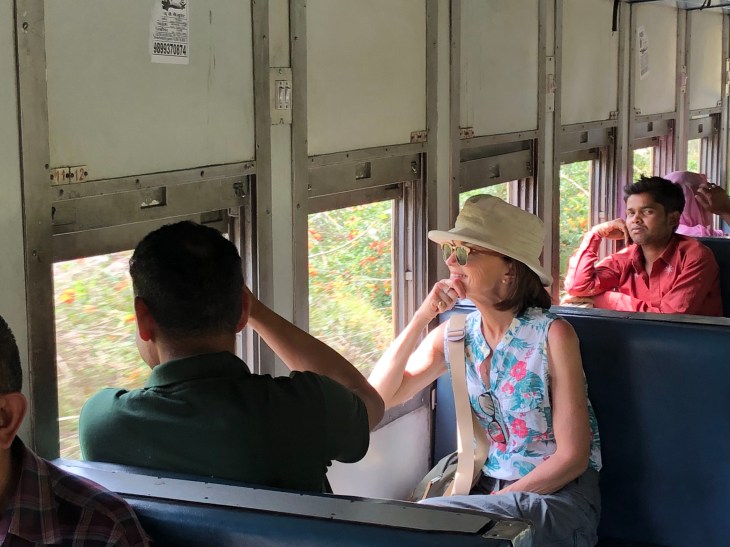
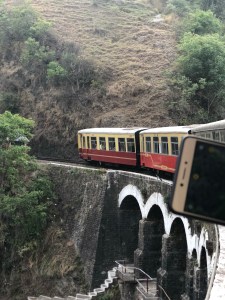
Next to the open window (natural AC!) we watched the pine trees peel slowly past, as we flanked the hillsides. We probably only made 10-15kph. The views of the trees and valleys were all beautiful but it was terribly sad to see so much discarded rubbish, carelessly tossed by the wayside. It jarred everywhere you looked. Our train mates, affluent travellers from Delhi, even instructed their children to toss their empty food trays out of the window. Such a shame. What hope is there if that is deemed acceptable?

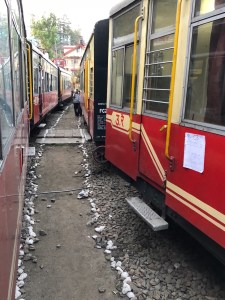
The little train hauled and tugged us slowly up for the next seven hours, two longer than scheduled, stopping for ten minutes at many of the stations and sometimes to wait for a descending train. Once both ascending and descending trains were stationery – for quite some time in what I laughingly called a ‘train off!’

People would jump out to stretch their legs or buy more food. Slightly against my better judgement my hunger forced me to do the same, and I gorged on a deep fried aloo (potato) confection. It was delicious. It was a good job that I did as we did not draw in until much later that evening.

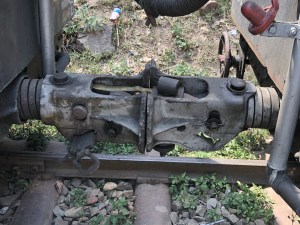
On one of the jump outs we were slightly foxed by this.. but we think it was the type of coupling that this train was fitted with…(?)

You are probably already well aware but the Kalka Shimla train runs on a narrow gauge track rising 7000 feet over 60 miles in 5 hours, with 102 tunnels, 886 bridges, and 600 viaducts. It only took only 2-3 years to build. Completed in 1903 it’s an engineering triumph! It’s now a UNESCO World Heritage Site.

Taking this train may have been slow, hot and dirty, but it was a great way to appreciate the brilliance of those engineers who would have had to survey all the land before building could even begin. Their planning and foresight have really stood the test of time. As the old summer governmental seat of the British Raj which moved all the way up there from Delhi for 8 months of the year, Shimla was refuge from the stifling heat of the plains, and the railway a lifeline. What it was like moving the whole of the government entourage up there before the railway is scarcely imaginable!

At about 8pm we drew in, hot and dusty but having had a wonderful glimpse of the past.

Monuments to Strength

23rd – 25th April

After bidding our friends Upasana, Surya and his parents Deepak and Neerja a fond farewell at Wah, we were on the road again – this time to Judges Court at Pragpur.

However, we were going to stop off en route. We headed towards Kangra Fort: a monumental construction of about 1100 years old, built to dominate the Kangra Valley high above the confluence of two rivers.

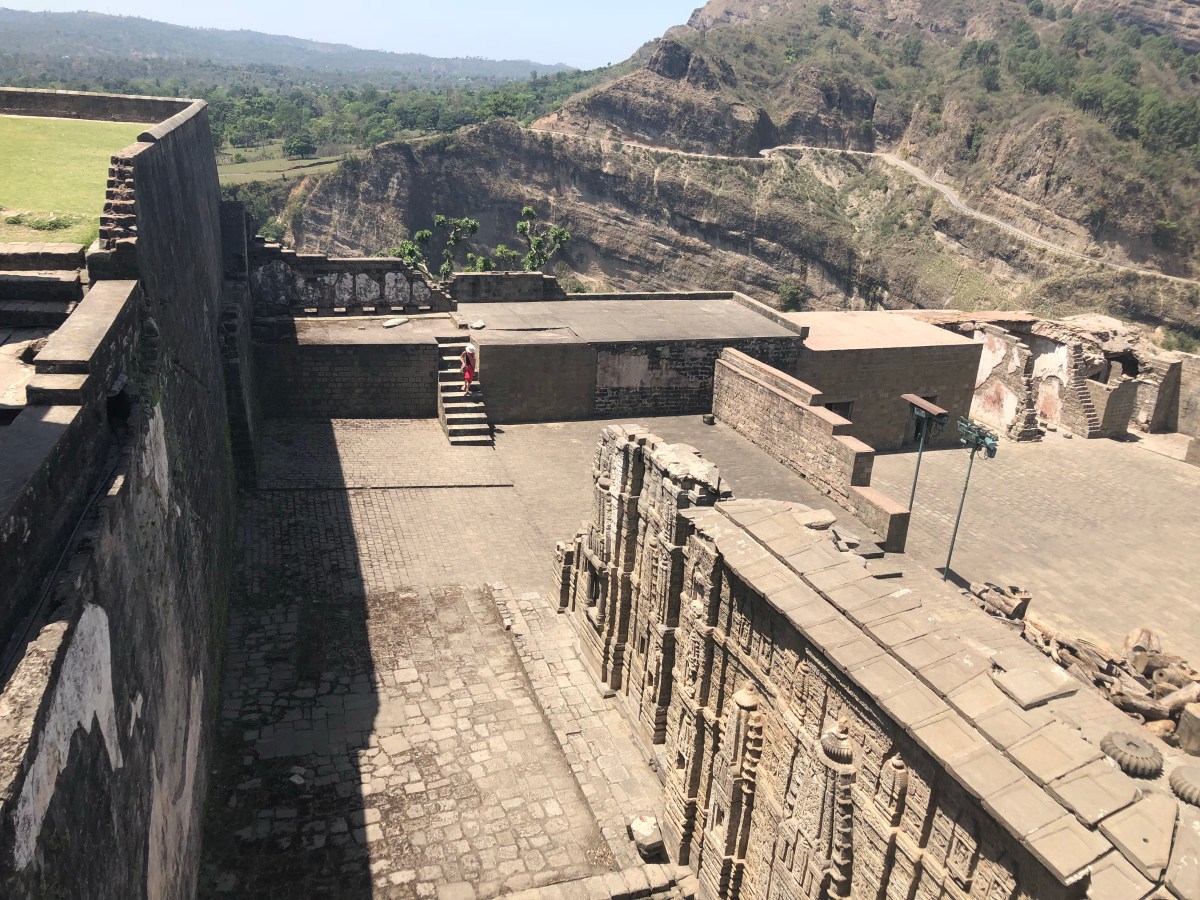
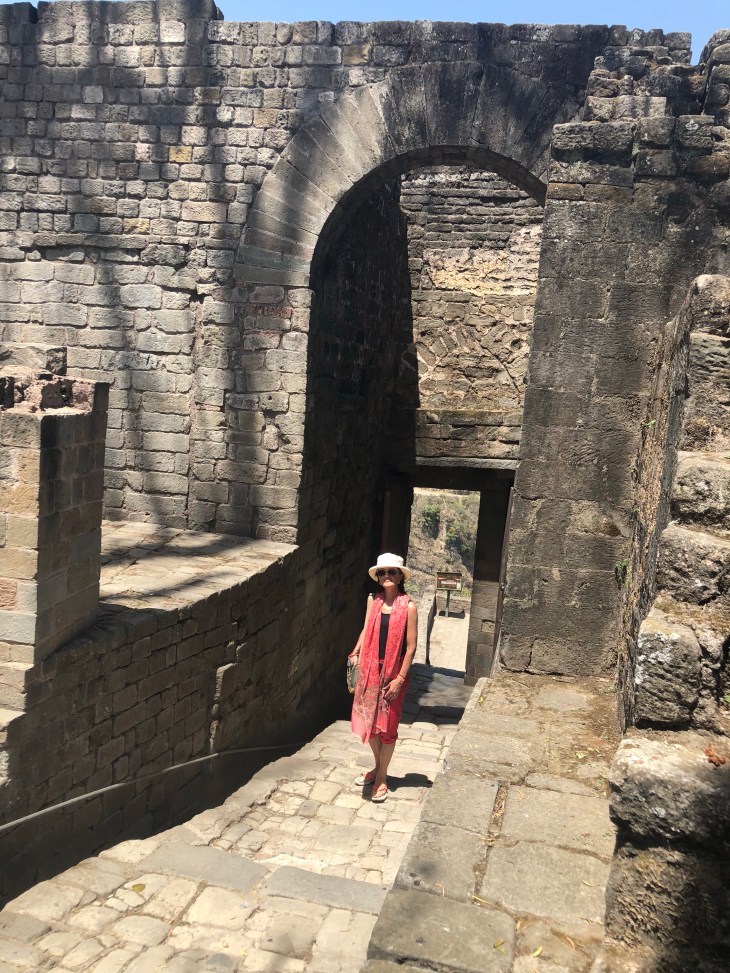
The sun was already beating down remorselessly by the time we got out of the car. We plodded up through gate after gate, marvelling at its impregnability.

There were still traces of where the gate poles and bars must have been placed to seal the inner courtyards. Tiny narrow slits in walls feet thick would have shielded defenders from attack and allowed them to pour goodness knows what onto marauders. The further we penetrated, the more the complexity of the fortress revealed itself: small armouries, meeting rooms, a large square and giant well. Stone carvings were still deep and vibrant in the temple in the middle of the fort.

Once at the top, the views were spectacular right across the valley, stretching far into the distance. The Himalayas were just discernible to the north. We stood and gaped, melting quietly. To have conceived and constructed such a mighty edifice, most likely in the searing heat, and assuredly without the benefit of modern technology, was a marvel. The fort had been occupied latterly by the Sikhs and finally the British, before succumbing to the even mightier foe of Nature, in the great earthquake of 1905 which shook the whole of Himachal Pradesh.

Almost deliquescent with heat, we slithered down from the fort and up to the little museum cafe, successfully obscured through lack of signposting. After a bite of freshly made pakora we headed back to the car and pressed on for Masroor.

“Only an hour,” said Jeremy. Famous last words.

Our poor driver had quite some difficulty in finding his way over mile after mile of serpentine semi made roads. He stopped and asked the way a few times and confidently assured us this was ‘short cut’ but alas it proved not to be the case. Jeremy was watching behind the scenes on Google Maps, but sometimes they cut out too. We were in the sticks!! Against all the lurching and bumping I could feel my tummy and body begin to revolt. Finally, when I thought I would burst, we arrived at Masroor.

https://www.tourmyindia.com/states/himachal/masroor-rock-cut-temple-kangra.htm

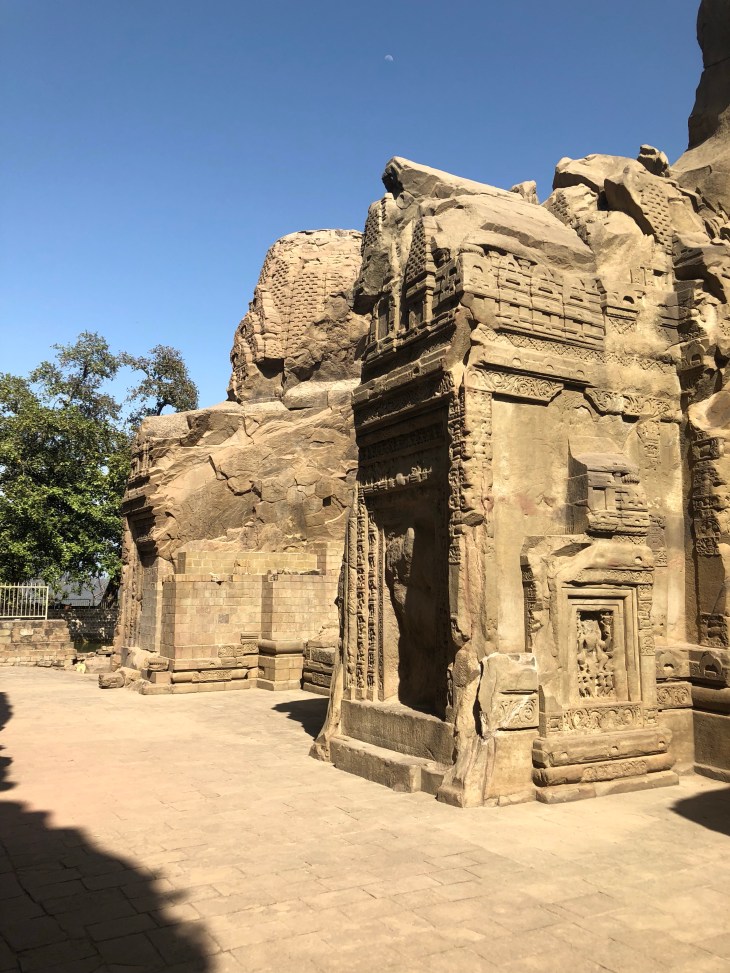
It was an enormous monolithic temple built out the existing rocks: another remarkable monument that would have required tremendous vision and dedication in the making.

We walked around in the continuing heat and took pictures. It all seemed so otherworldly.

Having been baked and fried twice already we got back into the car and headed for Judges Court.

Unfortunately, what should have been only an hour proved to be another interminable traipse over extremely difficult twisting terrain. It was hard to settle into any kind of rhythm with the driving. In the end there was nothing for it and I got out my headphones. I listened to everything from Richard Strauss to Emilie Sandé. It all helped!

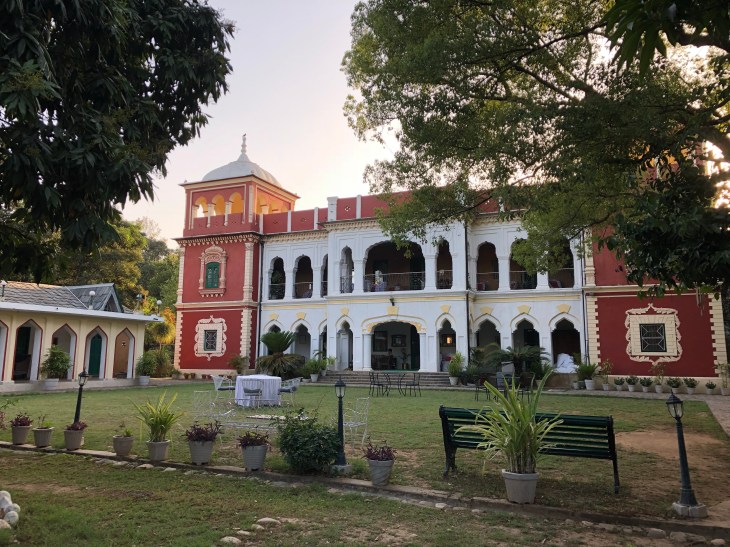
At long last we pitched up at The Judges Court and fell out into the welcome cool of the old house. It had a slight sense of faded grandeur from the former glory days of the Raj; old black white photographs of dignitaries hanging at odd angles on the walls. The furniture was mostly dark, with various inner drawing rooms and leather sofas adding to the Victorian feel.

Our room was spacious and dark, having both mud floors and walls. These were interestingly painted in bilious brown and bottle green. The enormous carved wooden bed had been bolted to the floor, and was rimmed with the green. A chandelier hung from the ceiling. We settled in and were very grateful for electricity that worked (most of the time) and a shower that at least sprinkled if not gushed.

The next day dawned extremely hot. We got into the car for a short outing and headed first to a little ‘heritage village’ called Garli where there wasn’t a whole lot happening and then on down to the river Beas. There was not much of it left but there was still a little ferry which Jeremy was keen to take. We yelled and hollered to rouse its captain on the other side, but he didn’t appear, so we turned round. At this point I pleaded exoneration from further duty under the ‘mad dogs and Englishman’ rule.

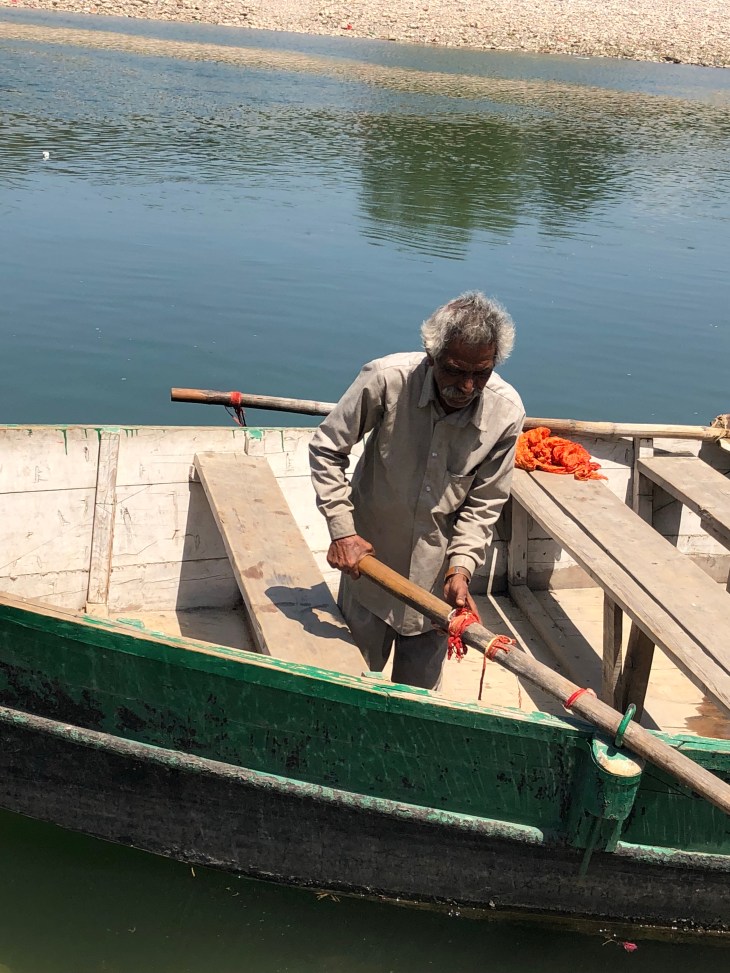
It must have been about forty degrees.. and I was still tired from the day before. Tilak our driver took me back and left Jeremy to continue walking. By the time Tilak found him again later he had walked three kilometres up to the nearest road bridge and back again on the other side and roused the ferryman who was asleep under a banyan tree, not expecting any customers that day!The old man rowed him very gently across.

By then, even Jeremy was tired, and came back for a spot of lunch. I rested all afternoon in the delicious dark of the room, allowing all those tummy crinkles to unravel and my brain to drift.

The next day we escaped in the nick of time before a Bollywood film crew descended with hordes of vehicles, and made our way to Kasauli, a garrison town an hour above Kalka, where we were to catch the famous Kalka to Shimla toy train.

We received less than a warm welcome from the receptionist at the Kasauli Exotica who clearly hadn’t been taught to smile during his hospitality training. It felt more like going through immigration. We were eventually granted entry and shown to a small clean room with a balcony. From there we took a good walk round the garrison town and decided that we perhaps after all deserved a little wine. So we picked some up and after a good shower later, enjoyed it thoroughly on the balcony, gazing at the twinkling lights of Shimla, somewhere in the distance.

A whole new chapter felt about to begin!

Fathoming the Faiths part 2

Jeremy has been doing some more ‘fathoming’ and research, so here is his second guest blog!

BUDDHISM AND JAINISM

I have included these 2 religions in the one blog, as they could both be said to be reform movements against the Vedic/Brahministic versions that represented Hinduism at a similar time – around BC 600 – 500

Buddhism in India

Founder : Buddha – ‘The enlightened one’

Siddarta Gautama was born around BC 563 into a high class/warrior family (and therefore brought up with Hindu/Vedic traditions) in Lumbini, Northern India – a village now located just inside Nepal. He led a pampered life until his early 20s when he started meeting people outside his own environment. Unable to understand why they were so different – poor, not good health etc he left his family and went to meditate under a bodhi tree in Bodh Gaya for 45 days. Nothing distracted him as, by the end of that time, he had reached a state of enlightenment or ‘Moksha’ (see earlier Blog).

He rejected key elements of Hinduism:

• the Vedic gods and scriptures

• the caste system and

• no eternal soul

However, he accepted other key principles:

• the cyclical nature of life – ie rebirth

• ‘karma’ – the impact of actions in previous lives

As he was developing his thinking, he gathered round him 5 disciples and preached ‘4 Noble Truths’ and ‘The Eightfold Path’.

The 4 Noble Truths were:

• life is painful

• suffering is caused by ignorance and desire

• beyond suffering, there is another state – nirvana

• nirvana can be reached by following the ‘Eightfold Path’

Nirvana has been described variously as supreme bliss, unshakeable serenity, unrestricted spirit freedom

The ‘Eightfold Path’ consists of each individual choosing and following the right:

• aspiration

• knowledge

• speech

• behaviour

• livelihood

• efforts

• mindfullness and

• concentration

The essential elements in following the eightfold path are the perfection of wisdom, morality and meditation.

None of the Buddha’s teachings were written down for another 300 years, but were passed on orally. Initially, there were two schools of followers – Mayanana (The Great Way) and the Hinayana (The Lesser Way). However, Buddhism has now developed over the centuries into a number of schools in different countries.

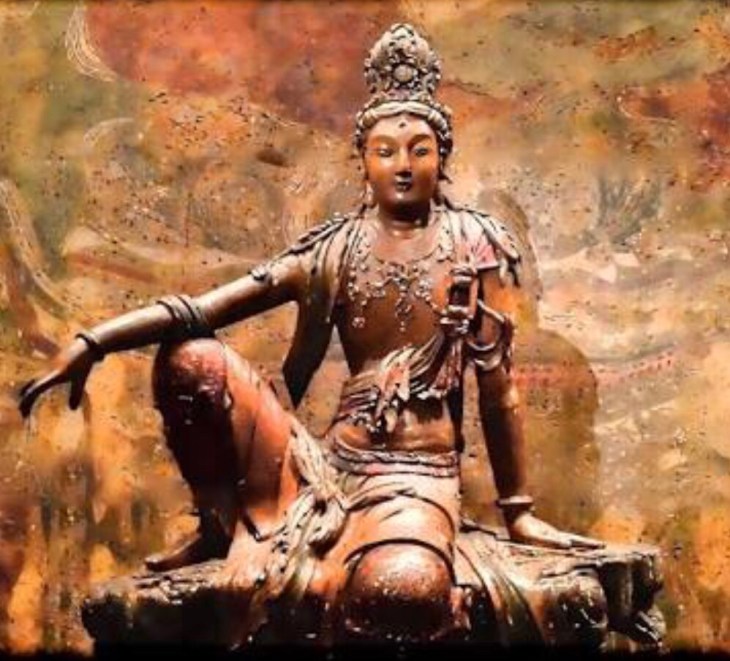
Mahayana followers (The Great Way) believe in salvation for all. They practise a more devotional form of meditation and chanting. New figures (additional to Buddha) play a prominent part in their beliefs and worship. These are ‘bodhisattvas’, saints who have been predestined to reach a state of enlightenment through thousands of rebirths.

Schools that have developed from Mayahana include Theravada, Vajrayana (sometimes known as Tantric Buddhism) and Zen (developed in Japan).

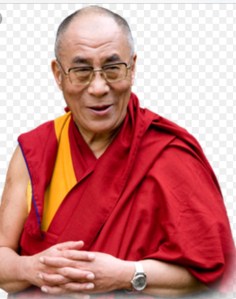
Tibetan Buddhism has developed into 4 schools – Gelug (the current Dalai Lama is from this school), Nyingma (sometimes known as Bon), Kagyu and Sakya. The Chinese authorities have persecuted Buddhists in Tibet since the early 1950’s. In 1959, the current leader – His Holiness The 14th Dalai Lama – moved into exile to McLeodganj, Dharamshala, in Northern India.

Here, a very large Tibetan community has grown up over the last 50 years. It also has attracted a number of Western followers, many of whom make pilgrimage visits to Dharamshala and Northern India. A Buddhist teacher maybe known as a ‘Lama’ or ‘Rinpoche’.

Theravada followers are mainly found in Sri Lanka and South East Asia – Thailand, Myanmar, Cambodia, Malaysia, etc and gaining devotees in the West.

Surprisingly, it is estimated that there are over 200 million Buddhists in China (despite the Chinese authorities) out of approx 500 million worldwide. (The reasons for this are outside the scope of this blog)

Buddhism in India over the last 1000 years seems to have lost out to a resurgence of Hinduism and the savage slaughter of most Buddhist priests in India by the incoming Muslim/Mughal conquerors of the 12th century AD. Despite Buddhism developing out of the Hinduism/Vedic tradition, it is estimated there are only around 10 million Buddhists in India today.

Jainism

Like Buddhism, Jainism began as a reform movement against the Vedic/ Brahmanistic form of Hinduism practised around the 6th century BC and in the same border region of India and Nepal as Buddha was born. It appears never to have spread beyond the borders of India and has only around 4 – 5 million followers today.

Jain is from the sanskrit word ‘jina’ – descendants of conquerors. Jainism principles developed from 24 ‘tirthankaras’ (prophets), the last of whom (Mahavir) is credited with its foundation. He was born into noble birth (and therefore the existing Vedic/Brahmanistic traditions) but renounced it all at aged 30 and then led a life of austerity as an ascetic. The 24 tirthankaras demonstrated that through a life of austerity, it is possible to conquer the mind, passions and body to attain deliverance from the endless cycle of rebirth.

Jains accept the Hindhu ‘karma’ and the concept of God, but not as the creator of the universe, but as demonstrated within the lives and examples of the 24.

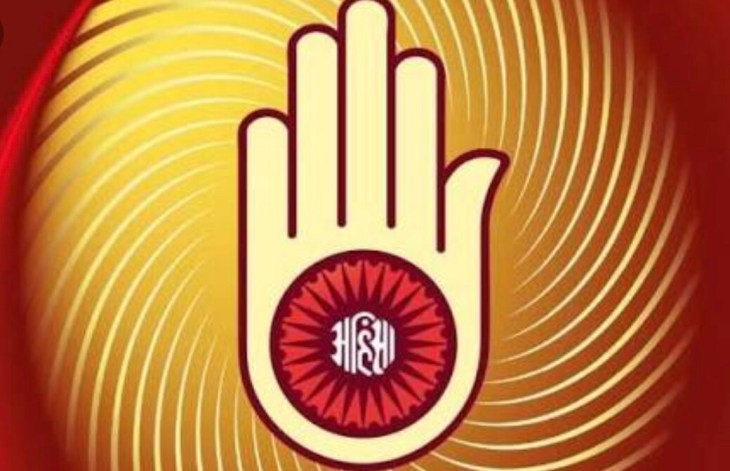
Jains believe in 2 principles – the living and the non-living. All life is sacred and all living entities , even the smallest insects, have within them an indestructible and immortal soul. They developed the notion of ‘Ahimsa’ – non-harming and non-violence

They take 5 vows:

• not to harm any living being

• to speak the truth

• not to steal

• to give up all sexual relationships (not sure how the sect continues over the centuries!!) and

• to give upon all possessions (for some even clothes – see below)

The first vow means they are very strict vegetarians – do not eat anything that runs, swims or flies! Many do not eat root vegetables as they believe that destroys the plant. It also means that strict Jains carry a peacock feather with them to brush clear any insects on a chair before they sit down! The most strict, employ someone with a peacock feather to clear the path of insects in front of them whilst they are walking!

Jains believe that salvation is achieved through one’s own efforts – no guru or divinity can help you achieve this. Also your manner of dying is important – many fast themselves to death (Sallekhana) – when they feel they have completed all their obligations in this life.

As they believed in no harm to any living being, they barred themselves from the 2 principal occupations at that time – warriors and farming. So they became commercial traders and bankers. It seems to me that this presents itself as a considerable dichotomy – most Jains are rich! ie they haven’t given up all their possessions and their temples are some of the richest in India! It is said they currently control most of India’s diamond and precious stone trade!

Finally, there are 2 sects:

Svetambaras – ‘white clad’ –

mainly in east and west India and Digambaras – ‘sky clad’ – who often go naked and are mainly in the South (perhaps because its warmer all the year round?!)

Although the Jain community is small, it has left a deep impression on Indian society as it can be seen to have similar beliefs in common with puritanical forms of Hinduism. Vegetarianism, reverence for life, and non- violence are all seen by Hindus as highly commendable.

JMS

Written at the Mary Budden Estate, India – 12th April 2018

The Wah Factor

Friday 19th to Sunday 21st April

A huge Himalayan rumble chased us down the mountain as we left Eagles Nest. The clouds grew thick, looming and lowering over us almost obscuring the natural light. This was not the tropical purple of a Caribbean storm cloud, but a greeny shade of grey reminiscent of the forests it was cloaking.

Beneath it, for the last time, we made the hair raising descent towards McLeodganj via the unmade road. How the tyres survive on the vehicles which travel on it is a mystery. We bounced up and down in silent prayer on the back seat until we reached the more populated concrete narrows of the town.

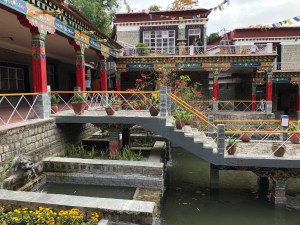
From there we slowly made our way to Norbulinka – the Tibetan Museum or Centre for traditional art and craft. It seemed a breezy haven of tranquility with its art studios, walkways and gently waving flags after the chaos outside.

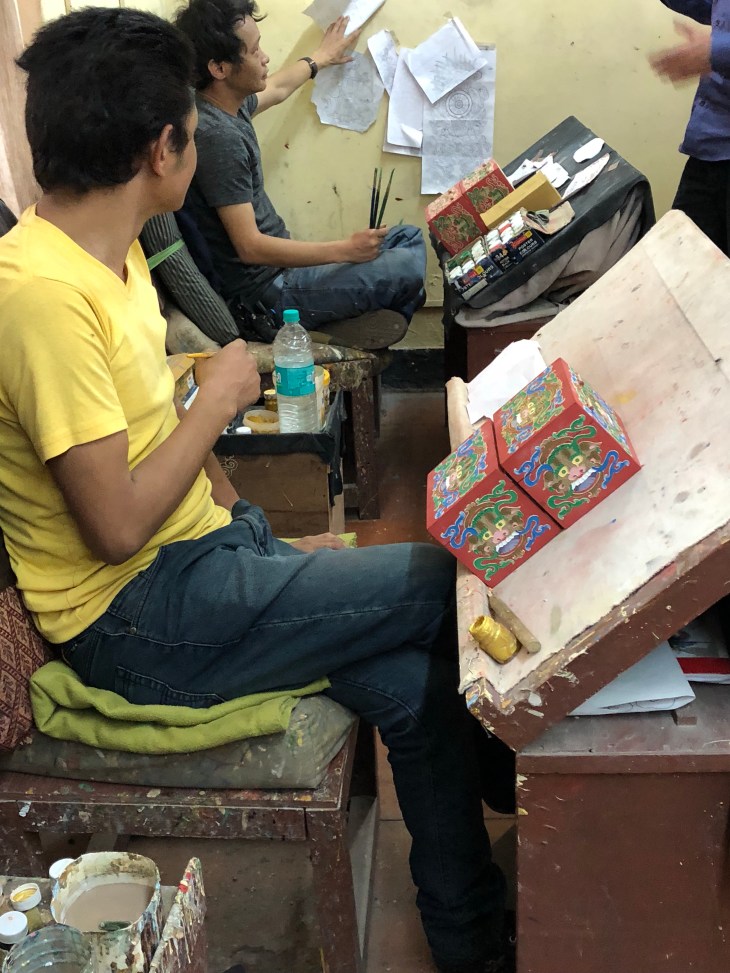
We wandered around, peeking in on the various studios where traditional crafts were being continued.

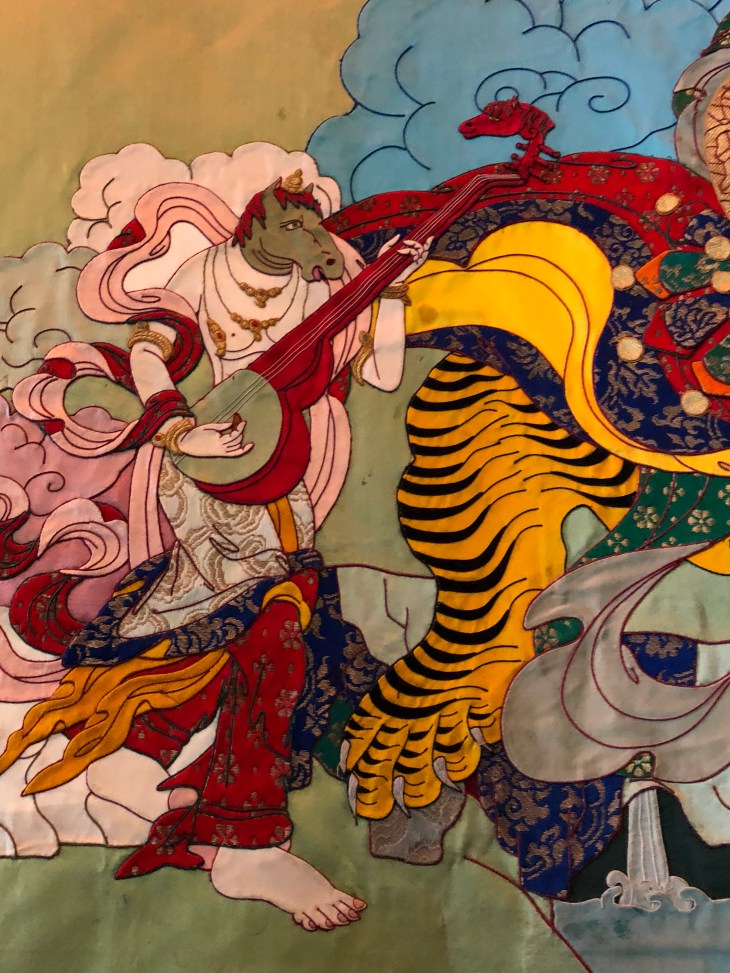
The Temple was a mass of red and gold and fabulous appliqué work on enormous cloth hangings suspended on either side of the gold Buddha. It was gloriously empty, with a shiny black floor and a few mats you could sit on if you wished. We sat down and stared. All round the outside of the temple were prayer wheels. I turned each one.

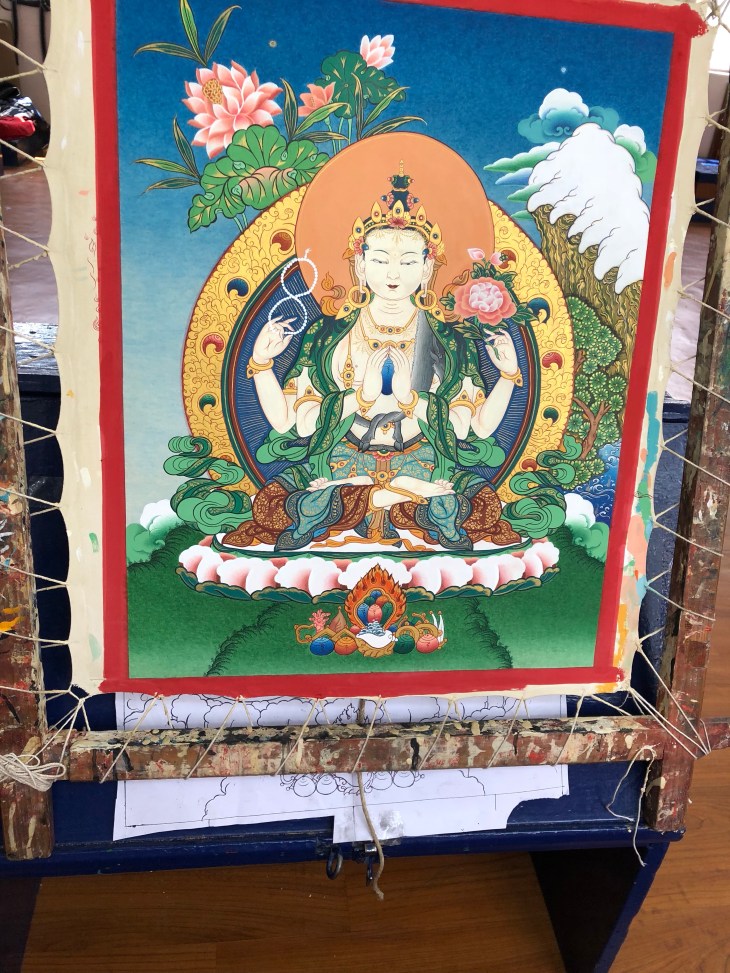
In other places we saw box painting, jig-saw carving, wood carving, sewing, and elaborate painting on stretched canvases. The artisans worked in near silence although a couple were peering down at their mobile phones from time to time.

Having soaked up this small sample of ancient Tibetan culture we had a snack in the garden cafe, before resuming our route.

We were aiming for The Lodge at Wah, which is a homestay on the Wah Tea Estate.

There was clearly some sort of meteorological tantrum occurring in the heavens, as the green grey cloud persisted, and after arrival we were hailed upon followed by more thunderous and torrential rain.

The Wah Estate nestles in woodland outside Palampur, under the shadow of the Dhauladhar Himalaya.

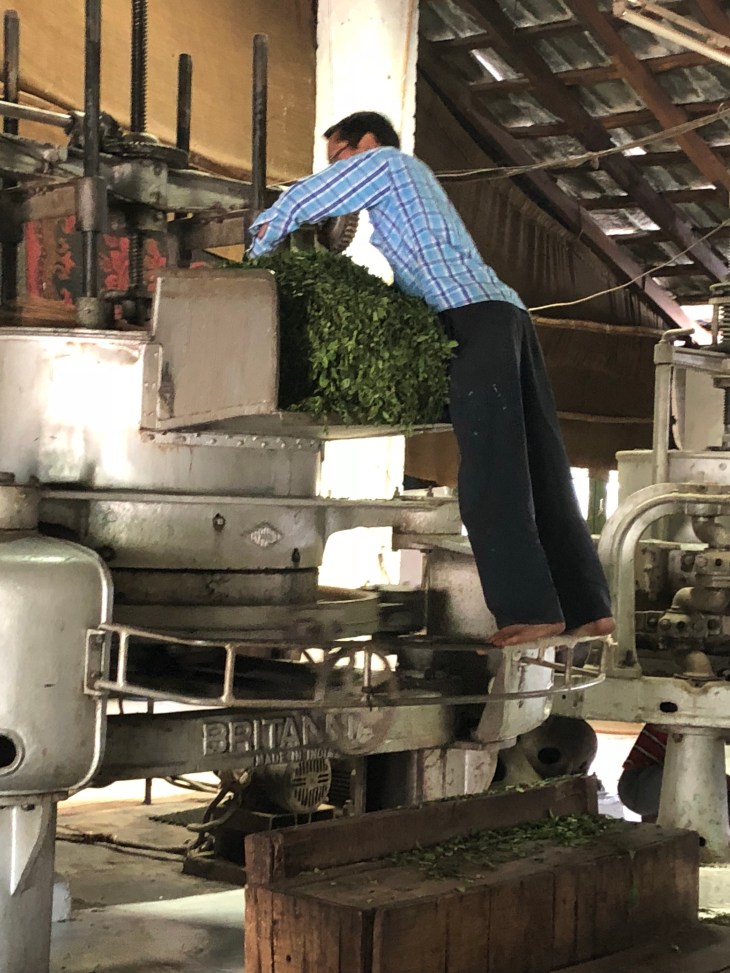
Its five hundred acres are devoted to growing speciality tea, as naturally as possible, producing about 150 tons a year. Only a quarter of what is harvested eventually becomes tea. All the tea is hand picked and dried according to the type of tea they are trying to produce. Green tea is made by stopping the oxidisation as quickly as possible after harvesting before moisture is removed, and black tea is left for longer. Moisture removal entails air being blown across it by enormous fans in a kind of wind tunnel. The following morning, our young host gave us a Tea Estate tour explaining the many stages passed through before the tea leaf and bud are transformed into good quality loose leaf tea. There are four gradings: the lowest, almost like dust, being eventually thrown back under the bushes as mulch.

Tea bushes can yield up to three flushes a year. The two types of bush we were shown were camellia assamica and camellia cinensis. This estate does not grow assamic tea, (strong flavoured) as the conditions are not suitable, but the camellia cinensis (China) variety instead, which produces finer quality ‘liquor tea’. The cinensis bushes have multiple stems and respond well to being cut back vigorously, although they do go through dormant phases and need to be ‘rested’. They are smaller plants than the assamicas which can grow up to 15ft and are essentially trees rather than bushes!

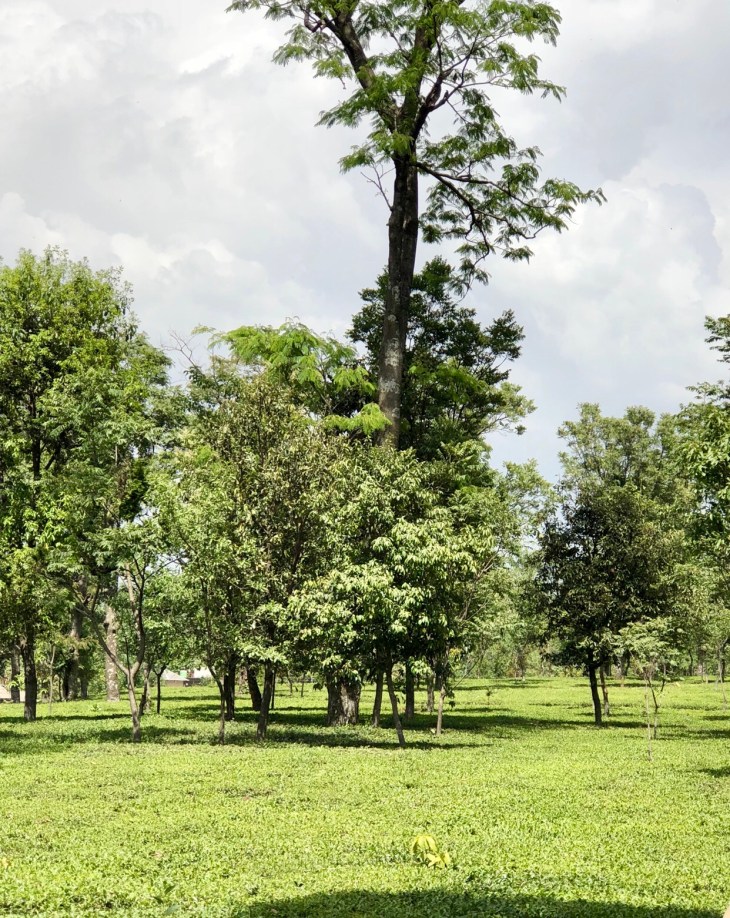
As you stroll through the plantation, the bushes sit low like a thick green carpet; densely packed with barely space to get between them.

Being a family run and privately owned estate the focus is very much on keeping pesticide free with careful husbandry of the plants in order to produce top quality tea. But like all farmers, they remain at the mercy of the weather and their tea pickers who must be trusted not to hurriedly pluck stalks as well as the bud and top leaves!

We were treated to a tea tasting. You take a sip, (we were given spoons although they generally sip straight from the cup so that metal does not affect the taste), and then suck in air over the top of it in a slurp, before spitting it out again. I got the hang of it but found that whilst I received the top notes of the tea nicely through my nose, a bitter taste was left on my tongue. Perhaps I need further instruction!

Leaf drying

Tea rollers

Loading the tea rollers

Extremely noisy machines for sorting leaves.

A final sort before packaging

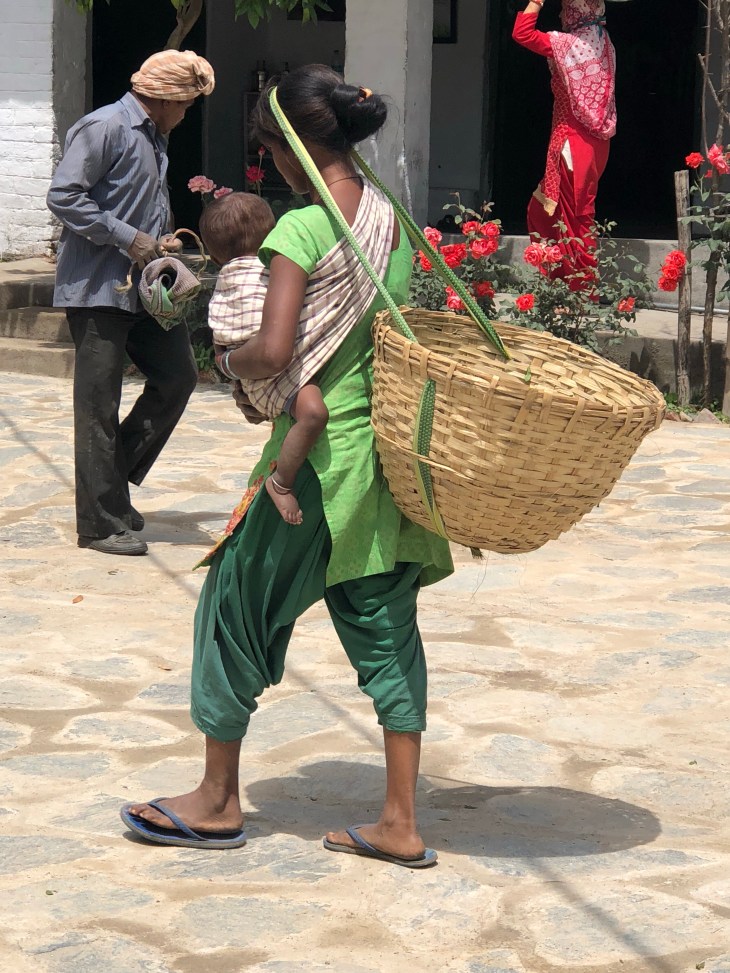
The plucking is predominantly undertaken by women. They have to pick 12kgs for their minimum wage and thereafter can earn more for any extra weight plucked. It’s hard work to pick that amount, and the women often have little ones in tow.

** ** ** ** **

In the afternoon we had great fun catching the narrow gauge toy train on the Kangra Valley Railway. We picked our way along the railway line itself in order to get to the tiny station. You could hear the train blowing its horn long before it arrived. Here’s J holding up everything.

.

We boarded at Patti Rajpura with Maneesh for company. It was terribly simple and refreshing. The train clunked rhythmically over the rails: dugga dung, dugga dung, etc! in a lulling sort of way. We peered out on either side at the lush vegetation rolling past, the train slowing down worryingly as we crossed a very old bridge.. As ever, you could lean out of the windows and the carriage door was open if you wanted to lean out of that too, which naturally Jeremy did. Lots of train footage was taken!

About forty minutes later we got out at Baijanath Prapol. More engine photos were snapped and we were then ferried to the ancient Baijanath Temple – circa 8th Century. Miraculously, it had survived perfectly despite the great earthquake of 1905.

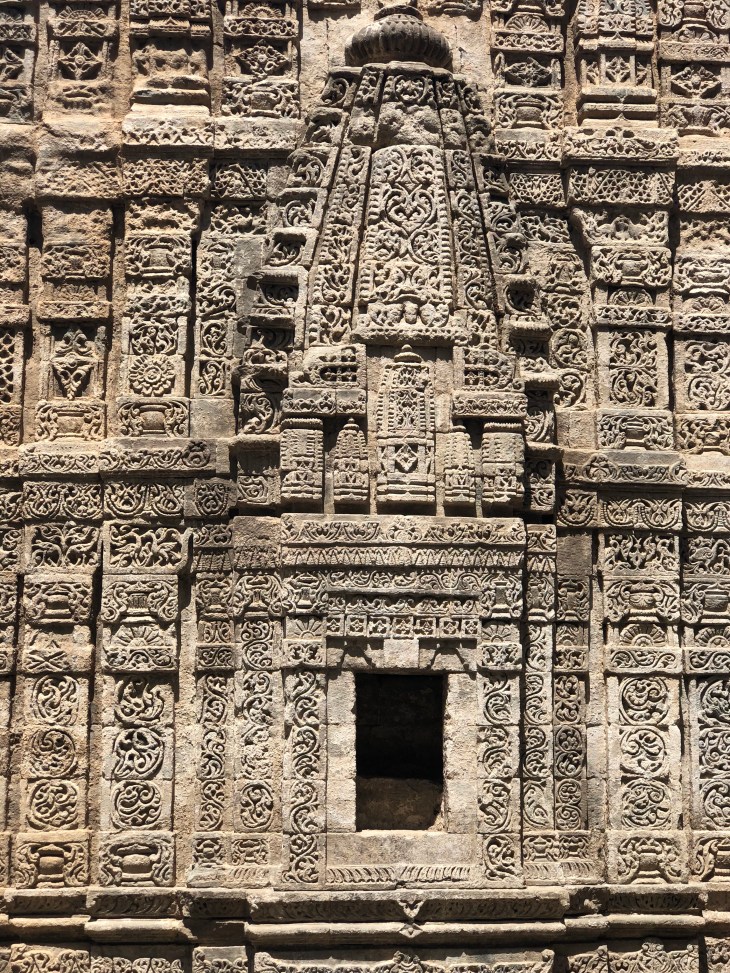
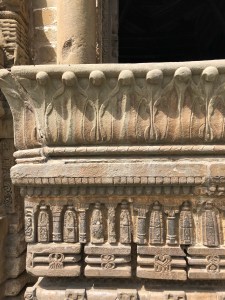
The ancient carvings had weathered extraordinarily well I thought.

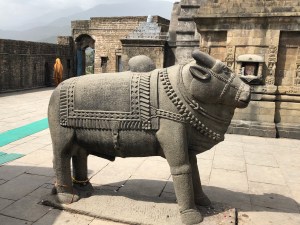
There was a lot of devotional touching of the stone bull. Incense was burning at its feet. Everyone wanted their photograph taken next to it, but managed to snap this in between!

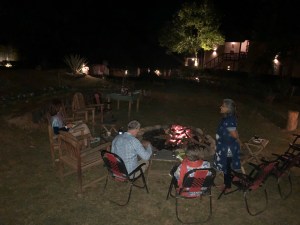
We returned to the Lodge by road. Feeling rather hot and dusty it was good to shower off and kick back for a few minutes. Later on a fire was lit in the garden and we had supper outside. It was wonderful to stare into the flames and reflect, before turning wearily in.

*** *** ***

Sunday 22nd April

……dawned brightly. We had our breakfast outside.

A delightfully slow morning ensued whilst I caught up on the blog (!)

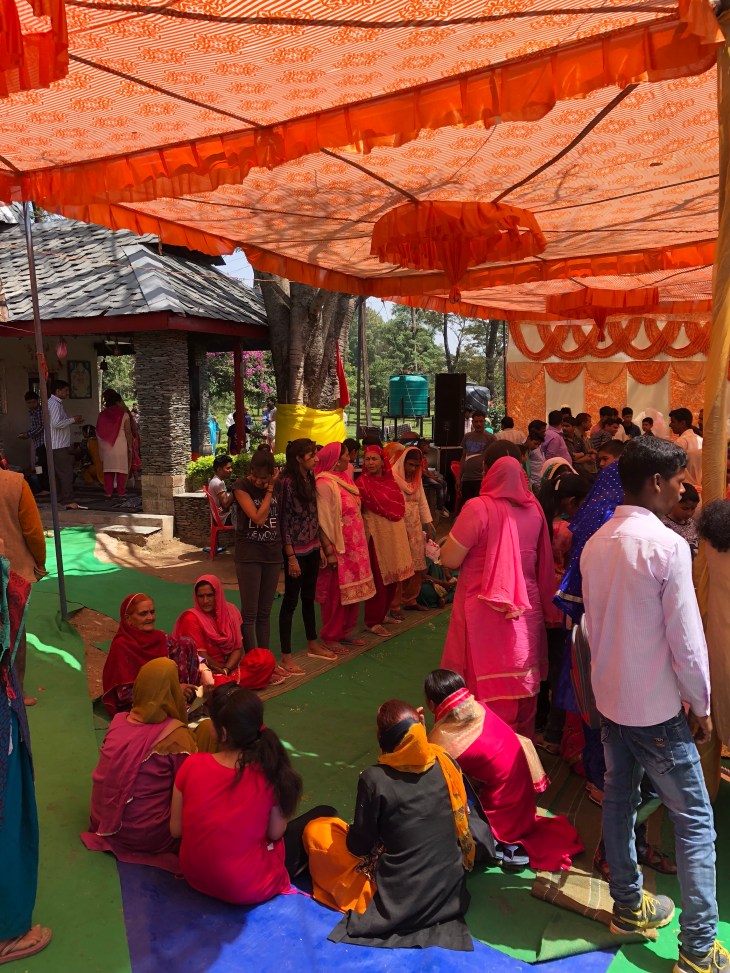
At around 12.20 we bundled into the car and were taken to a ‘puja’ for all the tea estate laid on by our hosts, the estate owners, Neerja and Deepak.

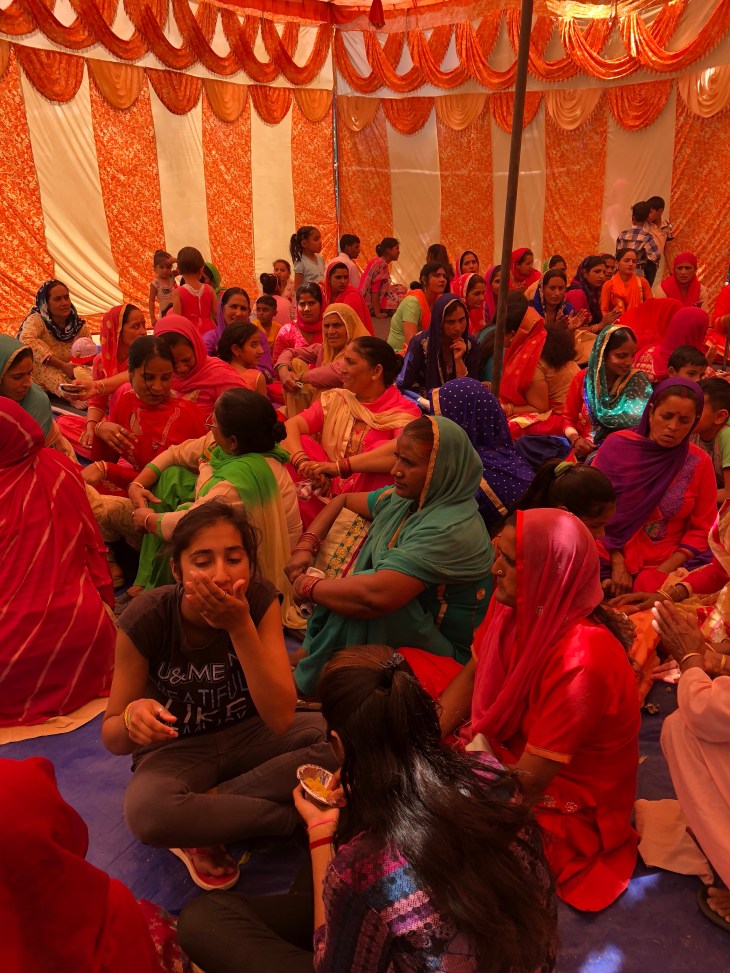
We had no idea what to expect but the puja was a giant thanksgiving/devotional meal laid on for all the village and tea workers who were treated to lunch and dancing. It was a visually stunning occasion: a riot of reds, golds, pinks and blues in the saris set against the bright greens of the tea bushes and the blue of a cloudless sky. With our new fellow guests, Jill and John we were completely agog!

Our hosts Deepak, Neerja, their son Surya and his wife Upasana

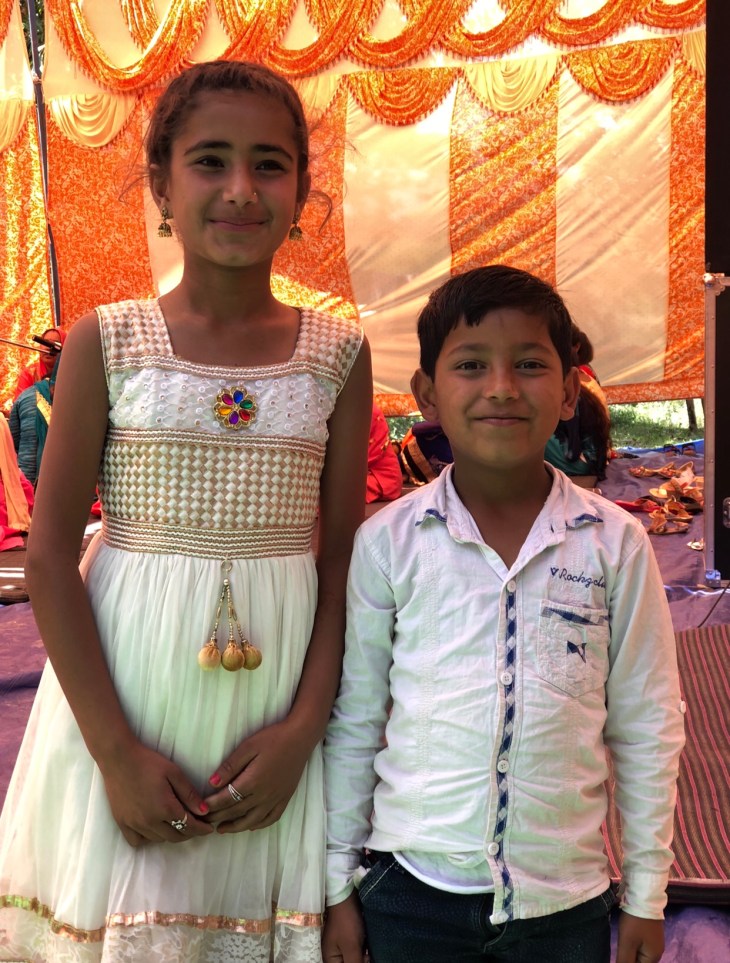
And here were a couple of mischiefs I met as we were leaving.

We felt very privileged to have been part of the occasion.