Head in the Clouds

Thursday 19th April

…well nearly.

Resting today. Our time at Eagles Nest has not been idle.

In addition to our first biggish walk to Guna Temple with Shapu, and attending the audience with the Dalai Lama, we have had two further sorties over some interesting terrain.

Being a small, fairly blow dried sort of person, I always suspected that time in India would have the effect of cracking the usual carapace before putting it back together again, the marks still visible but stronger for the mend.

And so it has been through the walks.

On Tuesday after lunch we set out with Ajit, the office manager (only too happy to escape from his desk!) to see a waterfall. We’d had a quietish morning, so my body was in a quietish, Pooh Bear sort of mode. It was also hot.

The route quickly became challenging; with the all too frequent steep and narrowness occurring dotted with lovely tree roots to trip you up, well camouflaged by deep beds of leaves on the footpath. Needless to say, you have to pay attention. Having been properly challenged on Sunday, my feet weren’t quite ready to respond to instruction. My brain too had become strangely sluggish, resulting in a near mutiny of mind and body. It’s at this point that feelings of frustration and petulance can often creep in. So on cue, they did.

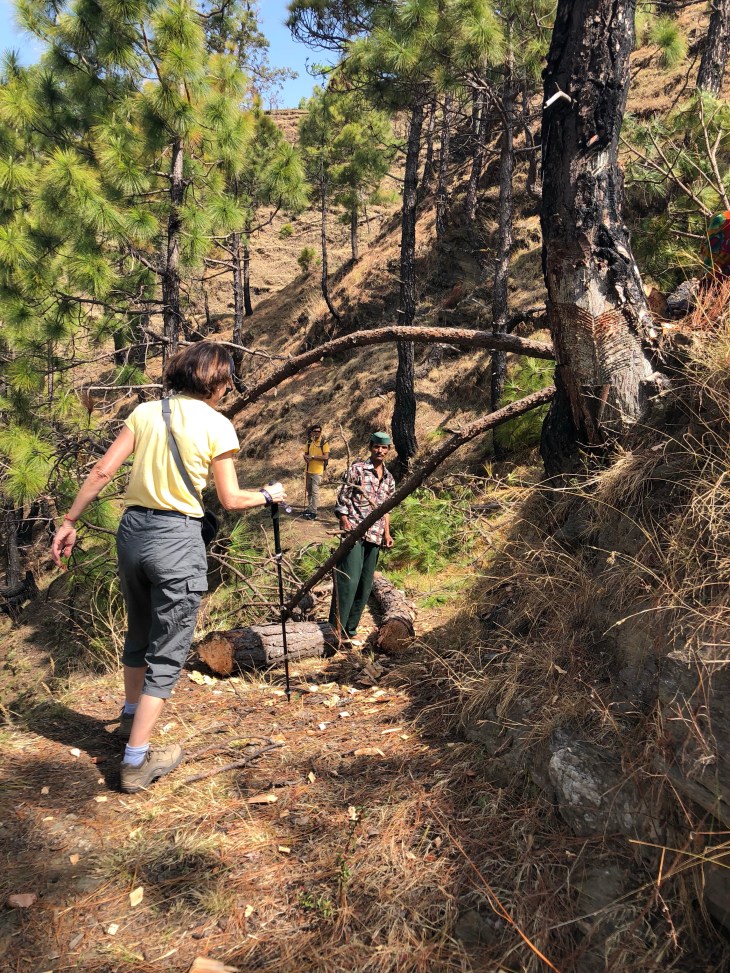
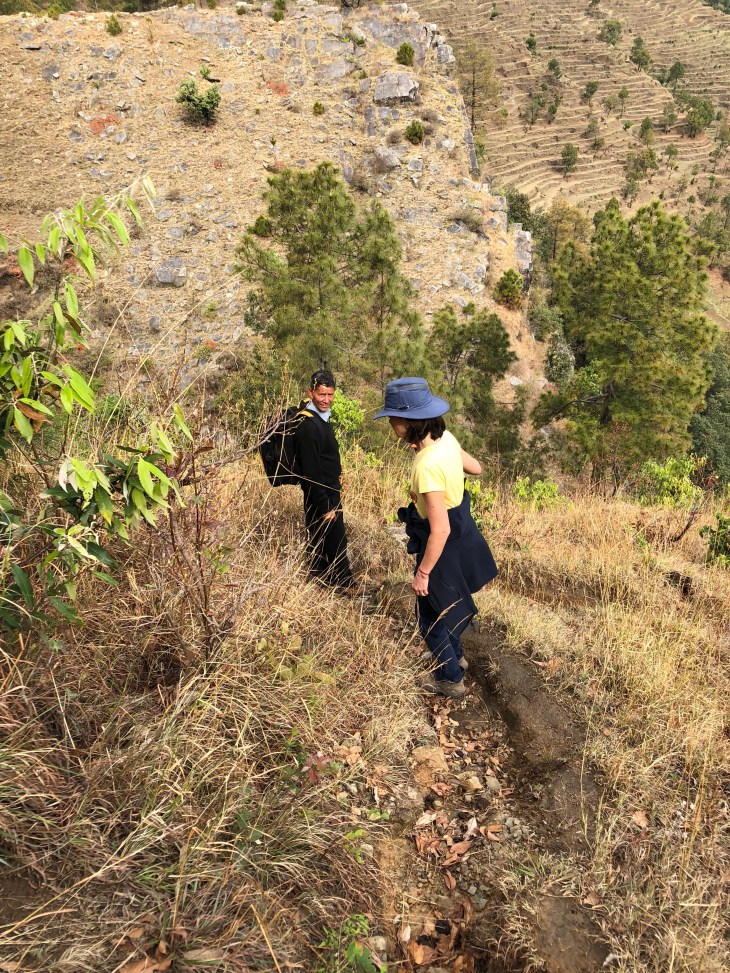
We came to a landslide of rock to cross at a rakish angle.
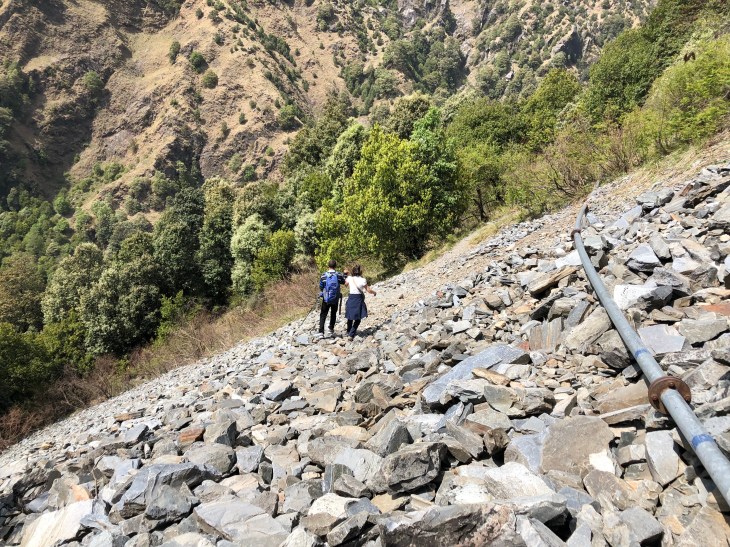
Ajit even capered down it to take a picture of us:

Why couldn’t I just saunter, light legged and jaunty over the ground like dear Ajit, instead of stumbling, clod footed (albeit in my faithful boots) and hesitant, picking my way so carefully?

Rationally, you know that you are a mere visitor and not a native, born with the print of these hills in your very DNA. But still that sense of competitiveness with oneself resurfaces, until you feel (in my case) wild with fear and frustration. But this is where the mending starts; acceptance, followed by regrouping and taking the proffered hand. Ajit spoke softly and reassuringly to me, guiding me across the scary sections, with great courtesy and humour, and took us all the way to our destination.

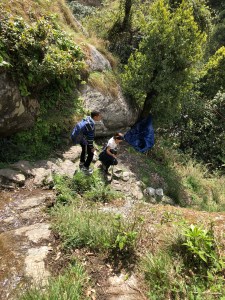
It was well worth it. The waterfall looked cool and inviting, some hardy souls dipping in the glacial waters.
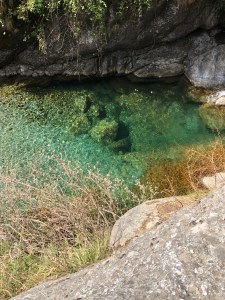
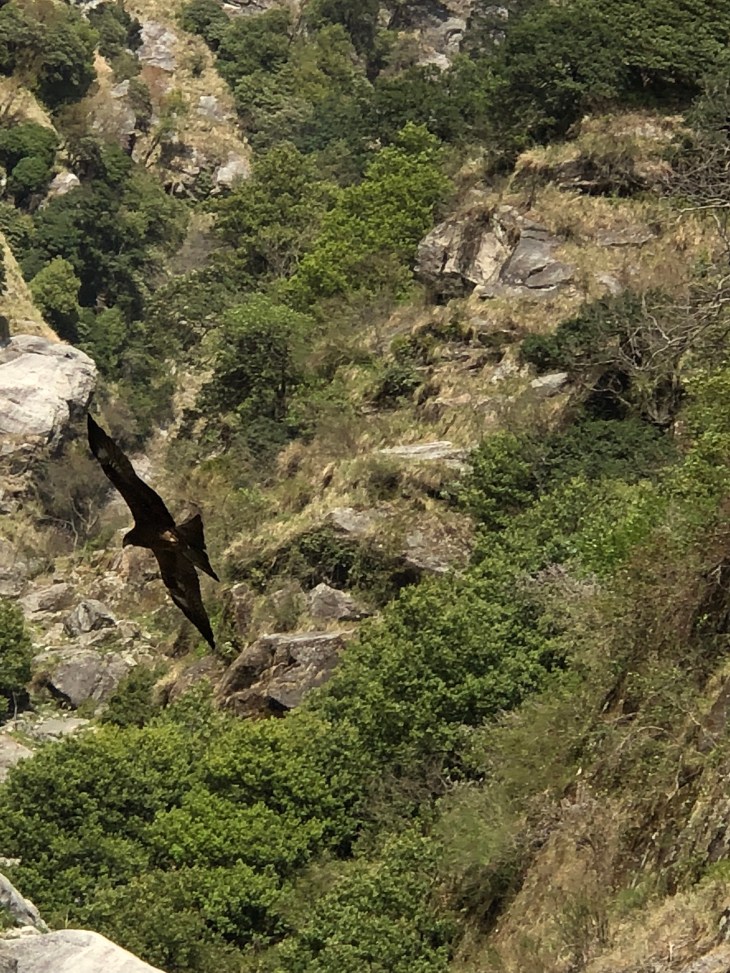
We simply sat and gazed, chatting and enjoying the rest, high up on a cliff overlooking the river. We watched an eagle at our eyesight level, soaring away from us then back again, sweeping the valley in long and regular rounds.
I began to feel better and we took some lemon tea. Then a little sunbathe!!
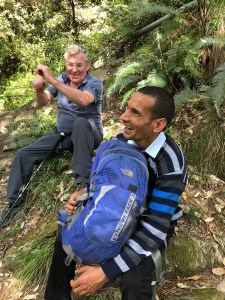
It was a beautiful walk, both for the company and getting to know the local area. My soul loves the hills and takes in huge lungfuls of air as inspiration.

We returned the same way. I stopped berating myself and trusted my guide and the universe.

** ** ** **

The following day (yesterday) came the real test.

In a marginally more determined mode, we set off to ascend Triund, which stands at just under 2,900m. Shapu was leading, and we also had Chandi with us as back up, in case anyone needed to turn round.

Like Snowden, it is a tricky but popular path to the top, with tiny tea stops along the way.

Ajit had said comfortingly to me “you can always turn round at Magic View, half way up, it doesn’t really matter”.

It was with this psychological parachute in my mind that we began. If you can imagine climbing deep stone stair after deep stone stair, none of them of consistent height or surface, you can begin to grasp the nature of the beast! Quads watch out! The brow prickled with sweat and my back was soon pouring between me and my rucksack. Up and up we laboured, eventually arriving at Magic View.

A brief pause there. It was decision time. Bail out and stay put, watching J and Shapu disappear into the heavens, or go too. I needed a pee. “Washroom?” I asked Shapu. “No washroom!” He replied. Eugh.. “We’ll probably find somewhere along the way”, offered Jeremy. I didn’t feel too optimistic as it was all more exposed than it had been on previous walks. “What’s the rest of the way like?” I asked Shapu. “Very steep mam, more difficult because harder and many bends at the end. We are already tired and then we have the coming down.” This was scarcely reassuring. He smiled a mercurial smile.

Ever the optimist, Jeremy said “well you can always start, and if you don’t like it, turn round”. Hmm. So I did.

Mercifully, a small siding sloping away under cover of some Rhododendron bushes hove into view. “Quick – you can go in there”, said J. Hanging on to the branches on the slope, I felt considerably more comfortable afterwards, rejoined the others and continued up.

It may have been a jaunt for our guides but it was a pretty relentless effort for us, involving much digging deep and bloody mindedness. The air felt ever so slightly thinner. Again I was grateful for the long cycle rides I had experienced (the Cambridge 100 in particular when we’d had the wind on our nose and no downhill for the entire time), and also to the heroic souls Sir Ranulph Fiennes had written about in his book ‘My Heroes’. Those were some of the people who had inspired him to undertake many of his own challenges. In fact you may know that he climbed Everest in order to conquer his fear of heights! Other than the military, or those that way inclined, most in our generation have rarely experienced real physical hardship. Walking up a steep hill of one’s own volition could scarcely compare with that.

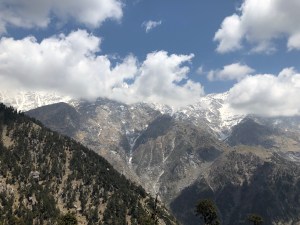
With all these things swirling around my head as we pushed on in silent meditation, Chandi suddenly turned and said to me “last bend!” There had been twenty two fiendish ones before arriving at the top. As we rose the last few feet and stepped out onto the plateau, I looked up at the Dhauladhar range that we had come a little closer to, and then down to McLeodganj and Dharamsala thousands of feet below. It felt great. There we were, tiny insignificant dots enjoying beautiful magnificent Nature. I stepped up to the shrine and offered thanks for our safe arrival.
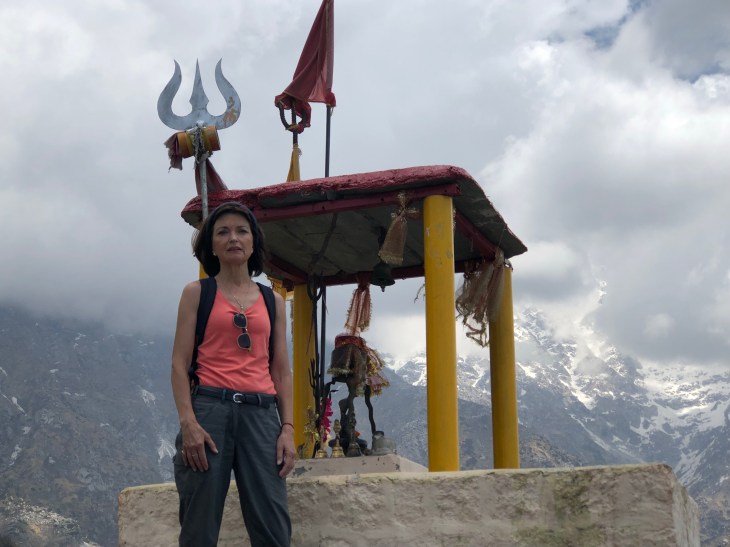
Thereafter we had a light picnic before the long descent. Happy feelings and a nice cool down did much to restore.
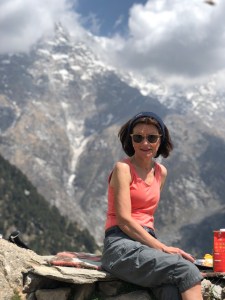
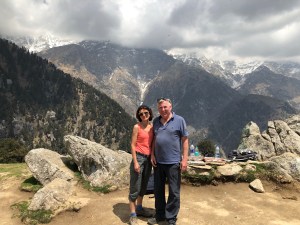
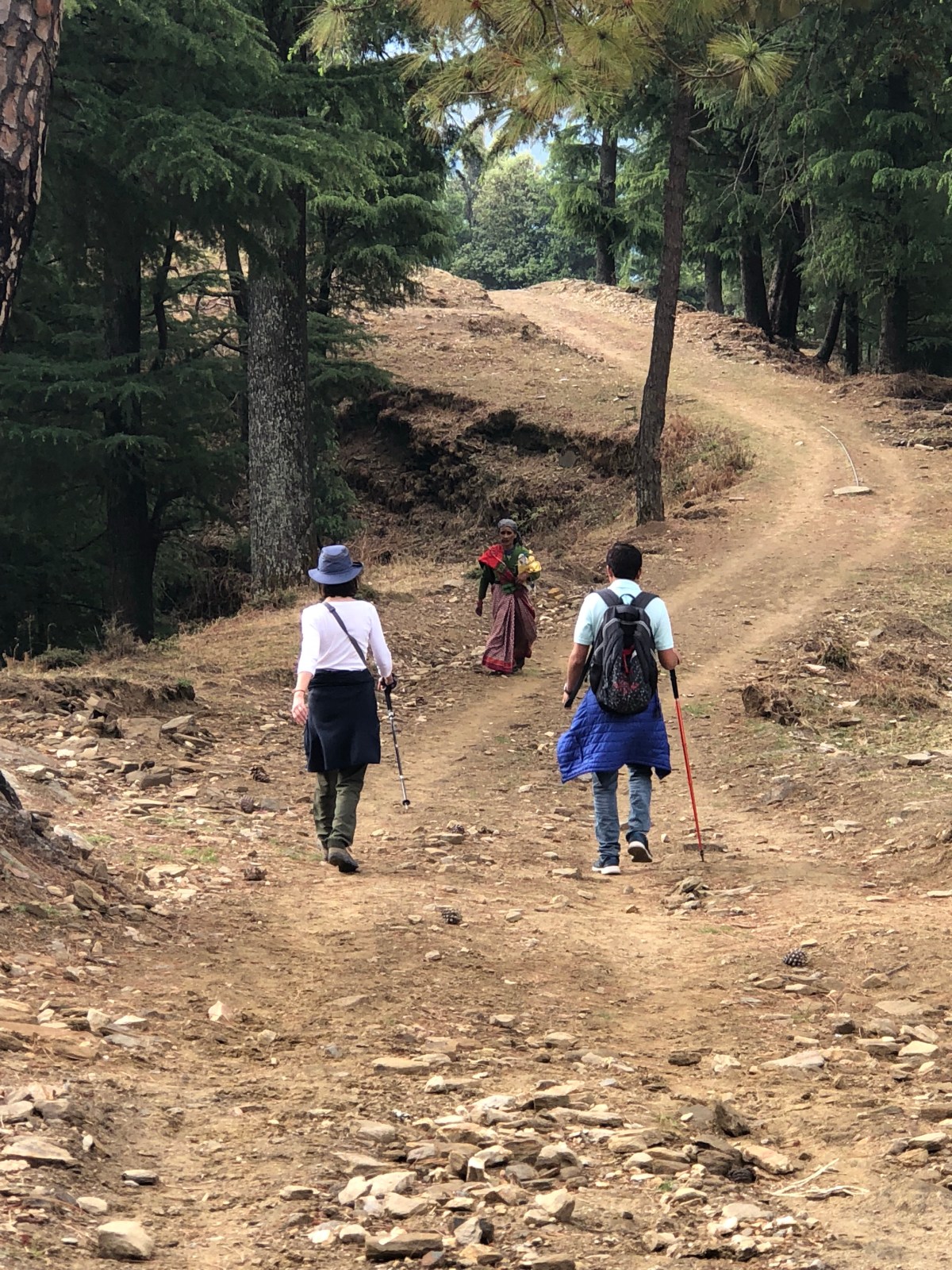
It was just as difficult going down, because of the rocks, but I stopped worrying about Shapu leading by a furlong and accepted Chandi’s balancing hand. It was like a bizarre rock dance, coming down together, hand in hand.

Five and a half hours later, we arrived safe and sound back at Eagles Nest. It was great to get those boots off! But also great to have got up there and made the journey!
Straight talking from the Dalai Lama!

Monday 16th April

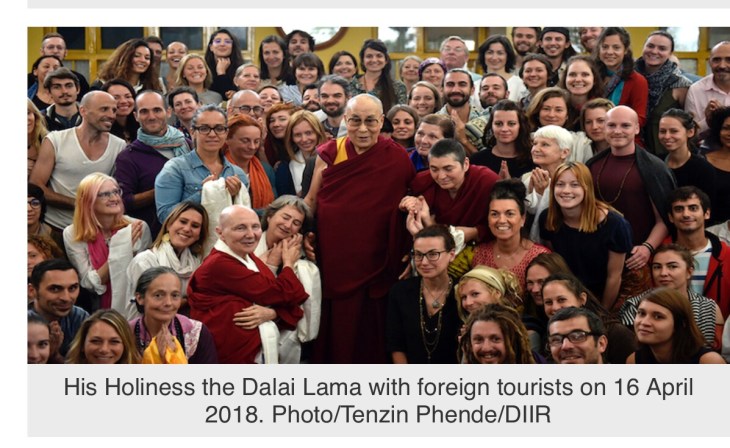
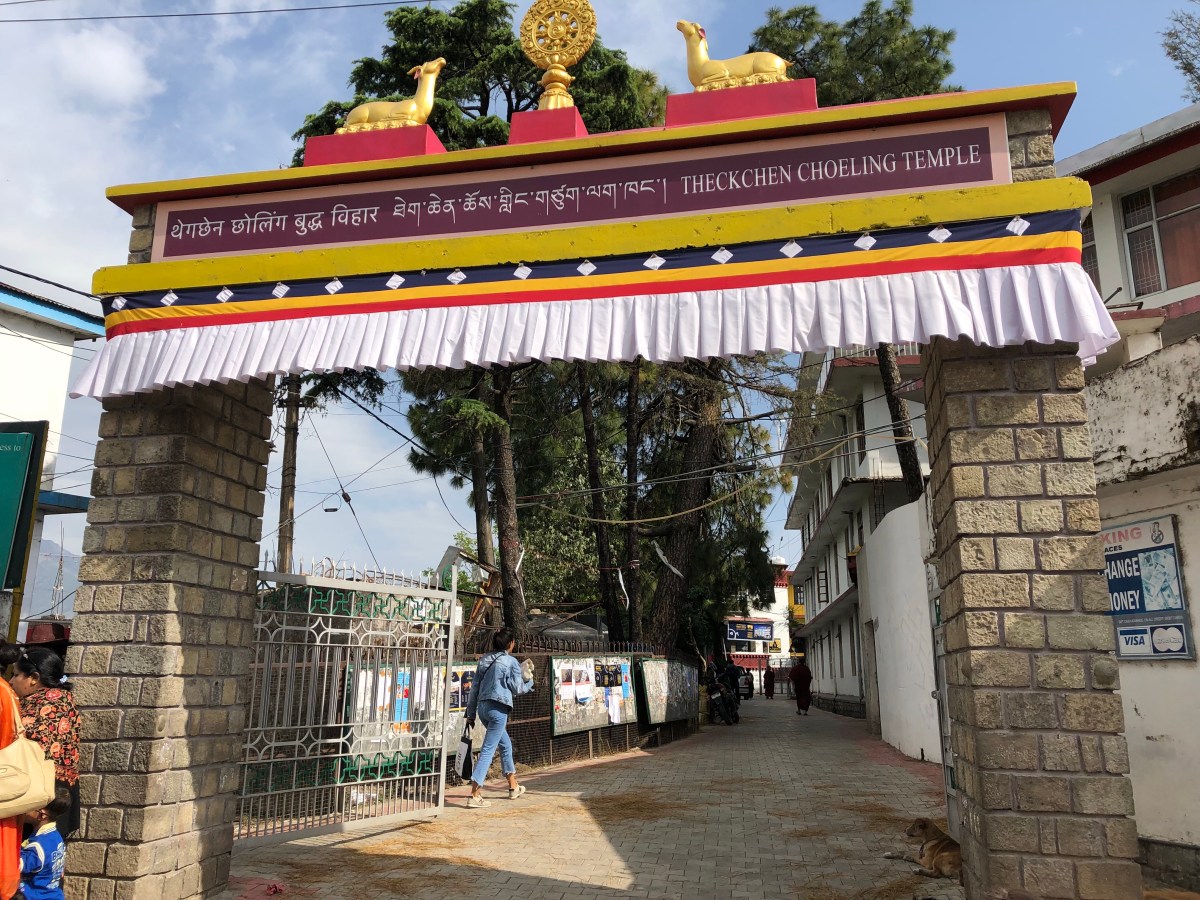
Today we had the enormous privilege of attending a public audience given by His Holiness the Dalai Lama at the Tibetan Buddhist Temple.

We had already pre-registered but still had to join queues of people to get to the inner sanctum where he would come and speak to us all. It was entirely for ‘foreign’ or international people rather than Tibetans.

There was strict security and no phones or cameras allowed. We were properly searched before going in! Once inside the canopied temple area, we were marshalled into different nationality groups. This was so the Dalai Lama could be photographed in front of each of them for Tibetan promotional PR purposes.

When he emerged from his inner sanctum, diminutive and beaming in his red robes, he was gently moved around the groups by his entourage. Although stooping slightly, for his 83 years he had a sprightly air of amusement about him and was quick to build rapport with people and crack jokes.

For the brief report on what he said go to

http://tibet.net and look for Monday 16th April.

Amusingly, if you go to the fifth photo down, you will just make us out standing at the back with the European contingent. Jeremy is in the white shirt and I am three people to his left. Otherwise see below!!

He then sat on a dais and spoke to us all. It was difficult at times to tune into his speech pattern and his accent, but everyone listened intently.

While he spoke, the heavens opened and beat down on the canopy roof. It felt pretty cold.

However, his words had a warming ring of truth about them.

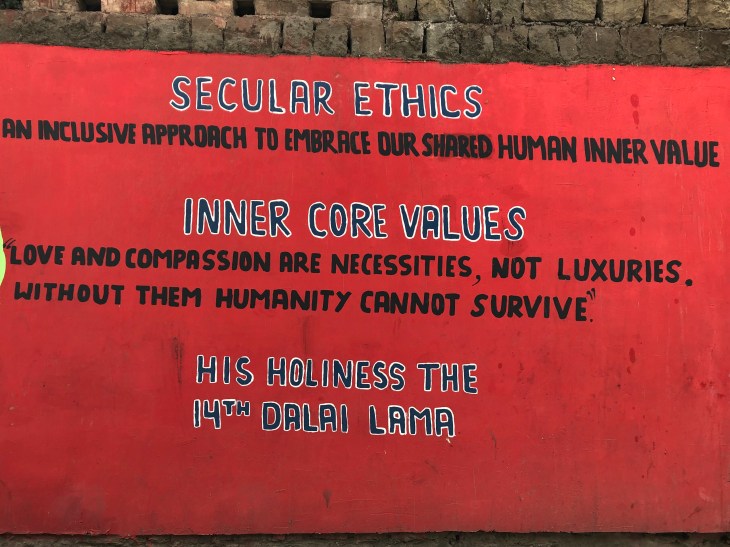
He spoke about compassion, self confidence and the need to get away from destructive emotions such as anger and hatred. Do please click on the link briefly to read a decent summary. I loved his straight talking. He turned to the Indian contingent and said he was not impressed with the caste system!! Amongst many other things he said

  • Our brains are all the same irrespective of skin colour.
  • There are no barriers between children. Our education starts to create division.
  • We need to cultivate inner peace through the discipline of meditation which will build self confidence and reduces aggression
  • Violence is born of fear and possessiveness

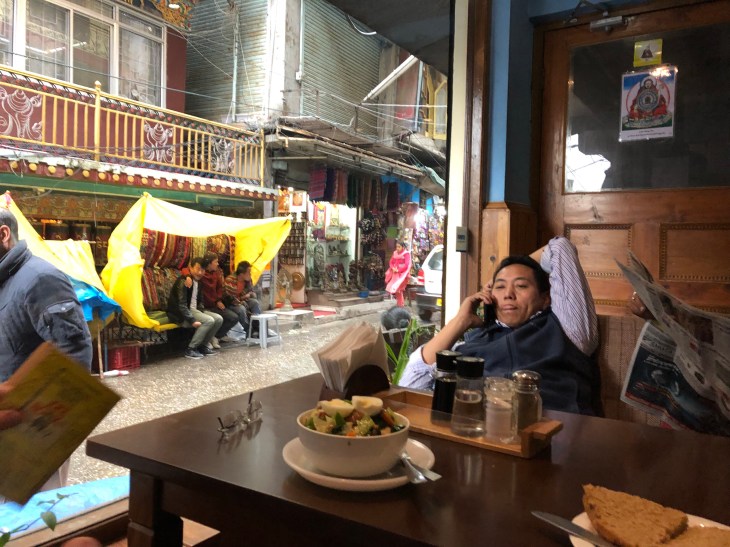
Afterwards we repaired to a cafe to shelter from the rain and spent a happy two hours doing nothing at all apart from watching the world go by.

McLeodganj was full of visitors, naturally, making it feel cramped and touristy. But later the crowds subsided and we had a gentle wander down Temple Street looking at the many stalls.

Pashminas, woolly hats, socks, momos, you name it. Everything and anything was available to buy. We passed a few prayer wheels too.

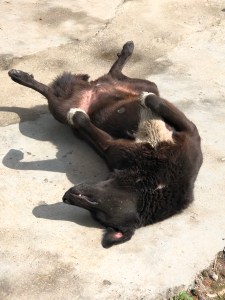
A sleeping dog was chilling out big time in the sun,

next to this stall holder.

The tuktuks and cars were all still shoving their way through, making progress slightly hazardous, so it was a relief to escape.

We cabbed it up to Daramkot and then walked up the raggedy road for the last 50 mins home. We then drank copious quantities of lemon ginger tea on the Point. I felt quite broken down after it all but also reconstructed in some curious way. Much to think on certainly!

“Step we gaily on we go..”

Sunday 15th April

It’s funny how snatches of music come into your mind when you’re pressed and journeying, but some readers will know the words of the song above.. they are kinda comforting.

We had a blast of a walk today; the toughest yet. Down 2000ft, then up 2000ft to Guna temple then down again, then back up 1400ft to a resting point at our guide’s house and up a very steep final 600ft to Eagles Nest. Beads of sweat took about ten minutes into the walk to burst across my head and stayed there until my forehead was encrusted with salt. So much descending on steep rocky paths was a true test of knee ligaments and concentration.

But it was the most glorious day, beginning and ending in hot sunshine

Our guide was Shapu, a fiendishly fit and wiry man with years of experience in hikes and climbs.

He set a cracking pace. ‘Keep going legs’ we each thought privately.

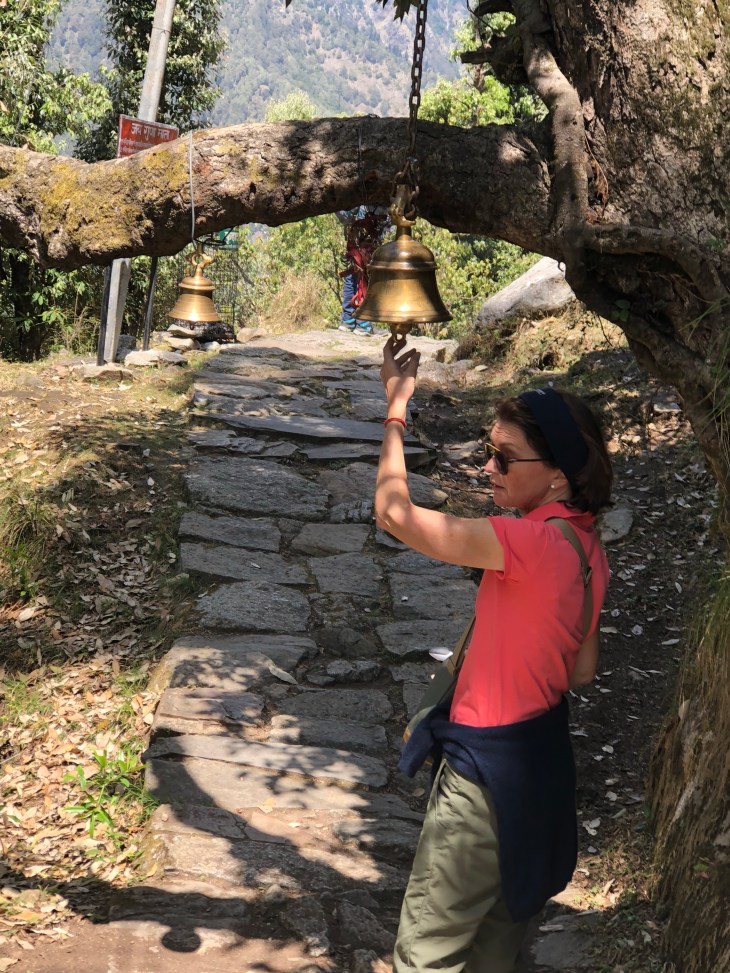
We went through a couple of gateways en route to the temple and donged the bell. There were tea sellers in the most unlikely of places, hoping to catch a passing pilgrim.

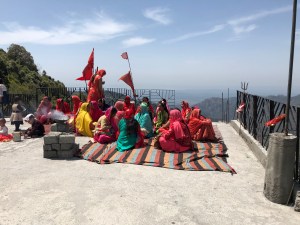
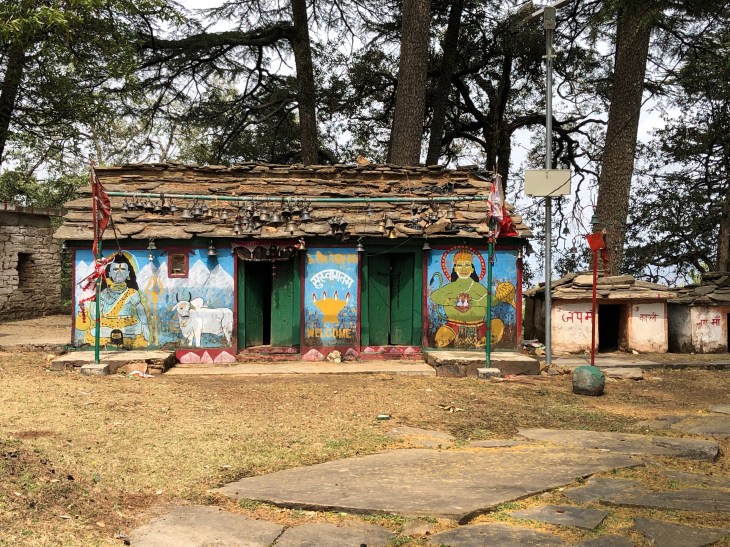
We climbed the baking 2000ft to Guna temple and watched Hindu ceremonies and ritual singing outside the shrine to Rudra, one of Shiva’s wife’s incarnations. Under a cloudless bright sky it was all very colourful and musical.

The views down to the plains stretched as far as the eye could see.

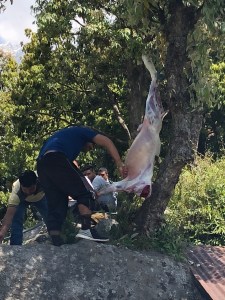
While Shapu was talking to me about his beliefs, Jeremy was taking photos. He had gone round the back of one of the buildings where a dead calf was being expertly skinned. Eek! We were not quite sure whether it was for consumption or sacrifice, but ironically, another cow was calmly observing the whole thing….!

Once we had finished soaking up the atmosphere, we headed nearly all the way down again and then cut across to Naddi, Shapu’s village. The sun was right overhead and our legs were beginning to feel it, picking their way down the stony track. It was a good thing we’d had an enormous breakfast. I became grateful for some of the longer distance cycling I have done when your mind takes you forward where your body tries to leave off! The marine training then came in (not that I’ve had any myself, I hasten to add!), when we arrived at Naddi expecting a sit down for some much needed refreshment, only to find that none had been arranged! We looked askance. Mercifully our guide took us in to his house, and offered a lemon and ginger tea and a bit later some chapatis and peanut butter – good fuel for the 600 ft ascent back to Eagles Nest!

While we were there I had the pleasure of meeting his little (3 year old?) niece. She was shy at first, but her little eyes flashed. We didn’t need much spoken language – we had the universal one of play!

All too soon it was time to get going again. The sun had already moved round so a different light followed us home. We were glad of the cooling shade of the pines as we neared the top, gasping.

We ate ravenously in front of the fire that evening and fell into bed full of thoughts and pictures of the whole day.

Trials of the Unexpected!

img_4740Friday 13th- Saturday 14th April
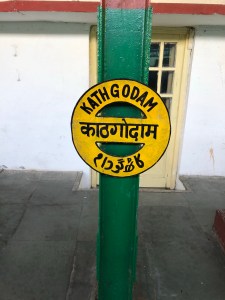
We left Mary Budden on the brightest of mornings… looked in on the women’s weaving project then continued a twisty descent for about 4.5 hours down to Kathgodam Station. It is a rail head before you get into the hills.

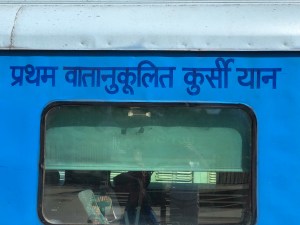
We arrived in good time and stood on the hot platform. The train was already there : the Shatabdi Express to Delhi – and we had seats booked in the Air Conditioned (AC) Executive car. AC car does not necessarily mean deluxe on Indian railways but this time it was very pleasant, with plenty of room to stuff baggage overhead. Best of all the loo was civilised, with a seat you could perch on and no view of the track whizzing past below.

I spent much of the journey time writing up the previous blog post, waiting patiently for pictures to upload, often to see them disappear again within minutes. Quite frustrating – but, progress in the end!

Six hours later we drew into Delhi at around 9.00pm. No sooner than the train had stopped, hordes of ‘coolies’ or porters, desperate to take peoples’ bags swarmed in. Jeremy rushed off and told me to stay put. The coolies prowled around surveying the suitcases while I resolutely stared the opposite way. Then Jeremy reappeared with a smartly dressed young man whom he’d arranged to come from the hotel and meet us off the train. The said young man then found himself in the midst of very aggressive argument over which of the coolies should be taking our bags. It got very close to a fight. Each coolie felt he had first reserve. It got so acrimonious that our man seized both the bags himself and marched on, with one of them following intimidatingly close. We steered clear and eventually the menacing pursuant slunk off. ‘Our man’ was quite brave I thought.

Traversing Delhi Railway Station was both scary and surreal – a seething mass of arms and legs, many belonging to people lying down anywhere on the platform awaiting their train. We picked our way through trying not to tread on anyone. I clung to my bag and Jeremy’s rucksack, head down. Suddenly, we popped out of a door into a small car park where another uniformed man greeted us and we were bundled in to the back of the hotel car. As if by magic we were then spirited away from the station madness to the very opposite extreme of an upmarket downtown hotel. As we drove away, Delhi seethed around us. The traffic was thick and chaotic. There were food sellers on every corner, right by the road.

Suddenly we found ourselves in the alternative universe of the hotel whilst still dressed like couple of hill walkers. It was getting late. I felt tired and awkward, as well as hungry. But with barely time to shower or change we still had to grab a bite to eat before getting up very early for our flight the next morning. We made our way up to the restaurant. The nice girl who greeted us also informed me I had the wrong kind of shoes on, (sandals) but that we looked tired so she’d let us in. Hm!!

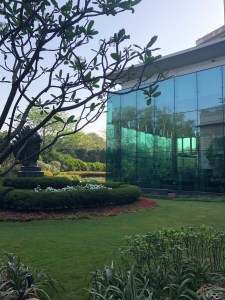
Only hours later it was time to get up, grab breakfast and get to the airport. Breakfasting in the beautifully planted gardens and being in such a ‘western’ style environment felt very alien. But we tucked in all the same!

***

The flight to Kangra, the airport for Dharamsala/McLeodganj, went smoothly and we were pleased to be met by a driver from Eagles Nest, our next destination above Daramkot. As we left the plains at 800m and started up towards McLeodganj it got more and more windy. We had another 1600m to get to 2400m (that’s just under 8000ft in old money).

McLeodganj itself was a tangle of impossibility – run through by the tiniest of streets, barely passable by one car, let alone two trying travel in opposite directions. Our driver seemed to be cutting a swathe through it all, although we did dip over into the gutter at one point, and nearly lost a hub cap. Tiny shops selling food, woollens, rucksacks and every conceivable bit of Tibetan memorabilia lined the streets. There were far more westerners in evidence than we’d seen so far as well as many red and orange robed Tibetan monks.

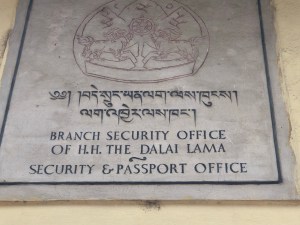
The residence of the Dalai Lama was close by and we had been advised he was to going be giving a rare audience to people from overseas in a couple of days time, so a great many had flocked to register for it – including ourselves! We inched out of the car at the Tibetan Secretariat to the Dalai Lama and joined a raggedy queue along with Americans, Italians, Spanish and many others, all dressed in drapey clothes and looking decidedly hipster, and some discussing yoga poses. Registration forms were handed out and then began a long sweaty wait in order to be officially registered for the audience. I felt painfully hungry. We advanced terribly slowly until we were queuing under a plastic roof in a semi enclosed space near what smelt like a kerosene container. The fumes were snaking into my lungs and I was starting to feel sick. I snuck out to breathe some ordinary air just wanting to forget the whole thing and crawl into the nearest cafe. But I went back, and after another age, and distracting myself by talking to some Italians, we were at last admitted to a small fusty office where two officials tapped our details into a computer and asked us questions – as well as taking a photograph. “Where are you from?” one of them asked Jeremy. “Birmingham” he said. “Ah, my mother lives in Birmingham!” Then there were questions about which football team he supported. Need I say more!

Emerging from the dark depths of the little office, my mind returned to food. But Jeremy was keen to get up to Eagles Nest. So we pressed on.

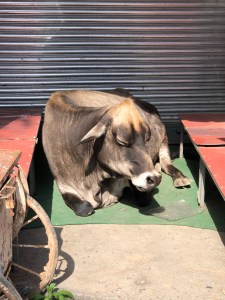
Words cannot describe just how steep and narrow and difficult it was to proceed out of McLeodganj. A true test of clutch control. It all seemed impossible: so many people walking randomly in the tiny space, cars driving at one another, and then the fun of manoeuvring round the occasional cow. Somehow, we pushed through. We were aiming for Daramkot and above.

If I had thought the road to Mary Budden was problematic, this one took the biscuit. The road soon turned into a rough unmade rocky track along which, again and impossibly, cars seemed to be moving. We sat in the back feeling like we on an even bigger bucking bronco than before. The issue of narrowness worsened. Our driver had a worrying tendency to steer to the left taking us to within a perilous hair’s breadth of the edge of a drop plunging thousands of feet. He did this while giving way to an on-coming vehicle and I literally said my prayers… Clearly, someone was listening, as very eventually we pulled up into a small patch of open ground, crammed with vehicles. We got out, feeling slightly shell shocked. Some porters appeared to take our bags and we did the last twenty minutes uphill on foot.

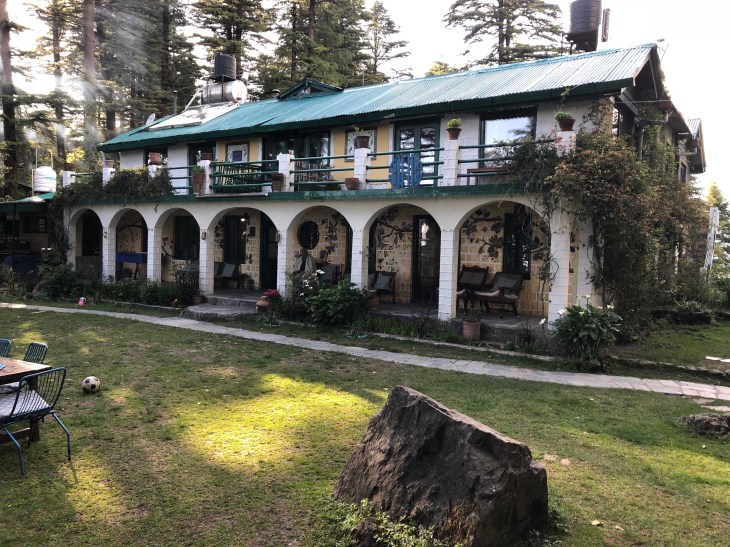
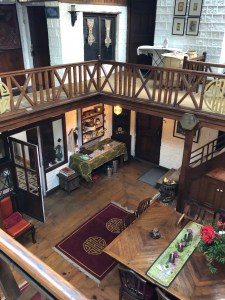
Patience was rewarded. A lovely old house awaited us and a room with views towards the mountains.

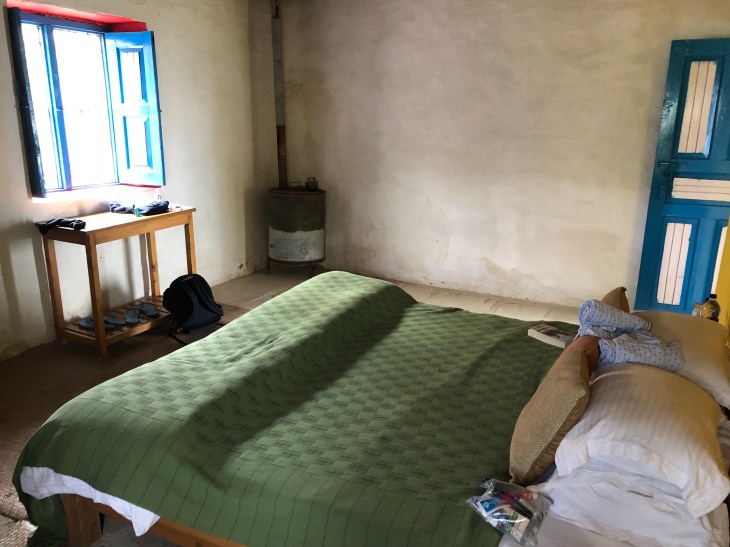
The house has a chalet feel with an upstairs gallery off which you access the bedrooms.

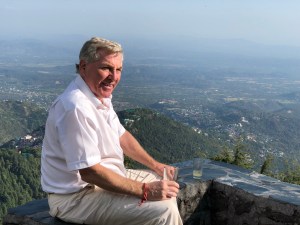
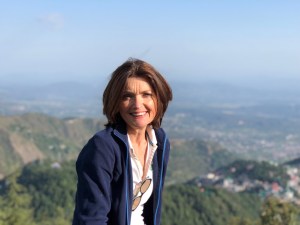
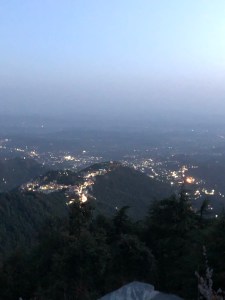
We were kindly invited to join Bo and Sheila, the owners, for a drink at Point. It’s a wonderful look out post on the property, with panoramic views down to McLeodganj and beyond. You just have to breathe in the view.

Here’s Jeremy having a go

and yours truly, feeling grateful to have got there.

Some friends of theirs joined us and we all relaxed considerably over a stiff drink. In the fading light, the views became magical, and we retired weary but thankful for dinner.

Back to Nature at Binsar

Mary Budden Estate

Tues 10th to Friday 13th April
It was still very dark. There had been a colossal thunderstorm the night before. From somewhere outside the cocoon of the duvet and all its dark encompassing warmth came the familiar ringtapping of the alarm. Oh no! Time to wrench myself from this delicious lair and tog up to catch the dawn, and, we desperately hoped, a glimpse of the Himalayas, roughly 70 miles away. Would we be lucky?

We had left the Itmenaan Estate only a couple of days ago although already it felt a world away. The journey, meant to have been two hours, had been winding and interminable. As we finally crossed the threshold of the Binsar Estate (a bird sanctuary area about 24kms from Almora if you are looking at the map) at roughly 2300m, I thought ‘great, we’re nearly here’. But no. For a further 7kms, the last two of which were on unmade roads, it was another endless twist and wind up an increasingly steep incline. Pine trees gave way to ancient oak forests as we ascended. The single track road got narrower and narrower, and the contours ever tighter and more serpentine, until the slackening of my jaw at the steep drops below became entirely involuntary. Gaping like a fish I simply could not believe this was a real route. On and on we went, until at last we arrived, rumpled but relieved at our destination: Rhododendron Cottage on the Mary Budden Estate. http://www.marybuddenestate.in/history.html

Full of beguiling charm and aplomb we were greeted by Rudolph, the manager, who showed us to our quarters. More jaw slackening followed as it dawned on us that we had the whole building to ourselves, and a broad terrace to boot, overlooking the forests below. Not only this but we were the only guests, with local village staff there to look after us. When we had booked online, we had not appreciated the full extent of the accommodation. Suppressing squeals of amazement we contented ourselves with sneaking a few photographs.

The first day, we spent on a couple of walks. The first of those, during a cold but sunny morning, was with Deepak Joshi, an expert naturalist, who indicated a great many birds and plant species to us. It was like going to school, learning to use your eyes and ears properly for the first time.

For those readers botanically minded we were introduced to:

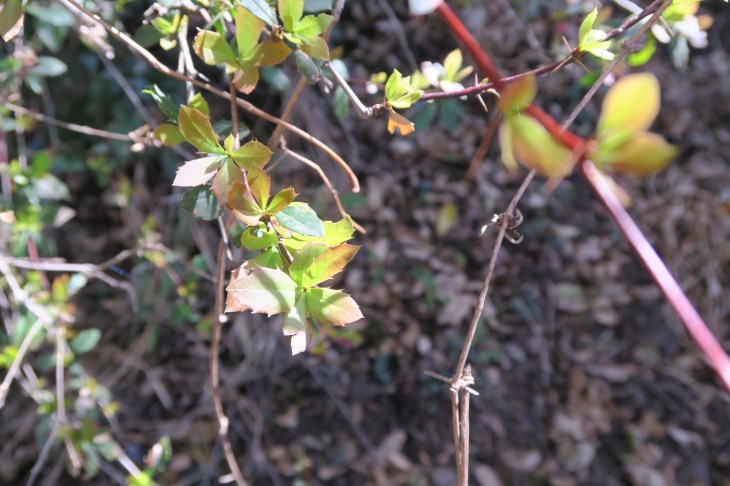
Berberis Vulgaris – which Deepak informed us was used to treat eye infections

Thalictrum – with its small blue green leaf

Turmeric – the root of which he dug out from the earth under a tree, often used as an anti inflammatory

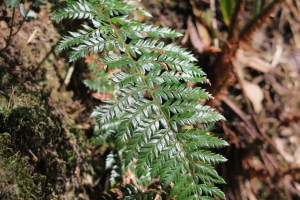
Pallistacum (fern)

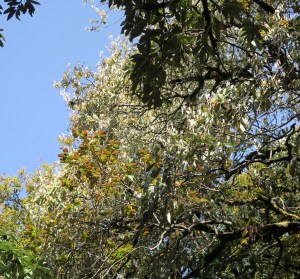
Quercus Incana – a beautiful silvery leafed oak, prevalent throughout the bird sanctuary.

Quercus Floribunda – another of the many varieties of oak growing up there above the pine belt

Chinese bamboo – tall thin and spidery, and used for basket weaving

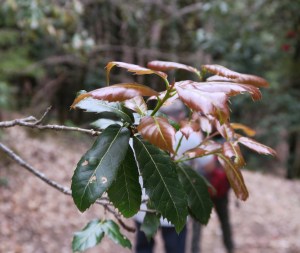
A Lilac with its young red leaves

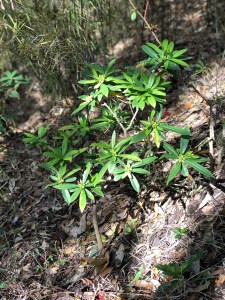
Daphne bushes still in bud (one of my favourites back home for its soft scent)

The ‘elephant eared’ Begonia, which Deepak called ‘pata chacha’, known for its ability to break down gallstones!! (His father had survived his by using this remedy).

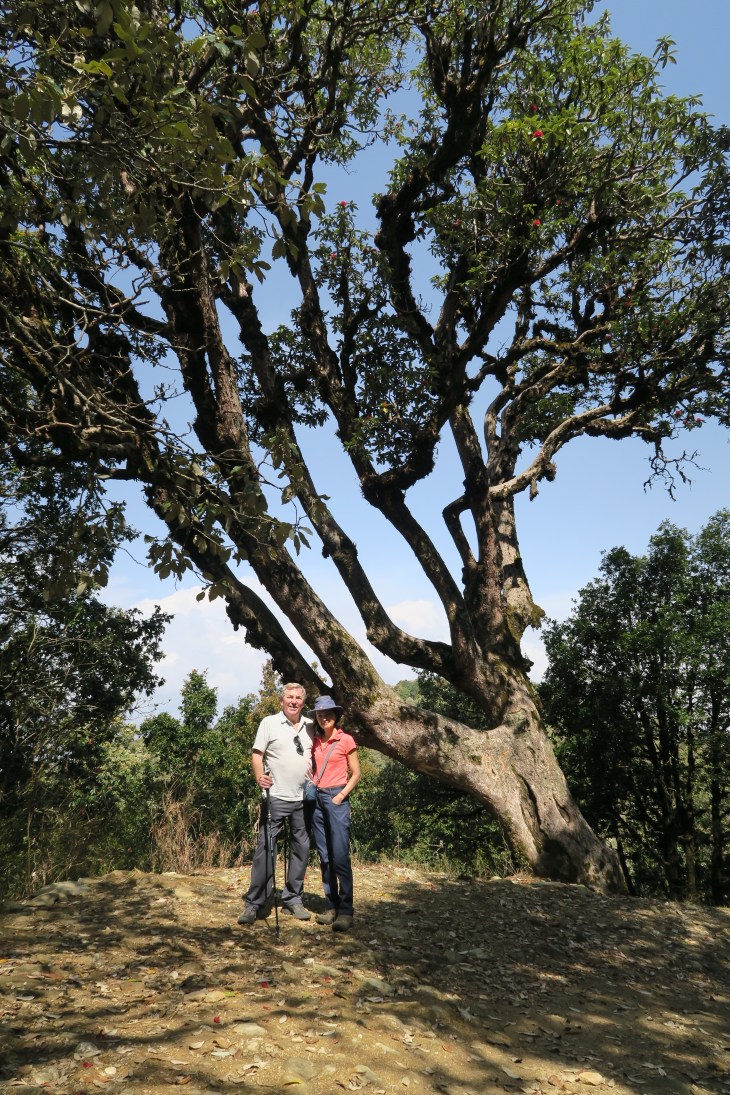
And the pièces de resistance – a 300 year old oak and a two hundred year old Rhododendron. See below!

There was also the beautiful pale tall cedar tree or ‘deodar’ growing in abundance.

Deepak showed us more plant species too numerous to mention or illustrate here, but these were intermingled with ear training.. we learnt to listen for:

  • The calls of the hoopoe (which sound like a resonant version of its name: hoopoo, hoopoo)
  • The cuckoo
  • White bellied blue flycatcher
  • Rufus silvia (a descending slightly plaintive little sound)
  • The barbet (he gets around)
  • A multitude of warblers and tits
  • The gritty notes of the Laughing Thrush
  • The tappy woodpecker
  • The rhythmic and gentle ‘toot tootoot- toot tootoot, of a small collared owl

It was a plethora of new music. Strangely after only a couple of days, I found myself better able to hear the birds than spot them. Jeremy did rather better on the sightings than I did, possibly a hawk in a previous incarnation?!

The sun had shone but it was quite cool.

Shortly after returning for lunch the heavens opened and we hunkered down by the fire.

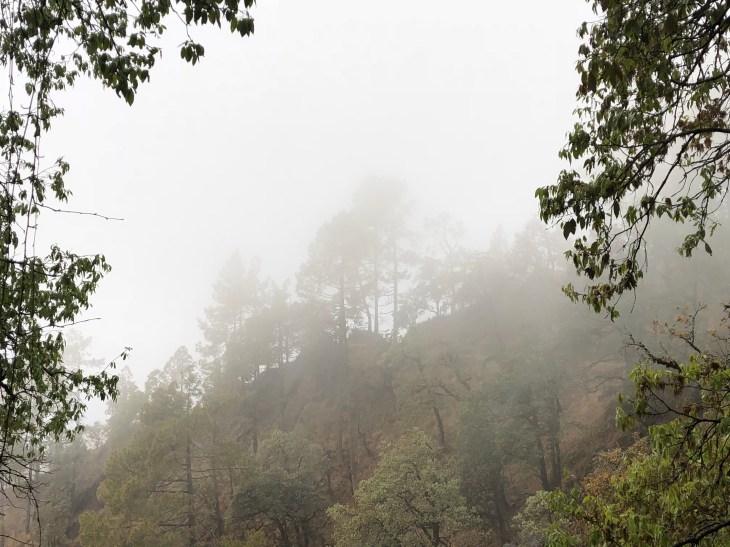
Later that afternoon, we set forth with Deepak again, and Rudolf joined us. This time it became more and more ethereal – the pathway being overhung by the ancient cloud soaked oaks, their twisted mossy trunks standing motionless and wizard-like in the misty damp. Rudolf and I were laggards, getting the camera out at every opportunity. That’s his camera by the way not mine!

There was so much to take in

Once it became too wet to proceed we dashed back to the house and gave in to tea and cake.

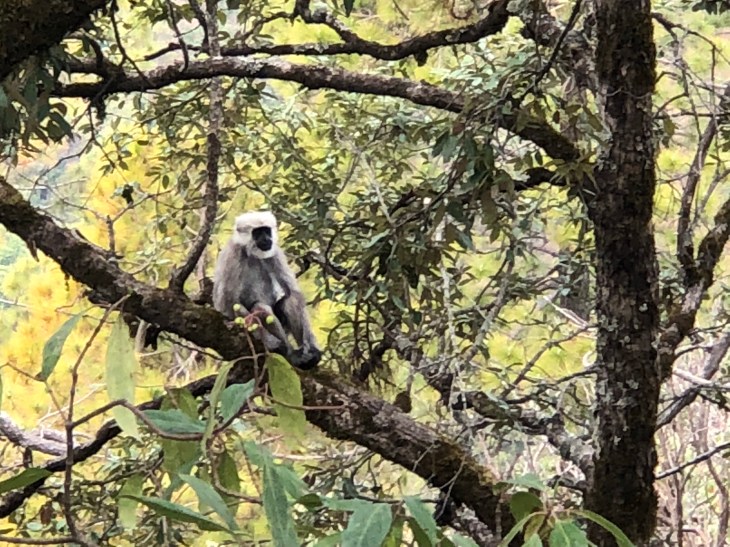
Mary Budden lies in 47 square kms of protected woodland, the Binsar Estate, at roughly 2300 and 2412m at the highest peak, confusingly called Zero Point. Pines give way to oak and deciduous forest housing a rich and varied bird population, 22 leopard, porcupine and wild boar. Living there too are barking deer and the silver coated langur, who swing effortlessly through the branches.

The buildings we were staying in were once the site of an orphanage run by the redoubtable Mary Budden, unmarried daughter of a pastor, known for her many good works in the late 1800’s.

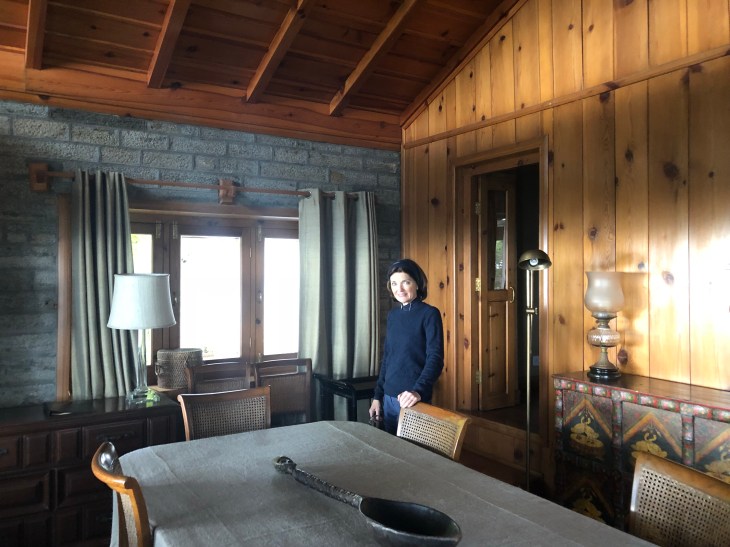
I loved the warm wood feel of the house, the perfect spot from which to write a book. The current owner has done exactly that. I must reserve some time there!

Returning to that duvet…

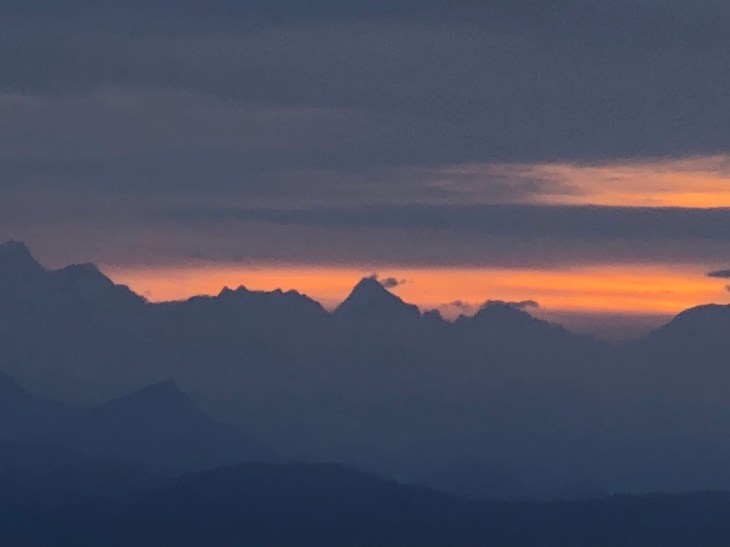
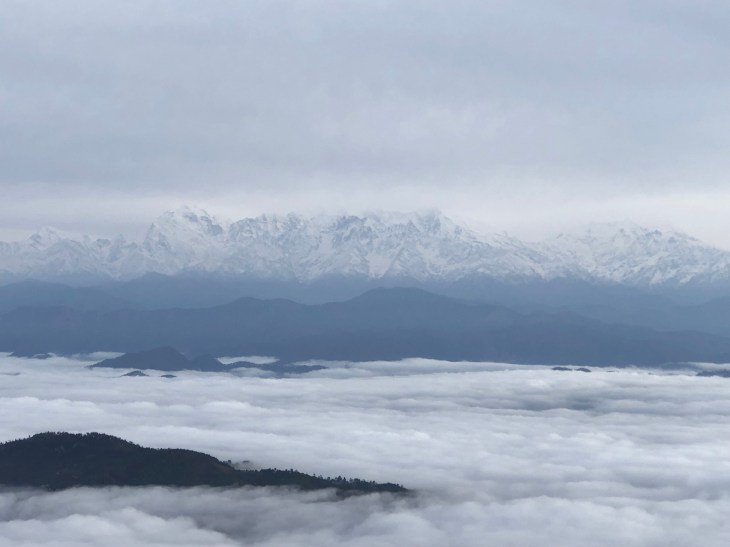
It was day two of our visit. We had been told that if you could see twinkly lights across the valley and the stars at 4.45am, you stood a chance of seeing the Himalayas lit up by the dawn sun. This not only involved a very early get up but a stiff march up to the look out tower at Zero Point. It had to be done. Grabbing coats and walking poles we stomped up in the dark through the steep leafy paths, torches in hand. Breathless at the top, it was time to look and marvel. There was a breathtaking view across miles of puffy cloud way below us, through which hill tops protruded like dormant whales.

Then slowly in the distance, the silhouette of significantly higher mountains could be seen.

It was an awesome sight.

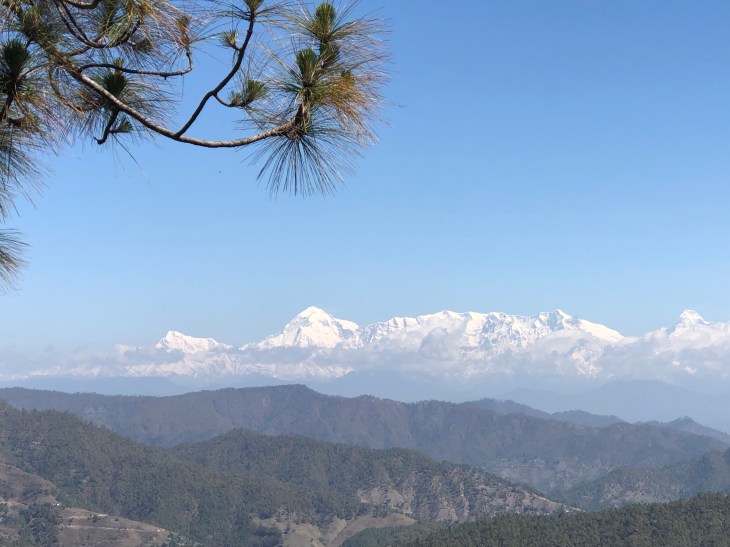
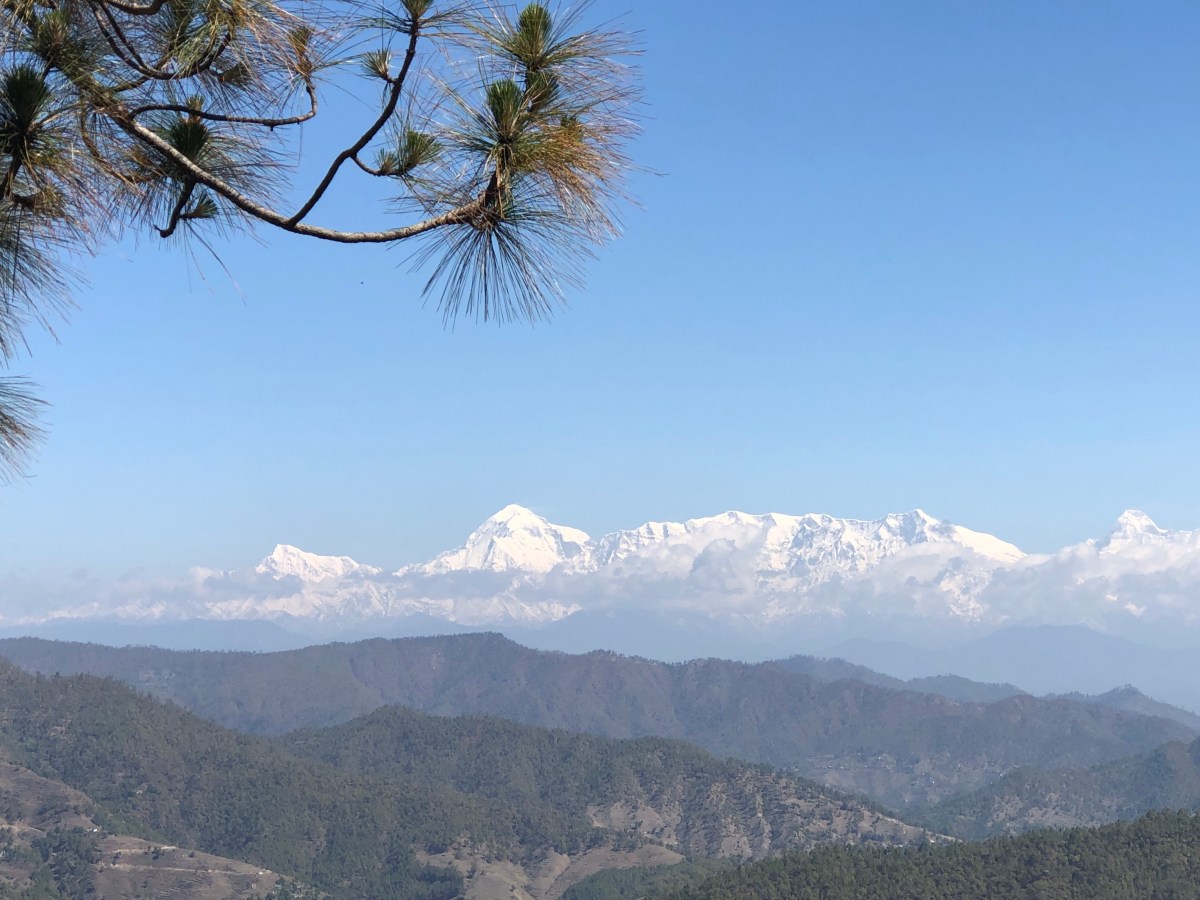
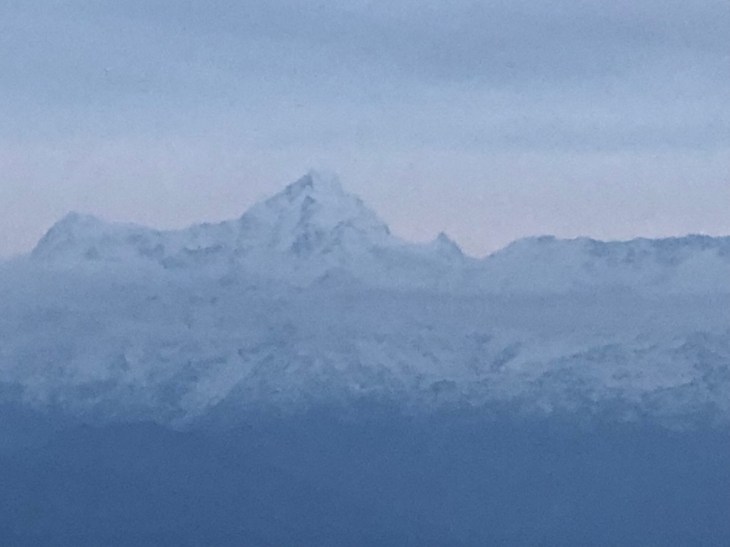
It wasn’t completely clear but we could see Nanda Devi, (above) the highest peak of the Indian Himalaya at over 7,800m, looking cold and magnificent.

The higher the sun rose the more the mountains crept back into obscurity but the warmth was also very welcome

On return we wolfed a hearty breakfast, washed down by lashings of coffee.

Then, as if the legs hadn’t already been pressed sufficiently into action, Deepak arrived to take us for a wild day’s walk through the woods, dropping down 600m (2000ft) to his house.

Having been so cold early on, the sun now beat down fiercely, involving a certain amount of undressing.

Wild walk? It was for me. We started gently along the road, before swinging up hill through the woods. Thereafter we started to push along some extremely narrow overgrown paths, with little between the edge and a very long drop (1000ft). I tried to focus. Don’t look down, stop obsessing about slipping and just do the next steps, I told myself. I felt like a cat, reluctant to step on the ice. Eventually this section came to an end, no barking deer spotted, and we rejoined the road. A troop of langur monkeys was having great fun ‘hanging around’ at one corner, and Jeremy got some good footage!

Blood pressure was just returning to normal when we swung off the road once more to ascend a pine crested ridge. To my horror, more narrow steepening precipitous paths had to be negotiated, with Deepak on one occasion inviting us to stop at the narrowest point to look up at an eagle. I just hung on to my pole. We then proceeded to a delightful plateau before dropping down even further via the tiniest twisty paths. There were moments when I felt my throat constrict with humiliation, finding it hard not to fear a mistaken placement of my foot and a terrifying plunge to the bottom, punctuated by tree trunks, but I didn’t need to say much and Deepak took my hand firmly along the tricky bits. He was very kind and reassuring. “Nothing to fear”, he said. “People carry heavy loads along here..” “Hmm., not so sure about that!” I thought back. But he was marvellous and we arrived safely at Deepak’s house in the warm sun, to be introduced to his beautiful wife and two very young daughters.

He showed us round his well tended garden and the varied crops he was growing whilst holding his older daughter on one arm and speaking gently to her in a mixture of Hindi and English. She was incredibly cute. It was a privilege to be welcomed to his home located in a remote village with probably only twenty other dwellings.

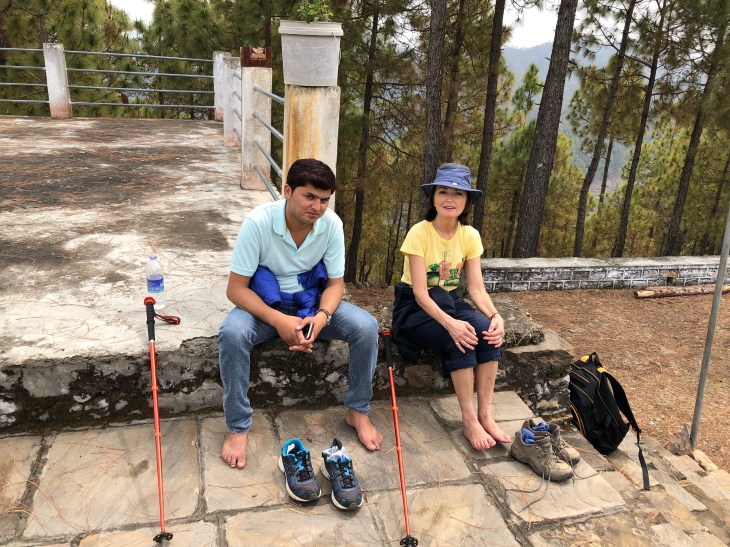
After a reviving cup of ginger black tea we walked on to another village house, also part of Mary Budden, for some lunch outside. This was a blissful picnic of paneer and peas, raita, lovely potato paratha and.. some magic chutney. (See an earlier blog post!!) More wolfing. Drunk with relaxation, we lazed in the sun, removing our hot boots and just revelling in the beauty of the scene, staring up at the trees, outlined against a deep blue sky. Deepak and I chatted while Jeremy sat higher up, surveying the scene. D said how much he loved his wife, his work and his life. He didn’t go for the crowds and crush of the city. In my heart I agreed with him.

We were spared the entire walk back, and after ascending so far were met by a jeep, which ferried us all back to Mary Budden. This was almost another adventure in itself. The driver was lean and skilled, knowing exactly where each pot hole lay and how to get past the great piles of hard core encroaching into the road.

The usual afternoon storm followed but we were just glad to be back, having had another rewarding day.

*******

Post Script

The morning of Friday 13th dawned. It was hot. The season suddenly seemed to have changed. It was time to bid a reluctant farewell to Mary Budden and make the long trek by car to Kathgodam and on to Delhi on the Shatabdi Express.

I was very sad to leave – a bit of my soul having found a place there.

But on descending from the Estate, what should we see but this:

Nanda Devi in all her glory.

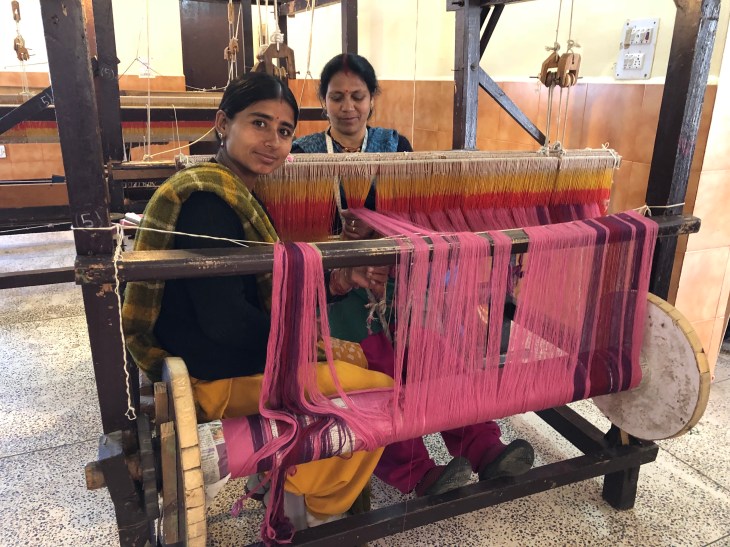
Shortly afterwards we stopped off at this wonderful Women’s Weaving Project, remerging a little later impressed by the friendly industry which was supporting all the women there.

I thought about the timeless mountain under whose shadow these women practised their ancient craft. Beauty next to beauty.

Fathoming the Faiths

Jeremy (leader of Stoke Tours) has been looking at the various faiths we are encountering and trying to work out just what some of the basic tenets and origins are. Here is his guest blog post:

As Phylli has been keeping her loyal readership informed of her observations on our daily interaction with India, a number of wider questions have bubbled to the surface, which are probably better treated outside her normal blog:

1. Are Hindus an ethnic group?

2. Is Hinduism a religion or mythology? How many gods do they have?

3. Where does Yoga fit in?

4. Did Buddhism precede or proceed Hinduism?

5. What is Jainism?

6. Are the Sikhs an ethnic group or a religion?

7. After Partition in 1947, did any Muslims remain in India?

As Phylli’s readership is so intelligent, well read, knowledgeable and avidly inquisitorial on their holidays (!) I am sure they will all know the answers to these questions. However, for the few like me, who do not (or would like to mark my humble and more than likely inaccurate précis below with a red pen), please read on!

Today, I am going to try to cover the basics of Hinduism in no more than 5 pages!! Interspersed over the next 4 weeks, I will try to address the other questions in a similar fashion (plus any other philosophical questions our readers would like to raise while we are here!!)

HINDUISM

Firstly, the word Hindu is derived from the Sanskrit word ‘Sindhu’ – defining peoples from beyond the Indus River in N.W.India (now Pakistan). Hence, the early name of Hindustan for India – the land of the Hindu people. However, this covered a huge multitude of ethnic groups of people and tribes.

My summary is that Hinduism is more a way of life than a religion (as we understand religion in the West). It is a fusion or synthesis of various Indian cultures and traditions, dating back about 4000 years, as these key features demonstrate:

  1. No founder
  2. No supreme ecclesiastical authority
  3. No head of church, with the authority to define belief or establish official practices
  4. No one single book laying down the rules, like the Bible or the Koran

Hinduism, therefore, has had the unique ability to assimilate other faiths rather than oppose them. According to the great Indian philosopher and former president of India, S.Radhakrishnan, religion for the Hindhu “ is not an idea but a power, not an intellectual proposition but a life conviction. Religion is consciousness of ultimate reality, not a theory about God”.

Hindu concepts and ideas:

The origins of the central philosophical concepts, ideas and teachings that would develop into what we now understand as Hinduism are to be found in the sanskrit Vedas and Upanishads, dating orally from around 1000 – 200 BC.

Most Hindus believe in 4 major human goals:

  1. ‘Dharma’ – the ethics and duties of your position in life
  2. ‘Artha’ – material prosperity
  3. ‘Kama’ – the satisfaction of desires/passions
  4. ‘Moksha’ – liberation/freedom/salvation (later also known as Nirvana)

Hindus believe in the cycle of rebirth (‘Samsara’) until we break that cycle and achieve liberation to Moksha/Nirvana. Central to the idea of liberation is the concept of ‘Atman’ – individual self/soul and ‘Karma’ – “the effect of actions (thought, word or deed) in a former life”.

We are prevented from reaching Moksha due to ‘Maya’ (temptations) of wealth, property, jealousy, hatred etc. Most major schools of Indian philosophy have devoted most of their attention on how to avoid Maya and seek Moksha. One of the best known is Yoga (and many others not covered here).

Yoga can be traced back to 3rd century AD. It seeks a synthesis of the spirit, the soul and the flesh – a union of mind and body. It is concerned with systems of meditation and self denial that leads to the realisation of oneself and can ultimately release one from the cycle of rebirth. In one text I read, Hindus believe that one needs to achieve 52 million rebirths before one becomes human and therefore, our time as a human should not be wasted!! Wise words.

Hindu Gods or Deities

It is said that Hinduism has as many Gods as you want to believe in! The major sanskrit works : the Ramayana and the Mahabharata (started around the 5th – 3rd century BC but not completed for another 500 – 700 years) tell of many mythological stories, including most of the revered Hindu Gods and their offspring.

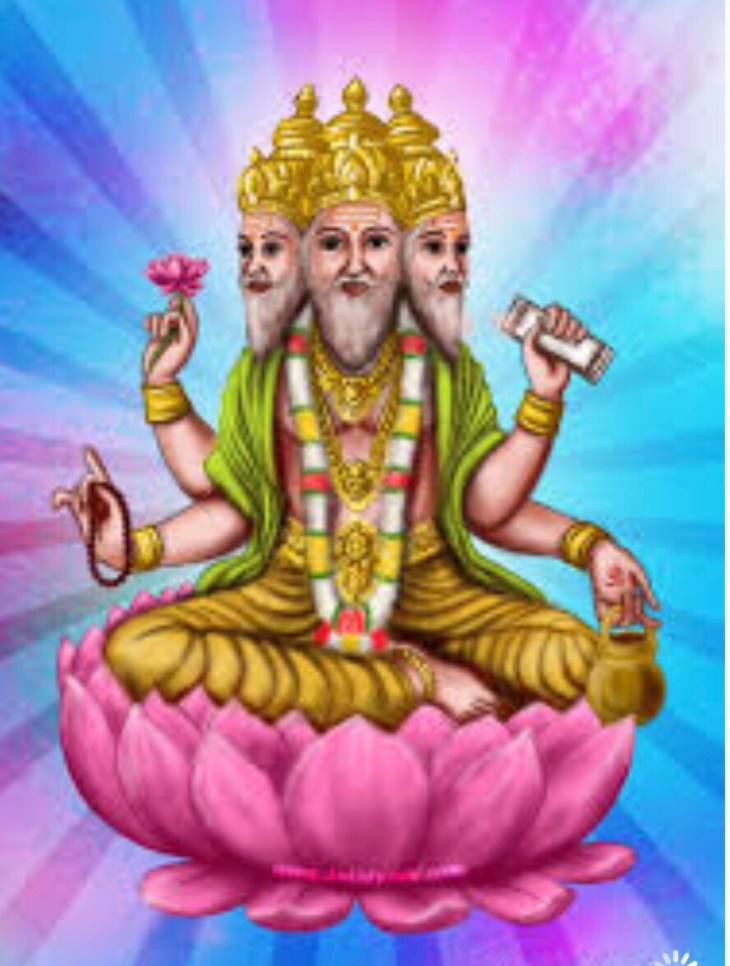
Central to all Hindu thinking is the concept of Brahman (not to be confused with the Brahmin caste – see later) – the omnipresent cosmic power – the supreme soul of the universe. All things emanate from it and all things return to it. Each human being carries within him a part of this eternal soul ie our ‘atman’. As it is difficult to relate to an identity that doesn’t have form, the Brahman has been divided into 3 phases of existence :

  1. Brahma – God of Creation. Consort : Saraswati (knowledge)
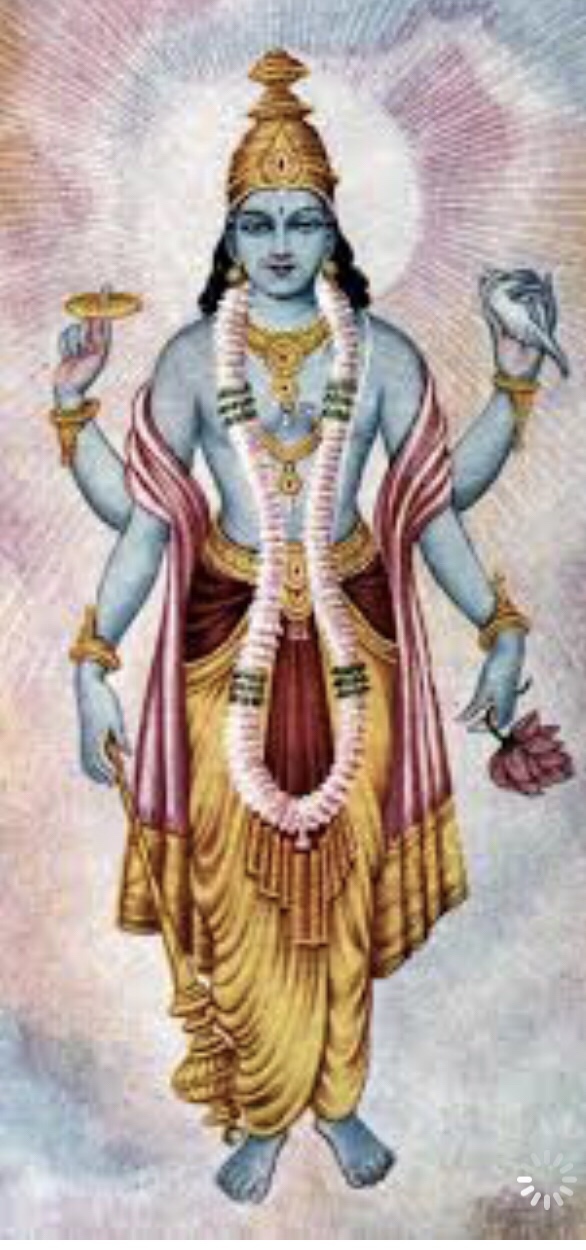
  2. Vishnu – God of Preservation. Consorts : Prithvi (earth) and Lakshmi (wealth)
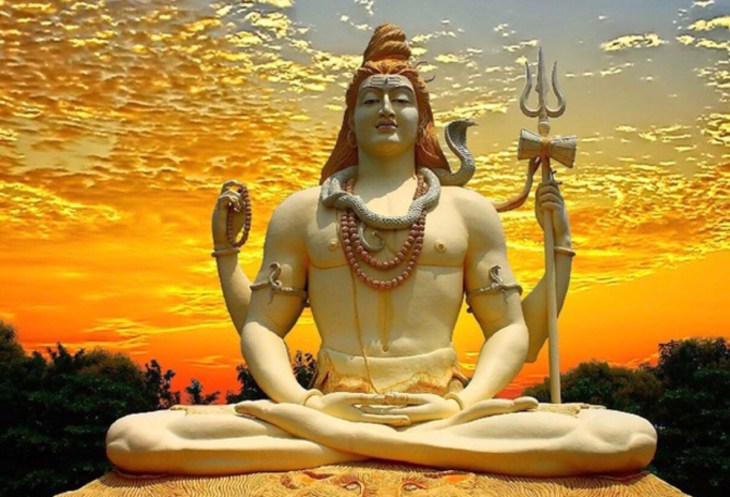
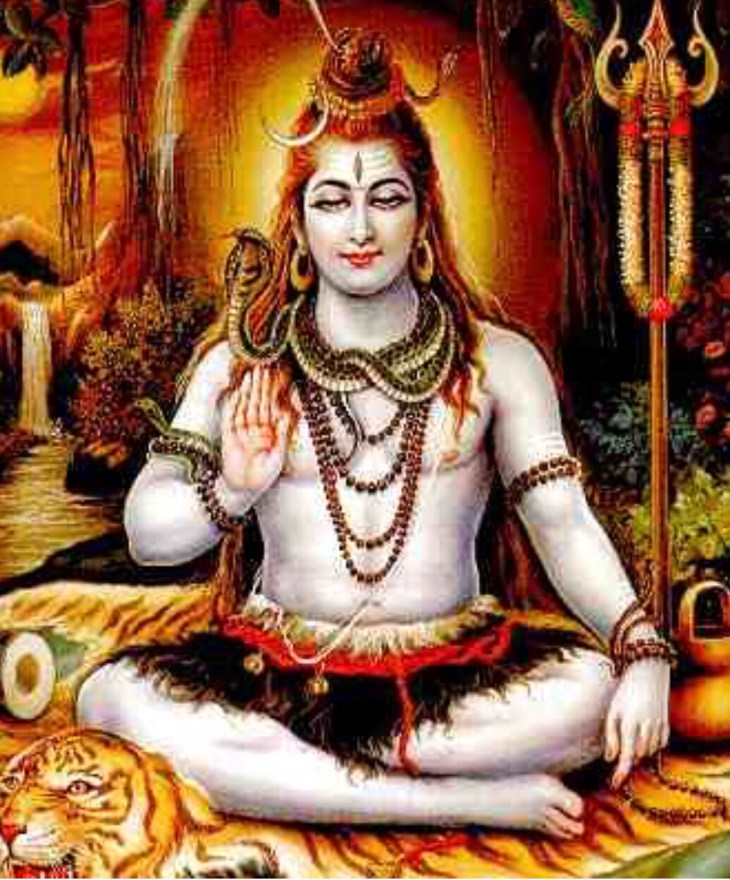
  3. Shiva – God of Destruction. Consort : Parvati (cosmic energy)

Vishnu (also known as Narayan) has been reincarnated 9 times and so has different temples dedicated to the various incarnations : Matsaya (the fish), Kumar (the tortoise), Varaha (the boar), Narasimha (half man, half lion), Vamana (the dwarf), Parshurama (the axe-bearing ram), Rama (in human form), Krishna (also human form) and Buddha. He is expected a 10th time as Kalki. Perhaps best known are Rama and Krishna.

It may surprise some readers to find Buddha in the list. As stated earlier, Hinduism has had the ability to assimilate other religions, so some scholars belief this inclusion of Buddha is a cunning ploy to retain followers of Buddha within the Hindu family.

Shiva is characterised by powerful attributes in many different guises (Parvati, his consort too, in many guises).

As Rudra – he is the destroyer. As Shiva, he is the reproductive power that continuously restores what has been destroyed. The symbol of creation is the lingam (phallus), while the female organ (yoni) represents the female energy of Shakti, often worship in female form as Durga or Kali

[Note : there is much worship of female gods that led to the development of Tantric practices, which may be covered in a later blog unless deleted by the editor!!]

A couple of important deities emanating from Shiva are :

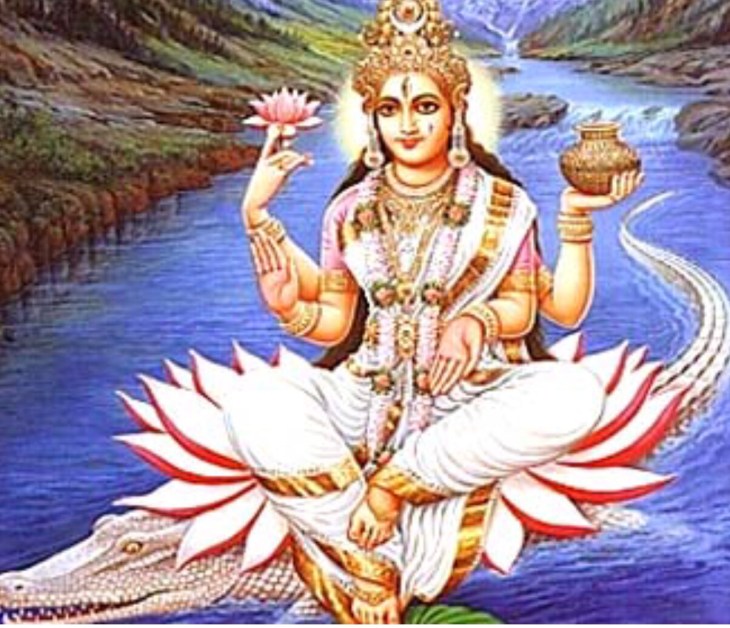
(1) Ganga (the river goddess who is celebrated at evening Aarti), who fell out of heaven to earth and whose fall was broken by falling on Shiva’s tresses.

(2) Ganesha – born to Shiva and Parvati but with an elephant’s head (one of our yachts chartered on flotilla was called Ganesha)

From very early times, anything that had an influence on peoples’ lives was venerated, so there a many other gods:

1. Indra (the rain god)

2. Chandra (the moon god)

3. Surya (the sun god). And for Archers fans, his wife Usha – goddess of dawn, daughter of heaven and sister of the night

4. Agni (god of fire)

5. Pavan (god of wind)

6. Hanuman (son of Pavan) – known for his strength and ability to fly

[That’s enough on Gods, thanks – Ed]

The Caste System

This summary of Hinduism wouldn’t be complete without a brief description of the caste system. Unique to Hinduism. It can be traced back to the early stages of their civilisation. Originally based on the colour of ones skin! The fair skinned Aryans had conquered the dark skinned Dravidians and as society began to develop 4000 years ago it was divided into 4 sections:

1. Brahmins – priests and teachers

2. Kshatriayas – Warrior caste, maintaining law and order

3. Vaishyas – Traders

4. Shudras – Cleaning and sanitation, living on the outskirts of the village

We also know this last caste as the Untouchables, the Dalits or as Mahatma Gandi called them – Hariyans (God’s people).

The caste system has remained deeply embedded in Indian society until the last 40 years. The Indian Constitution (post 1947) makes it illegal to discriminate against a person on the basis of their colour or caste. In the metropolitan centres it is certainly dying out, but I am told still has a strong hold in village life where more than 75% of Indians still live.

There is no doubt that nearly all those we have met and seen regard Hinduism is both a way of life as well as a religion and it is evidently widely practised.

How that fits in with the continuing caste system, worshipping multiple gods and idols, as well as the other major faiths in India – Muslims, Sikhs, Christians and other sects – will attempt to be covered over the next 4 weeks.

JMS

Written at Jim’s Jungle Retreat, Ramnagar. 5th April 2018

A Short Walk through the Village Hush

Sunday 8th April
Got it all?” asked Jeremy

“Hope so…”

Today we were leaving the familiar Deodar Cottage for a taste of something simpler. Ramming a couple of days’ gear into smaller bags, (not forgetting our poles) we bundled them into the back of the car and set off to be shown a temple high up near our destination, Thikalna Cottage. It was an extremely twisty forested climb; our driver, Raju taking it very carefully.

The weather was a slight concern. Following the storms of last night and wet forecast how much walking could we sensibly achieve? It showered ominously en route. But Jeremy kept saying “look, blue sky!” (ever the optimist). The Temple proved to be one of the oldest – 2000 years – dedicated to Lord Shiva, who was said to have meditated here aeons ago.

It was dank and cold when Jeremy entered in, but he found three Saddus living inside, one of whom extracted INR20 from him in exchange for a piece of string round his wrist and dab of coloured dye (tilak) on his forehead. After a quick look round we took a walk along the high road to a tea house, had chai and biscuits, and then began our descent on foot to Thikalna, a small village house, where we were to spend the night.

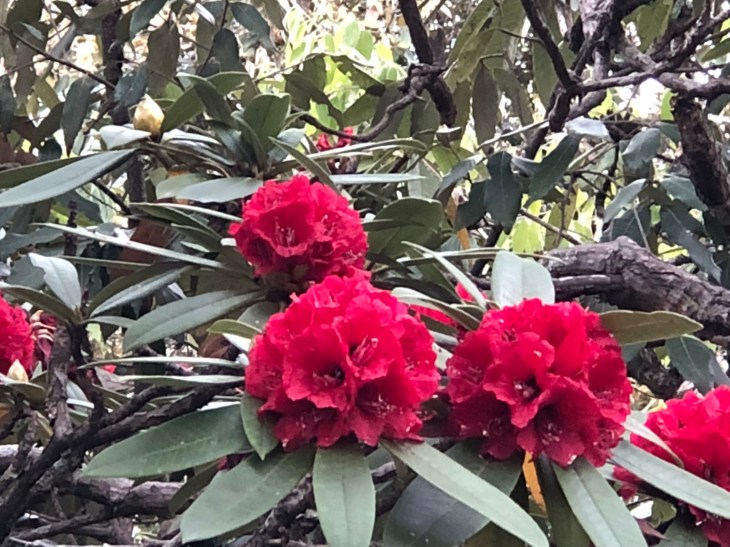
The walk was only three kilometres or so, along a sandy track and through the forest. Enormous old rhododendrons lined the way, red petals scattered like confetti amongst the leaves.

The red blooms from which they fell popped out like traffic lights amongst so many greens.

Jeremy’s earlier optimism must have influenced conditions because the rain held off and after what seemed like no time at all we arrived.

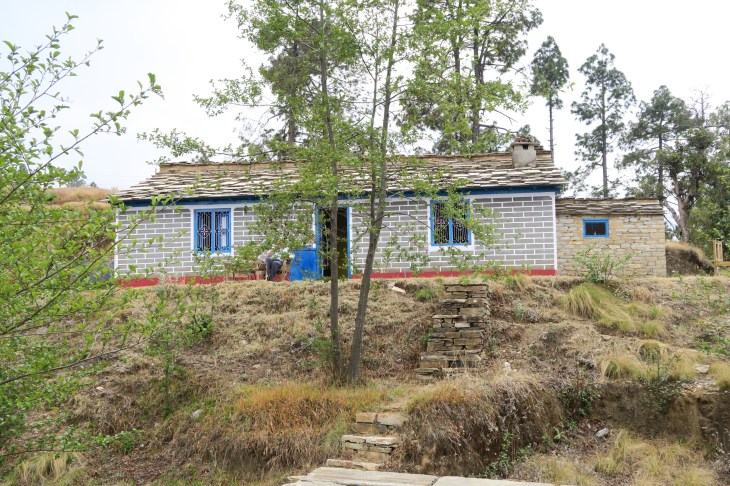
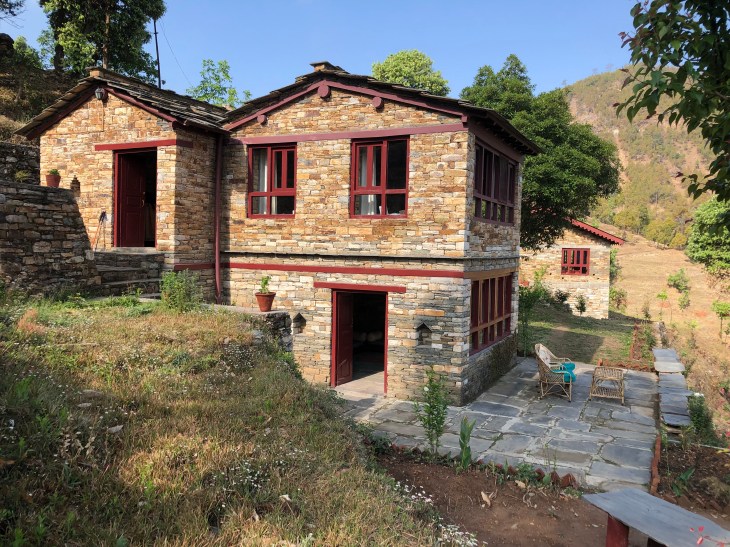
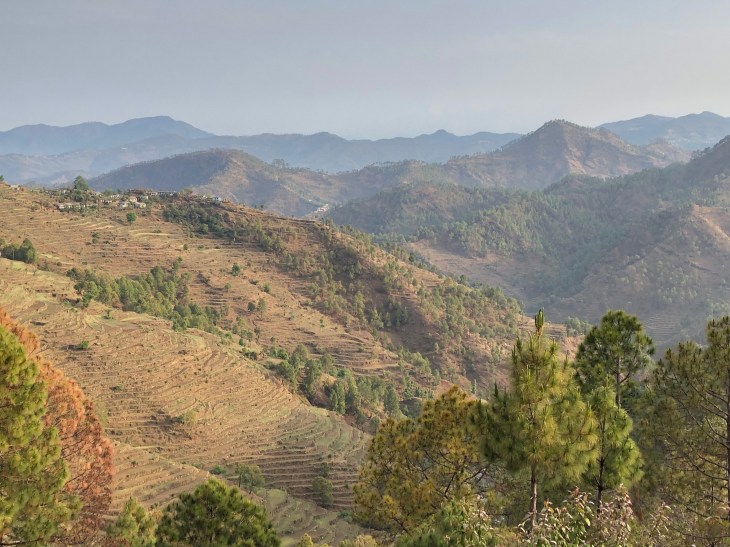
Thikalna village house perches on a hilly outcrop. It has panoramic views of terraced or wooded hillsides, plunging thousands of feet below.

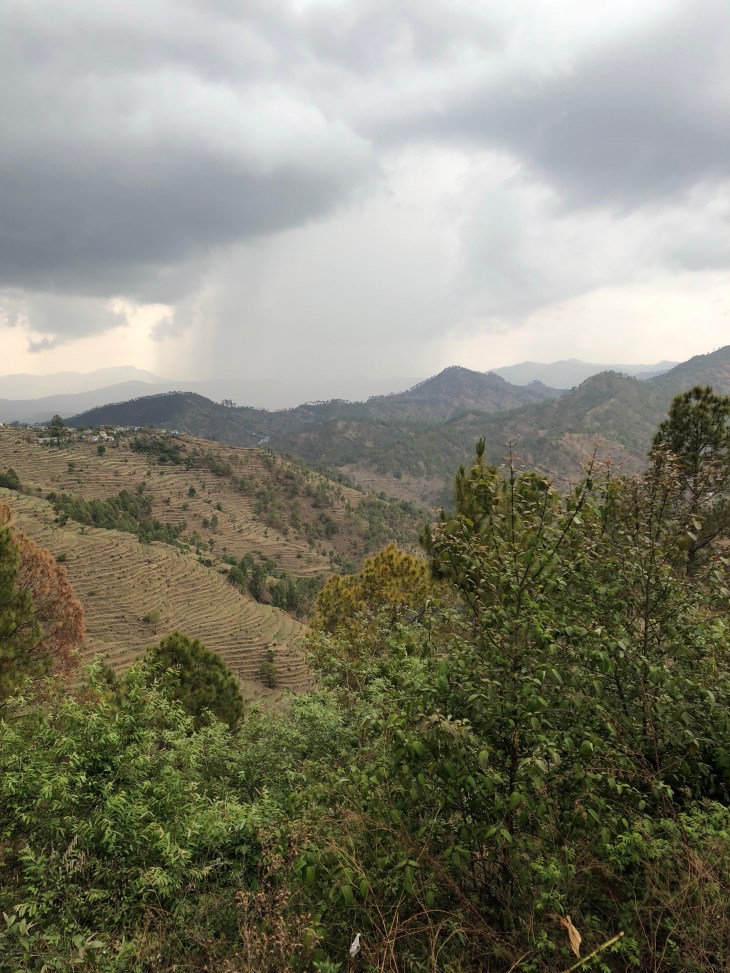
Looking at the terraces they suddenly reminded me of the ridges of rippled sand you sometimes see, left behind by an ebbing tide. We couldn’t see Nanda Devi (7000m) or Panchuli, (4,500m) two of the great neighbouring Himalayan peaks, thanks to the drifting cloud. But there was plenty else to take in!

We were served a welcome lunch outside and then treated to a warm afternoon sun. I took my hat off, and basked. Bliss… We both lazed, slit eyed, like a couple of well fed cats.

Eventually we stirred and took a walk on our own. We peeled up another wooded track. Gazing at the dappled light dancing through the trees and the flaming rhodies, and feeling the soft air around all us, together with the music of barbet calls, cuckoos, kukuan, and busy woodpeckers, it felt like walking through a sound painting, touching every sense.

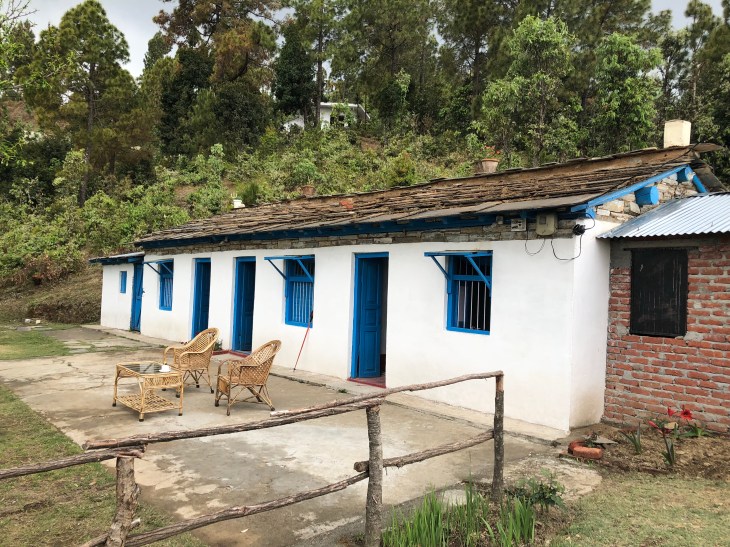
The accommodation at Thikalna is very simple: no hot water and no electricity, so gives a proper sense of being ‘away’.

The showering arrangements!

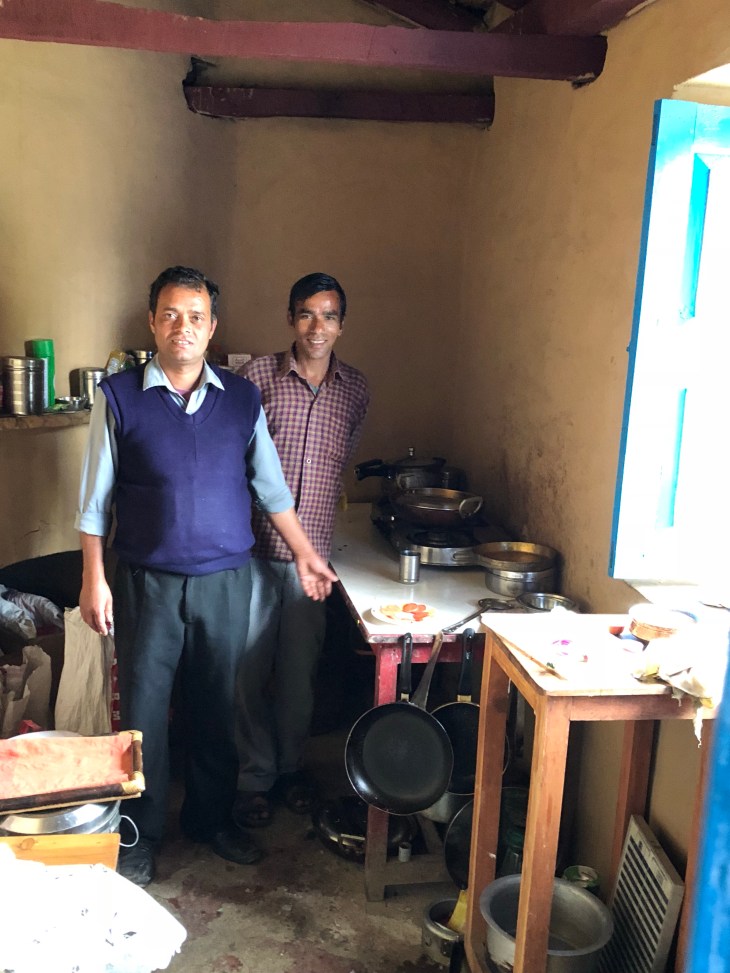
We were looked after by these two in the tiny kitchen, our very own good chefs, who produced a mean egg curry, on arrival!

Back from our walk we were just having a cup of black tea, when Amit came across and pointed out the triangular white peak of Panchachuli just peeping out in the far distance above the highest clouds. So high it was dramatic – giving a breathtaking glimpse of Himalayan majesty. We scampered up the bank to try and take photos of it, but they do it little justice. This peak is over 70 miles away.

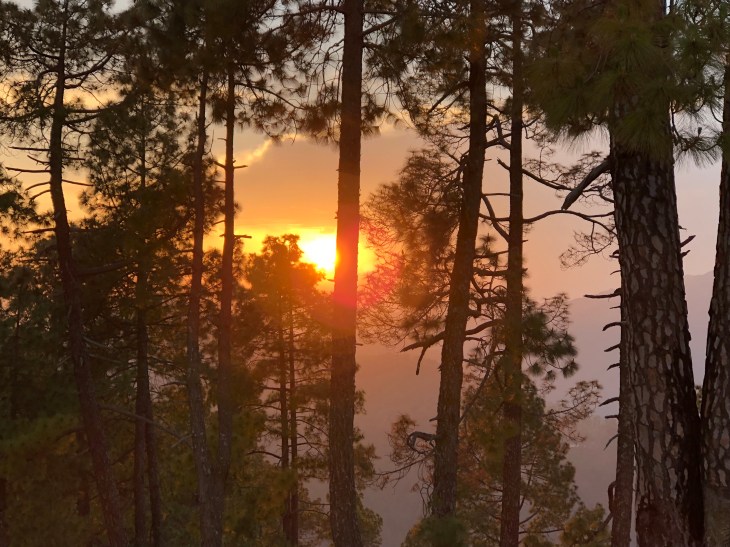
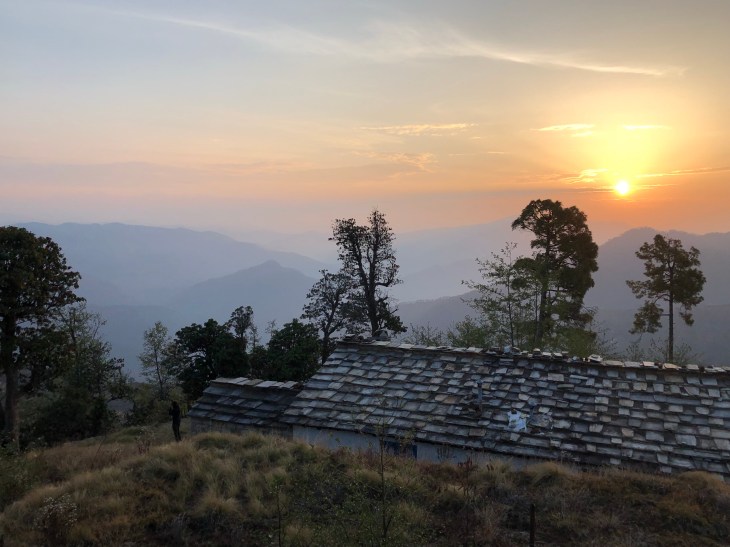
A spectacular sunset closed the day,

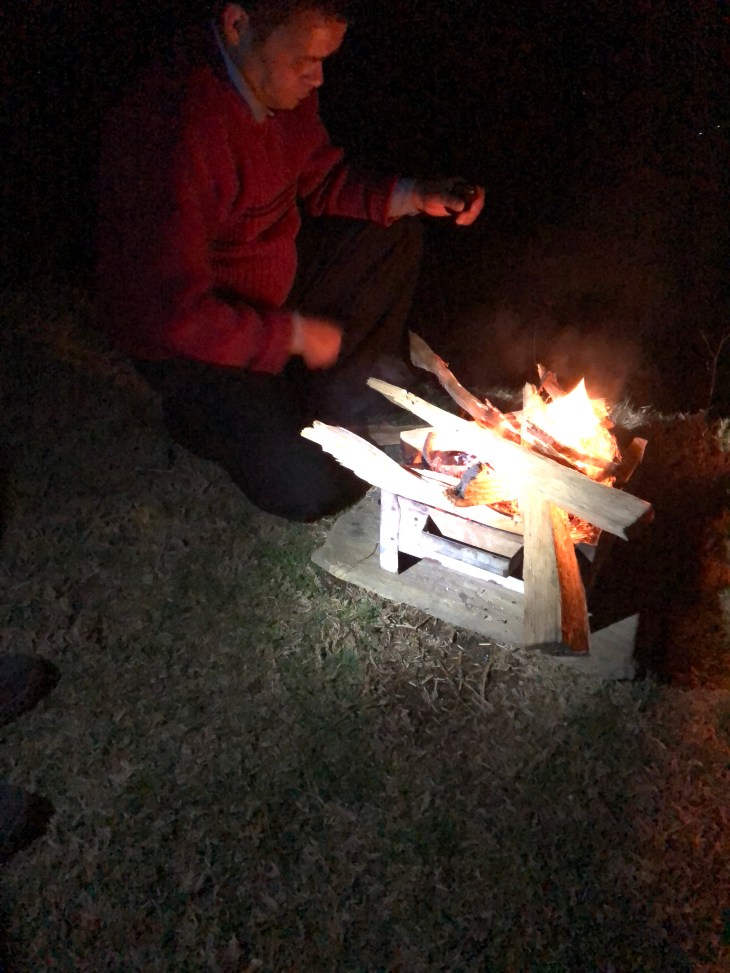
and we sat by the fire. It was getting cold.

There was no need for firelighters – resin was poured onto the wood and off it went!

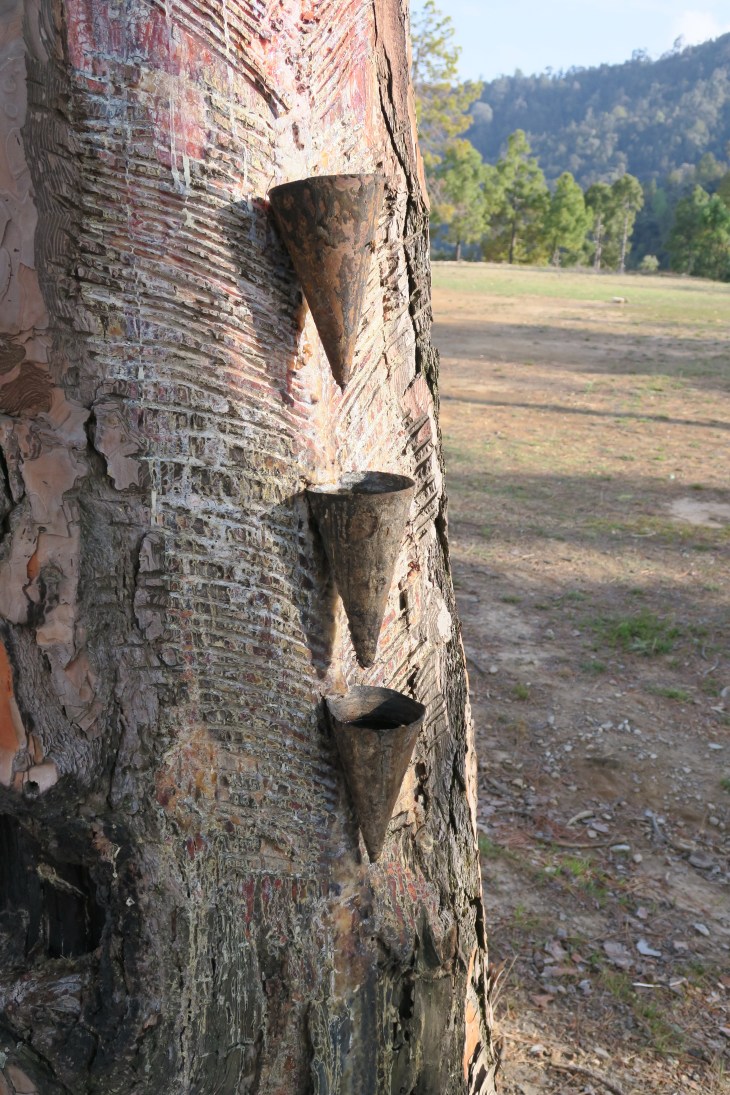
Resin is collected by scoring the bark of pine trees and placing cones beneath to catch the resin as it drips down

Our evening meal was served inside, sitting cross legged at little low tables, by candlelight. It was all very quiet and atmospheric.

After supper we went back out to the fire and gazed at the twinkling lights from far below. Above us: a twinkling carpet of stars. One of them was moving rather quickly. “A satellite” said Amit.

***********

Monday 9th April
After a mildly restless night, each of us suffering slightly with our tummies, we were awoken at 0545 with two cups of strong black tea.

We were to do a longish walk – roughly 14kms via trails and villages to a little house called Ganghet. The dawn broke fast over the mountains.

I felt a little the worse for wear, not having cleaned up properly and feeling slightly sleep deprived. I remonstrated with myself for minding, but that’s how it was.

However, you can’t beat a good breakfast at dawn! And outside there some breathtaking views to behold.

We set off at a cracking pace and marched the three kilometres back up to the road. Hearts beat fast and all the accessory muscles of inhalation were deployed!

Thereafter we wandered our way down 1000 feet for about 5km to the Jageshwar Temple complex. It dated from 8th Century AD. There is a main one which stands out tall against the two or three other smaller similar ones temples.

They in turn are surrounded by ten or fifteen smaller shrines housing candles or offered petals. Depressingly, there was quite a commerciality about the place; with a plethora of wily street vendors eagerly proffering identical trinkets and bags of offerings to buy for the gods in many gaudy forms.

Everyone removes their shoes on entry and wanders round barefoot on the cold stone. One hears chanting coming from inside the temples and sees small gatherings of worshippers seated on the ground, chanting and clapping together enjoying their unison devotions.

A dog trotted beside us for a time, trying make cupboard love. I’m afraid he was out of luck.

A cup of hot spicy chai later and we set off uphill to regain 1000 feet for another 6km stretch through tiny villages and smallholdings.

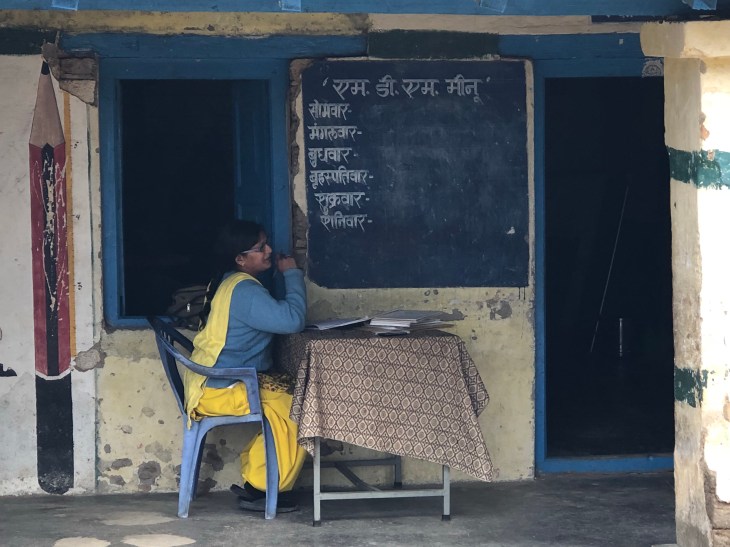
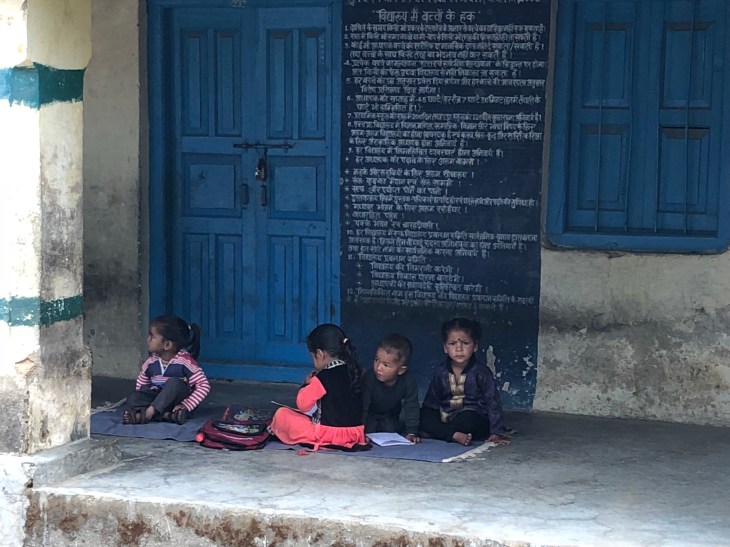
This was the most charming section of the walk, affording us intimate glimpses of mountain rural life. We passed a school where classes were being conducted outside. Those not big enough to sit at a desk, (ie toddlers) sat in mute awe on a mat at the back. No wandering off or whinging for an iPad here!

We continued on, until eventually we arrived at our lunch stop. It was a particularly good salady selection this time, and despite having already downed a hearty breakfast we tucked in.

The weather was now turning, grey and lowering, boomy thunder shouldering around the hills. So rather than risk becoming part of the next landslide we opted for a lift for a chunk of the way, walking the last part, and past these little people.

Ganghet was another village house property from which we were to have trekked back the following day, but with the weather situation, we opted to return to Itmenaan Estate and walk again the morning. Having already got 15 vigorous kilometres or so under our belt we didn’t feel too bad about it.

This proved to be the right decision. I was reminded of that famous quotation from The Best Marigold Hotel, “Everything will be all right in the end, and if it’s not all right then it’s not the end!” Such a good maxim for life I think. So on returning, and finding to our joy that the electricity was back on (not having been a reliable feature thus far) we got freshened up and then, unexpectedly, found the sun had reappeared, and were able to have honeylemonnginger tea on the terrace. It was as though the world had suddenly changed.

A magic meal

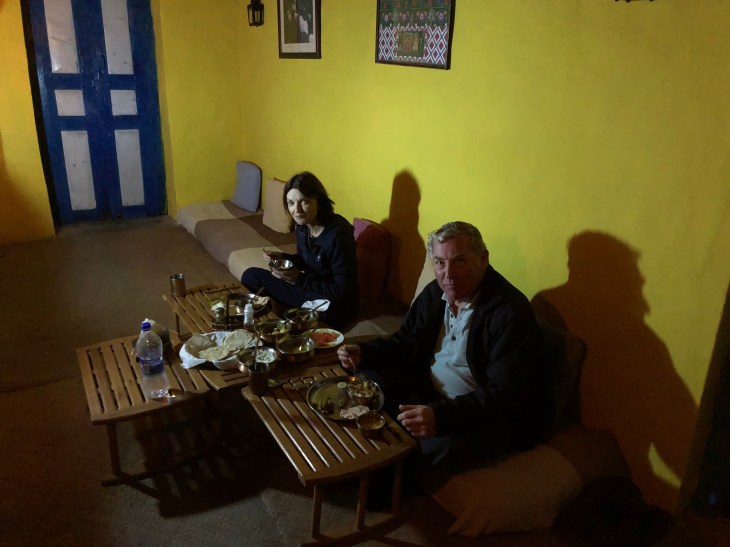
We were hungry for supper. All the beastly tummy problems now resolved, I tucked it. As usual we were served soup (this one had a great kick in it so I finished it), with pappadum, followed by rice and dahl plus a selection of other delicious vegetarian mixtures, some threaded with curry leaves and spinach, all of which hit the button. We even had wholewheat chapatis, glistening slightly, fresh from the pan. I tried to eat slowly, but found myself ‘troughing’, spooning it in for all I was worth. When eventually my belt couldn’t cope another second, I downed tools and threw in the towel. Amit strolled over. As General Manager, in addition to guiding us on all the walks and seeing to our every need, he was also the evening chef (with assistance). Poor chap had developed a slight cold. He was snuffly but still beaming and unfailingly polite. “Amit!” I said. “That was absolutely superb. What did you put in it?” He paused, grinning lightly, “Marijuana seeds, mam.”

!!!!!

A very good night’s rest then ensued with neither of us capable of stirring far from the bed.

Tuesday 10th April

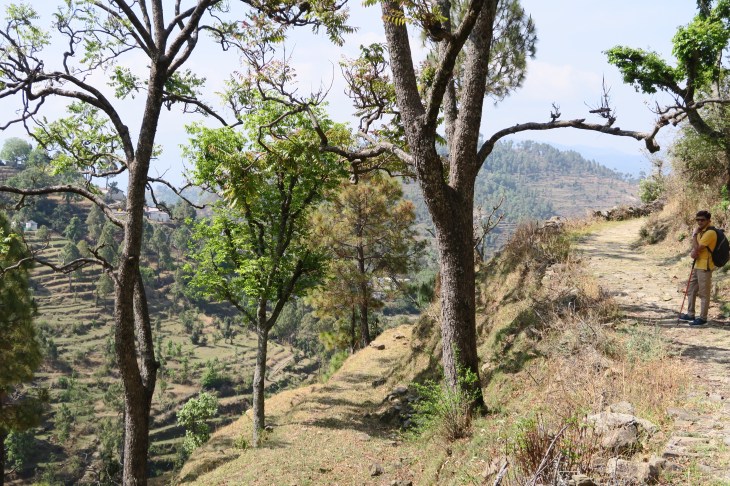
After our heavenly slumbers we woke to a bright morning. Following a good breakfast Amit took us for our last walk from the Itmenaan Estate. It was much the most beautiful. It takes a good 20 mins to get up to the road on foot so our legs were pressed well into service once again. Amit took us on a circular walk this time, descending quite steeply and then flattening slightly as we snaked the edge of some terraces, before climbing up again. The temperature was perfect – warm and sunny, but with the occasional shade from wooded sections, a wooshy wind sometimes blowing through the pines. It’s the mountain version of waves breaking on the shore and I love it.

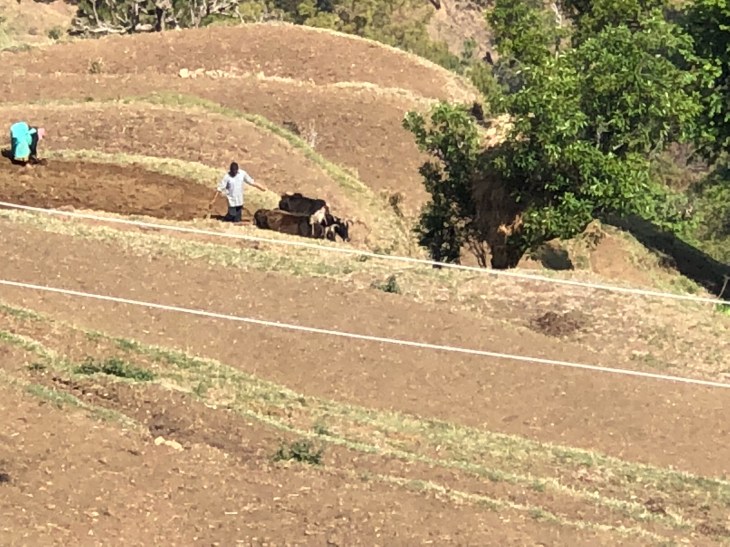
There were so many sights to see: a man ploughing the fields with two buffalo and a wooden plough, far below, a woman in a bright sari weeding (or sewing?) visible alongside.

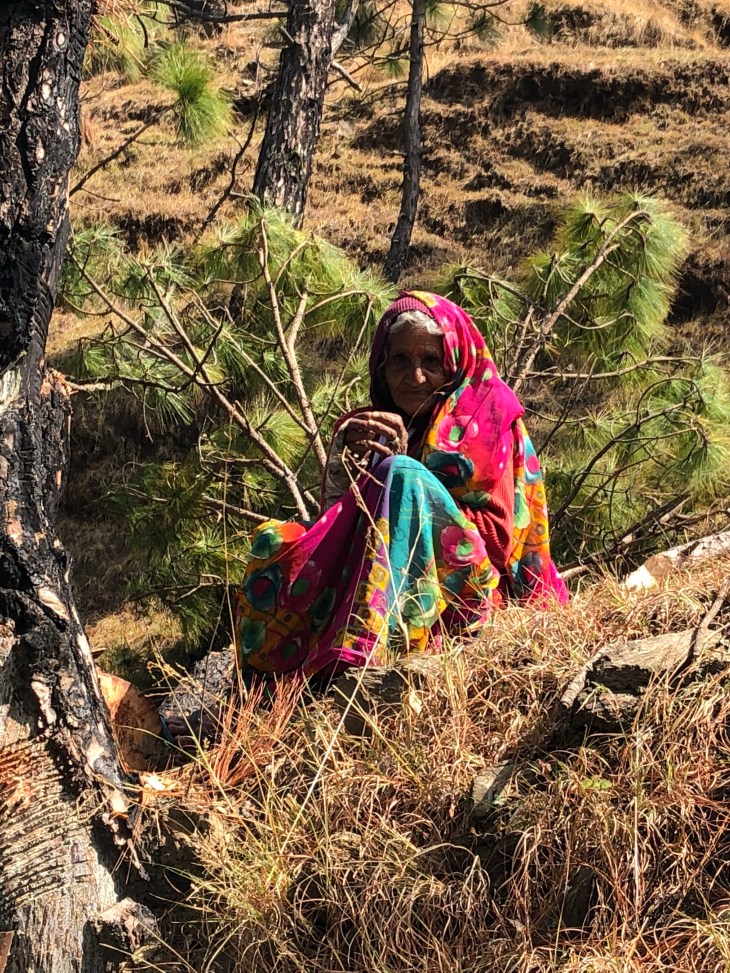
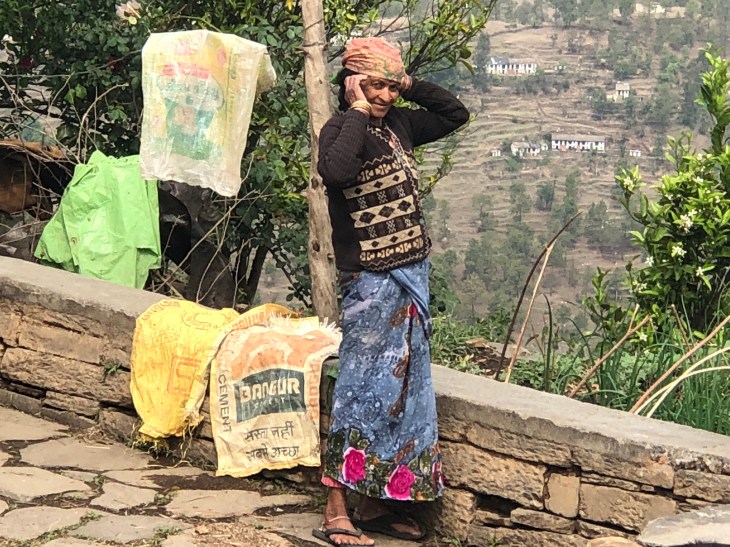
We came across some people cutting wood, a diminutive old lady with them, sitting and muttering merrily, watching the men work. I looked up and smiled – gesturing at my camera to see if she would mind my pointing it at her. She beamed back and spoke happy sounds. One does not need language sometimes – only some intention from the heart, I feel. Here she is. I could have popped her in my pocket.

What gladdened me so much was that she was outside, enjoying the air and safe, in company, not shut up in a room in an old people’s home.

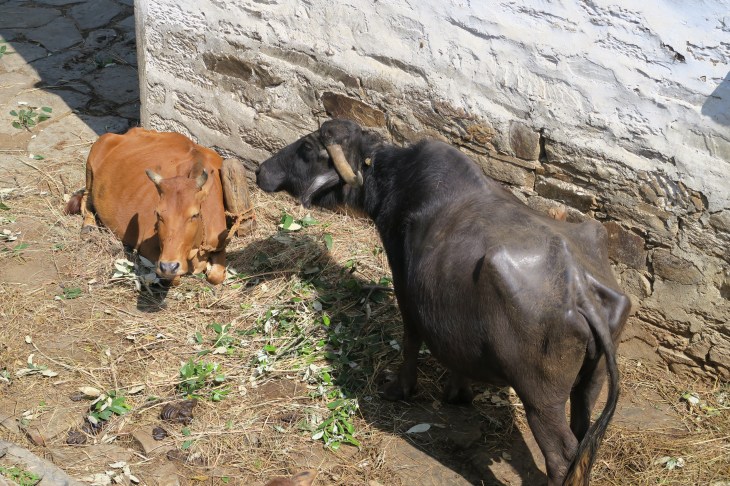
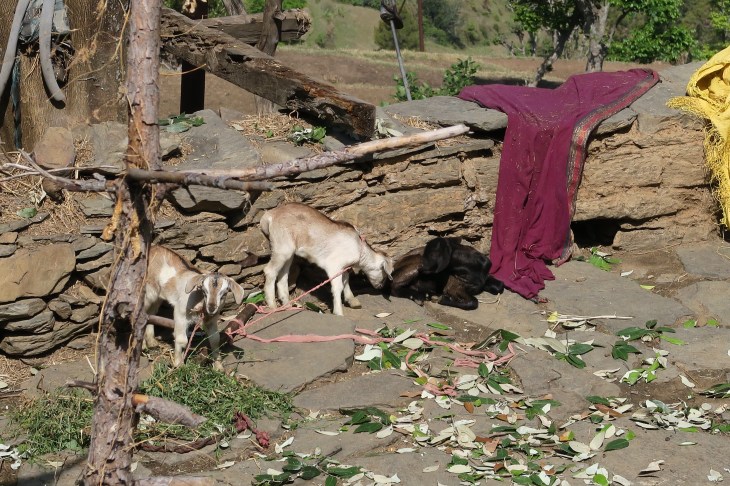
A typical sight was the shiny rump of oxen in the yard with little goats nibbling nearby.

We wound our way on, along an ever varying path.

We came across this fresh water well

now used for cattle.

We filed past Uday’s village and eventually hit the 15 minute descent for base one last time. Our friend the wood pecker was still terribly busy. Tired legs brought us thankfully down and straight into some tea, before a quick shower and lunch. We had walked for nearly three hours so hungry again!!

By 1330 it was time to leave. A farewell to Amit and a last lunch-legged trudge back up to the road.

What a special time to have spent there and how wonderful to feel slightly fitter and jump started (magic meal ‘n all!)

The Winding Stair

Saturday 7th April
Awoke to a cool but pleasant morning. We had huge storm last night – atomic thunder and great flashes of sheet lightning. Battering rain too. We were so excited we pulled open the curtains and watched it all from under the covers. (Yes, I know, how old are we…?)

I had had a restless night – a few niggles from normal life threatening to intrude. So naughty of them when one’s just trying to get on with it. But in fairness, it was partially kicked off by The Tummy. So it was very nice to hear the cheery chirping of birds outside, and know that the gift of a new day was right there for the taking.

A generous breakfast was served: watermelon juice, coffee, fruit plate, ‘muesli’ (or cereal of a sort), toast, and eggs. Knowing that our first warm-up walk was coming I tucked in (again, slightly crossing fingers).

A while later we set off, poor Jeremy loaded up like a mule (all those just-in-case items when you’re not sure what to expect) and me wielding my new found weapon (walking pole).

I am not a fan of descending anything, as anyone who knows me will know, but the pole was a boon! At last – something to hang on to! You could practically pirouette round it as you slalomed down the hillside. It was a steep and winding path dropping down 200m, set in a mixture of stone and red sandy earth. In case you are like me, the trick is not to look down at the view, but just a few steps ahead. Eventually you will get to the bottom. Hooray!

This morning we had Amit and Uday to guide us, one at the front and one at the back. They were incredibly patient with us stopping to photograph this and that. But it is special, and we want to capture and record lots of things.

The delicate pinnate fronds of the acacia..

Eventually the reassuring rush of river water was to be heard, signalling the end of the descent. A few swigs of water were extremely welcome.

Then began the climb – a steep one – up through the terraces and on to Ude’s village. Time had stood still here, aside from one satellite dish I espied. Tethered bison and cattle, goats, piles of straw for feeding them, mud glued roof tops were all there. The inhabitants stared at us but smiled too through a jagged landscape of intermittent teeth. We greeted one another always with a nod and a ‘namaste’. With Uday and Amit’s help we were able to understand some of what people were saying. One old man appeared, his shiny brown skin stretched taught across his cheekbones, lamenting how old and sore he was and that there nobody was left anymore (his friends having passed away). He spoke smilingly but it was sad. He said his legs hurt at night. He was 87 years old. Not much one can do, except smile back and give some warmth.

No matter where you are in the world, it would seem that the problems are the same.

This was old rural life still going on.

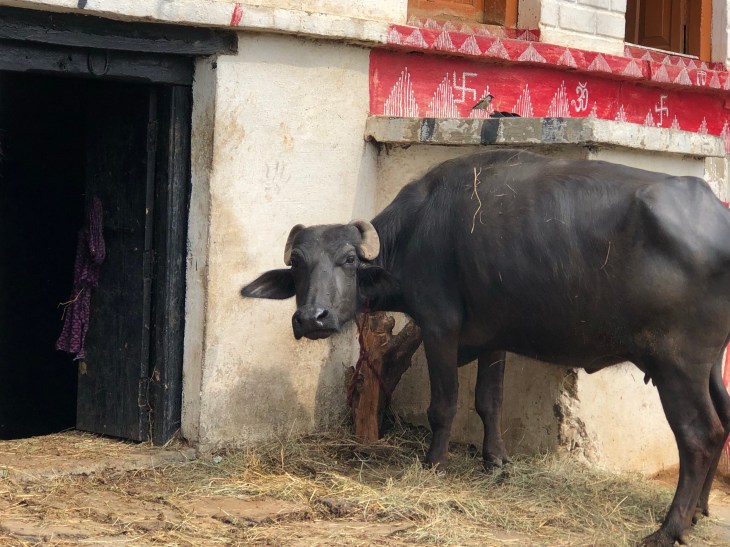
Uday showed us his bison tethered in the yard. They are used for milk.

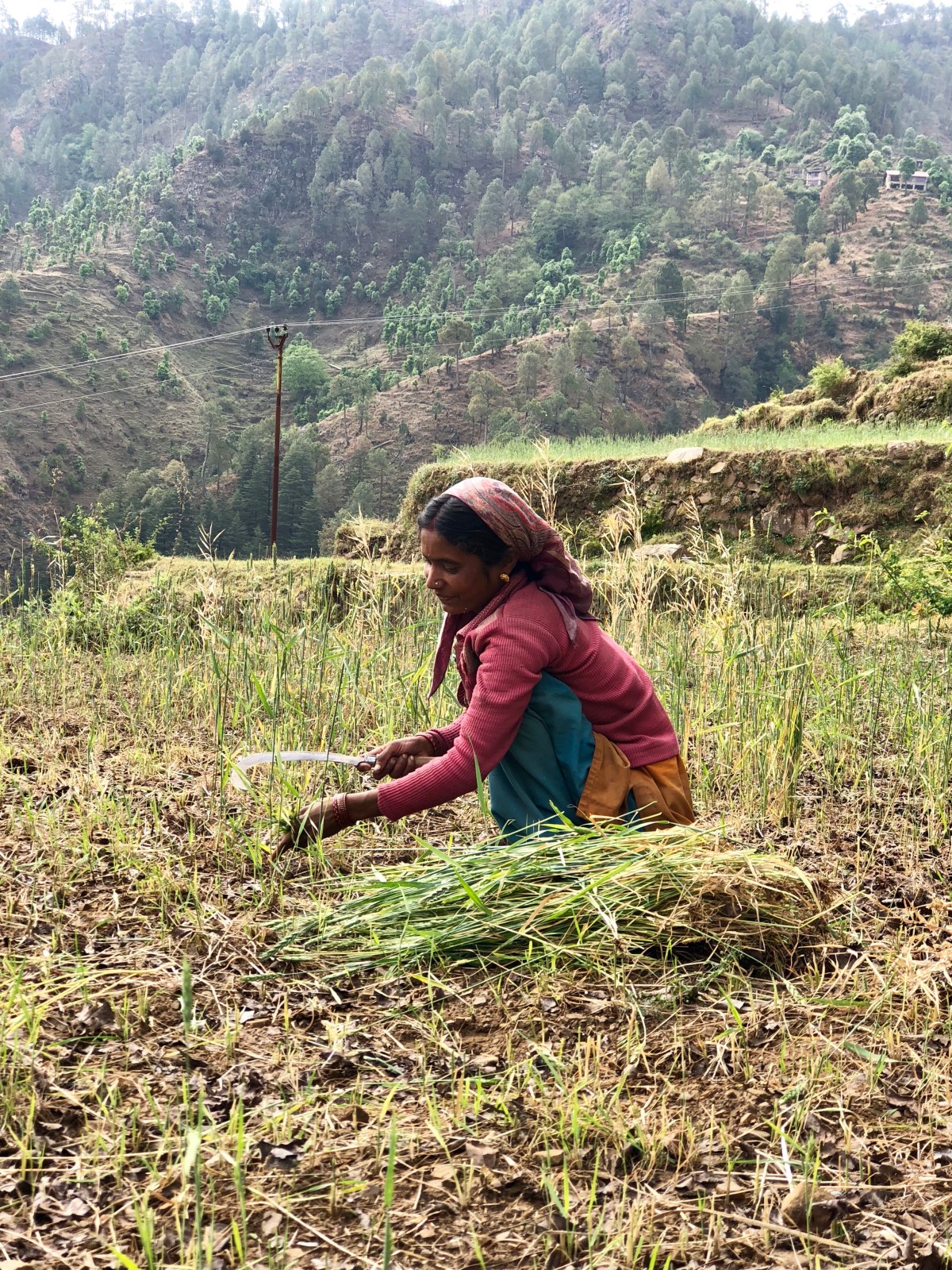
The contrast of the muddy paths of dirt and cow pats, with the colourfully painted houses and bright colours even in the oldest of clothes, was striking. Tasks are simple: fetching water, cutting wheat with a scythe, portering heavy loads up to the village balanced on the head. All done in the fresh mountain air. Who’s to say that this is any worse than living out one’s days in an air conditioned office block or pushing through the smoggy rush hour?

My goat like traits came happily into play as I clambered on up without too much difficulty. We passed by a shrine for justice on the way and rang the bell as we entered. There were lots of bells hanging before the shrine, each of which represented a justice achieved by the supplicants to this particular god. I did hope they were not tokens of revenge!

Another break for water and then up to the very top, arriving at the Ghantika Temple where a Saddu lives.

We had climbed 500m to an elevation of 2200m! We had to take off our walking boots in deference as we took a look inside. There were Durga, Ganesha and Vishnu in various representations. The Sadu looked quite jovial, robed in pink. He is 58 years old and has lived up there since he was 15, surviving solely on the gifts of Hindu devotees.

It was lovely to get the boots off for a bit and flex the toes. I have a good relationship with mine, plain and clumpy as they are. I feel able to do anything in them (well..almost). More slurps of water and on we continued, Amit pointing out things along the way: walnut trees, the delicate fronded acacias, and long thin oaks, quite unlike our own. On the ground were strewn clusters of long red pine needles, almost hair like. They use them for sweeping houses.

It was a much easier descent, through our nearest local village: Chalnichina. On the way round I had a go at pumping water from the local public pump. It stands by the side of the road, for easy public access, a bit like a petrol station!

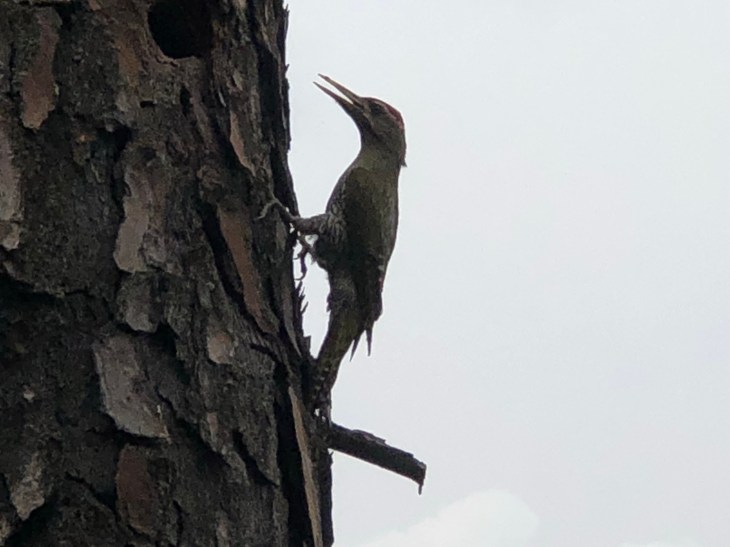
Eventually the winding stairway path down to our lodge appeared. Out with the pole again, and what felt a bit nerve racking yesterday suddenly didn’t. We passed a wood pecker on the way down who was extremely busy, tapping assiduously outside his hole.

As I write this, we are having a quiet afternoon, each writing something, a torrent of fat rain low overhead, soaking the entire area. The weather forecast is thunder and rain for the next few days.

Tomorrow we are due to leave to hike for three nights and four days, with just the bare essentials in our rucksacks. I have been alarmingly informed that there will be no hot water or electricity for the first two nights.

So there may be a slight interruption to the usual services. (Unless there’s a change of plan). Back on line when possible!

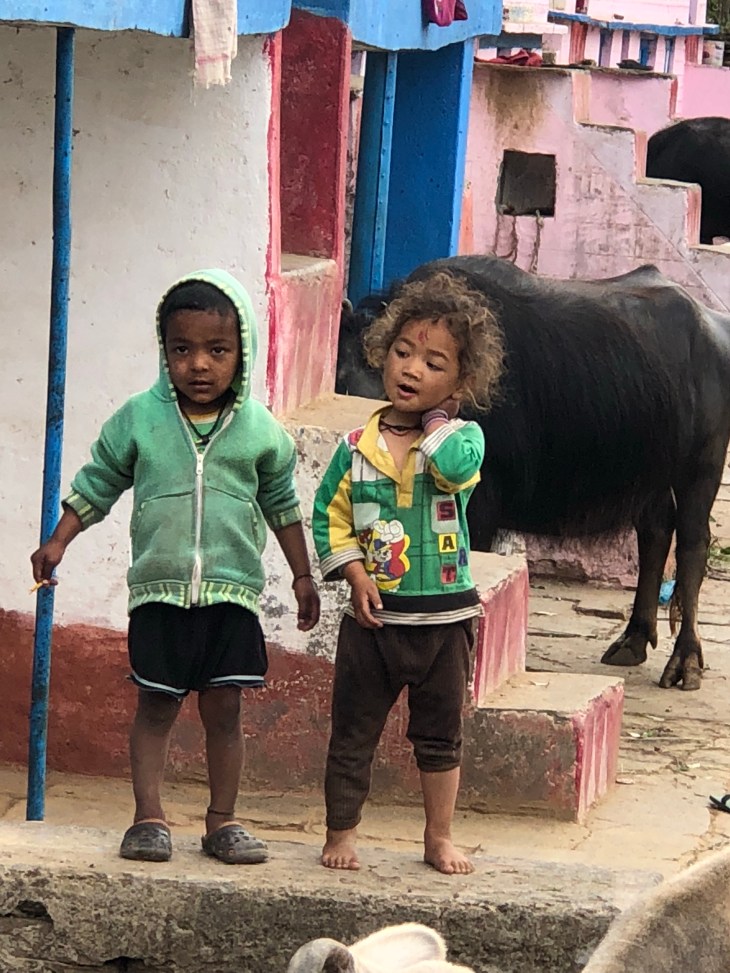
I close with these young faces. All photo credits to Skip today, as we decided not to duplicate shots.

Rollin.. rollin… rollin like a river

Friday 6th April

Itmenaan Estate – Deodor Cottage

A short post today..

At the best of times, undertaking a long journey on Indian roads is an act of faith. With a jippy tummy it is daunting. Will it behave itself? Will there be anything remotely resembling a loo en route? Should I eat anything at all during the day at the risk of disturbing the status quo?? With such concerns I got gingerly into the back of the car.

Our last hot sunny morning in Jim’s Jungle Retreat had dawned and we were all packed and ready for departure at 9.15. Ahmed, our host for the next few days, had arrived together with our driver for what proved to be a long and winding road up to where we are now. “Morning Mam” he said. He was only young – very polite but on the ball and helpful. Sort of clean, I thought.

To get out of Jim’s Jungle Retreat is a feat because you have to manoeuvre across the dry river bed, which could just as well be a lunar landscape. We bucked and plunged as usual but the driver did very well and we emerged still breathing onto the road. Get ready stomach, I thought.

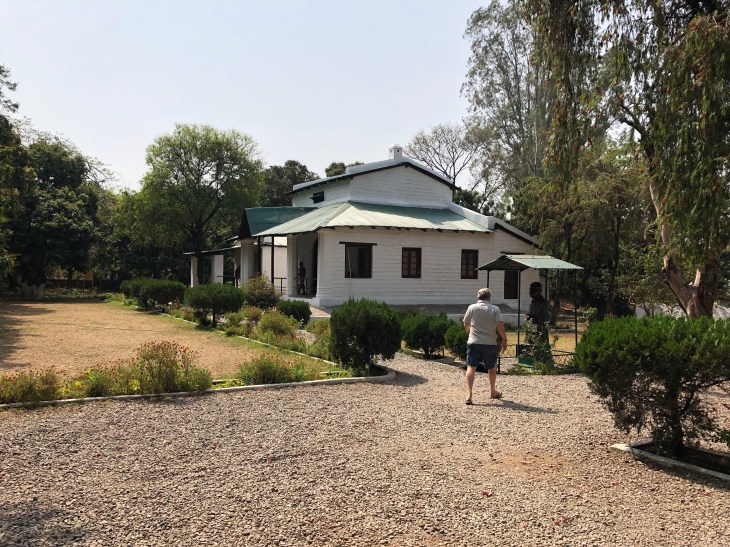
The early part wasn’t too bad. The Jim Corbett Museum is in Kaladunghi, which was en route. So we stopped off and had a look round. The museum is actually his old house, a very simple residence where he would stay in winter, retreating to the hills in summer.

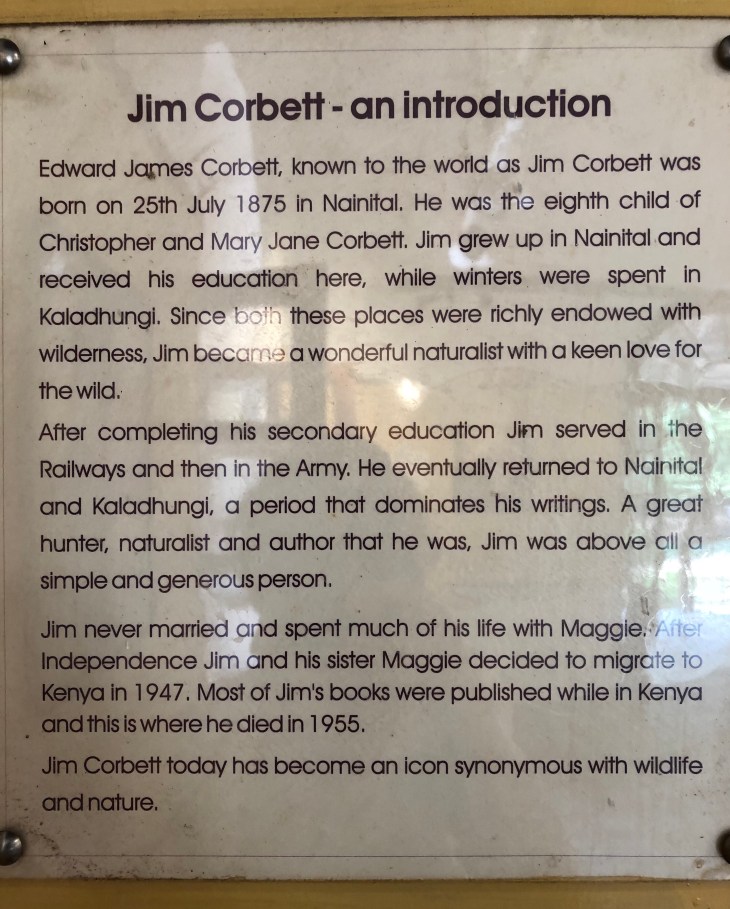
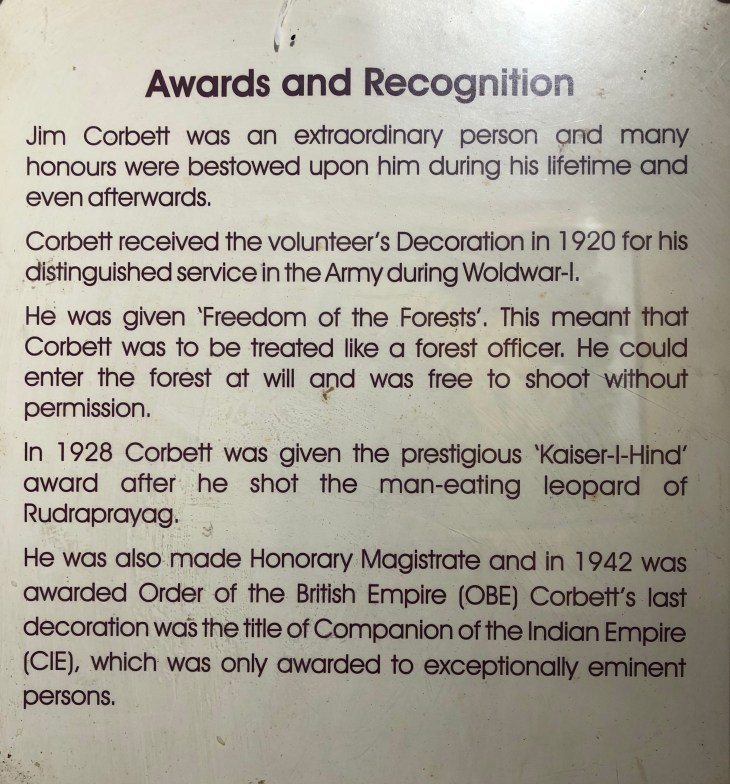
I would love to write at length about this man, as I have been inspired by all he did for the people around him and his legacy. Having lost his father aged 6, and come from nothing, by the end of his life he was greatly loved and publicly honoured. But the little museum plaques probably express it more simply and better than I can.

Here are a couple of them:
Lingering possibly too long in his house we got back on the road and pushed on. It is so difficult not to back seat drive when you see vehicles coming at you on all sides and the driver going to within inches of the bumper in front. But there is a curious insouciance amongst all the Indian drivers on the road, and somehow the impossible happens. Overtaking on blind corners going up hill? No problem. Driving straight at the vehicle in front and seeing who gives way first? No problem either. It’s usually the smaller one. Doing a five point turn on a major highway? Piece of cake. All these delights were giving my stomach muscles even more contracting to do.

Next stop was lunch. As we turned off the road I thought, we can’t possibly get up there. But it’s India. So we did. At the end of a series of hairpins and breath holdings we arrived at Freddy’s Bungalow, a beautiful simple guest property, to be served lunch. I had only planned on dry toast or (shh) an ice cream, feeling desirous of some sugar. But this was a proper meal, and spiced. I decorously took a very small amount and hoped against hope nothing would happen.

Those stabbing pains again. But, surprisingly, they subsided, terrorised possibly into submission by my subconscious. We got back into the car and then came the really tough section of relentless bends and twists for mile after mile, with our bodies tossed from side to side and backwards and forwards as up and up we climbed, narrowly missing some large lorries coming down. ‘Just accept’ I thought, don’t fight it, and DON’T look through the front windscreen! But after only a short time it was my bladder not my tummy that was complaining. Damn it. Jeremy tapped Ahmed on the shoulder and said could we stop at a washroom in the next ten minutes. “Washroom? There are no washrooms mam. No washrooms on this side.” I stared back, incredulous. And then mutinied. “Well I can’t last till we get there!” And now having lost all my pride added “I don’t mind where we stop – trees are fine”. “Very well mam”. The poor driver was now under pressure to keep going whilst looking for an appropriate spot. Within minutes we stopped on a hair pin bend where a stream came down.”Over there mam, you can go over there.” Having checked no one could see, (I was wearing my spot-the-tourist red trousers after all) I lowered myself down the bank to do the necessary. Feeling thrilled that no one had had to observe the baring of my all, I stood up to fasten the red trousers. Within seconds a woman bearing a heavy load on her head walked right past just above where I had been. Thank goodness she had been spared a viewing.

Then on and on we went, almost unbearably. There was one more stop for a photograph and this time I had no compunction at all and marched straight over to the nearest bushes.

Only an hour later, but earlier than we had anticipated, Ahmed stopped the car, in the middle of a pine forest and said we would now be walking down to our accommodation. Some men appeared, given the onerous task of portering our stuff.

He proffered two walking poles! I took mine gladly but the boss refused. It wasn’t easy in flip flops but we then wound our way down a steep stoney path for at least ten minutes until finally we arrived.

Quick pause..feelin’ happy

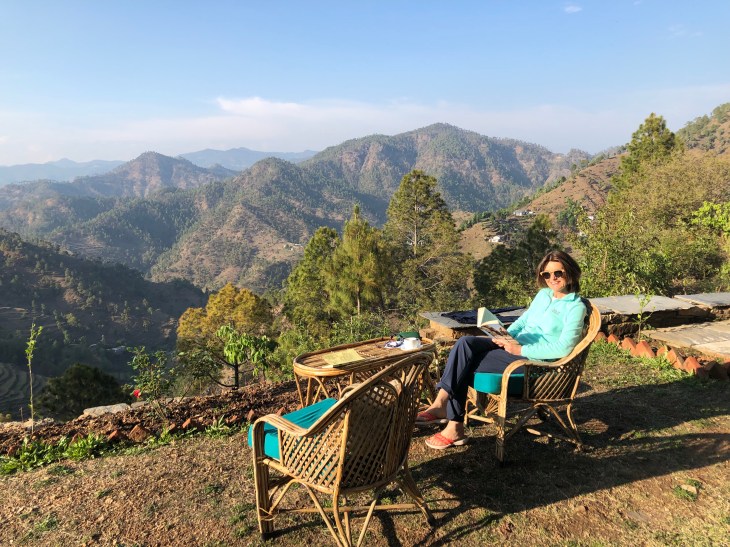
It was a really beautiful spot. Honeylemongingertea (said all in one go) was immediately served. Heaven. Behind us our lodge. Before us a panorama of breath taking views, across to the hills and distant villages and down to the terraced hillsides stretching away far below. The sun shone and the birds were singing like mad.

It was a wonderful end to the journey and those tummy angels had indeed been merciful.

Ramblings in Rishikesh

Easter Monday 2nd April

My eyelids fluttered awake to soft light pouring through the pale curtain, the volume of the toot toots from the road helping to rouse me from my first good night’s rest. It was a very nice feeling.

Our room is fairly monastic all painted in white, with a little dark furniture, but perfectly comfortable. A warm wind had got up overnight, which had dried everything but blown some of my smalls off to drape the hedge below. Off went Jeremy on retrieval once again. This time not eaten by monkeys. What a helpful hound he is.

We’d had a good if ‘don’t look’ scary sort of drive to Rishikesh the previous afternoon, arriving unfortunately at the wrong bit of the hotel. We’d then had to bump our bags all the way down some precipitous steps to the correct building. I managed to resist mine taking me down with it.

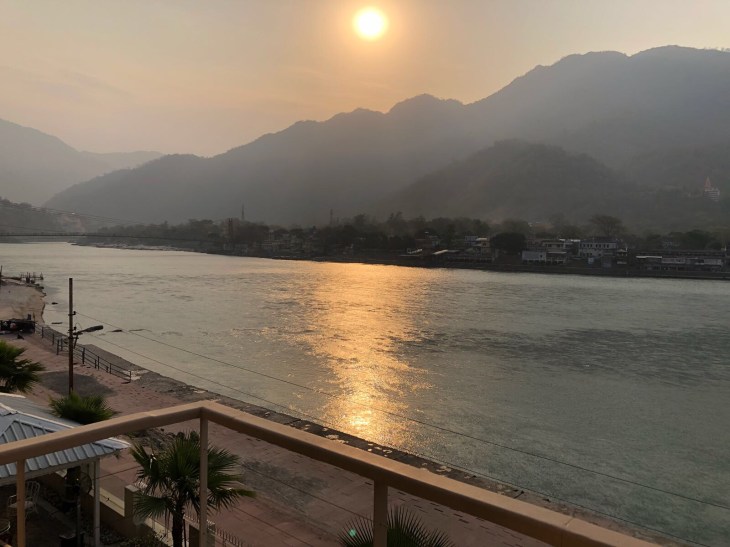
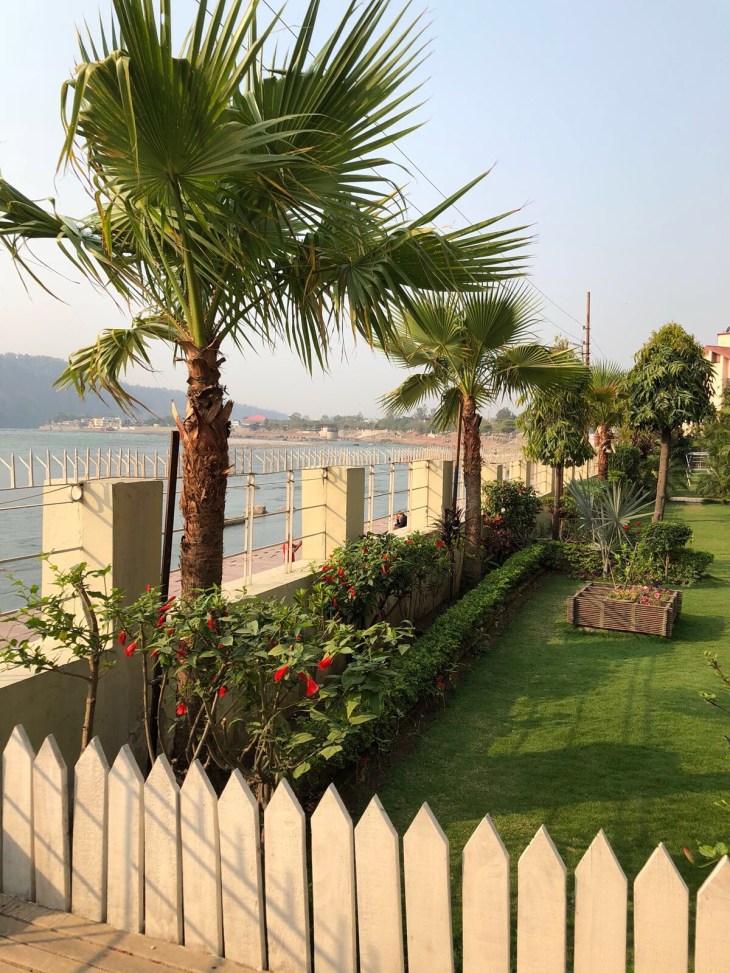
We survived however and checked in to the Yog Niketin by Sanskriti. Brilliantly, we were shown to a room overlooking the Ganges with a little balcony which had the perfect sort of wires to hang one’s washing on. What a mighty river she was looking yesterday: wide, fast and blue.

We’d had peaceful afternoon followed by doing some essentials – or washing them should I say.

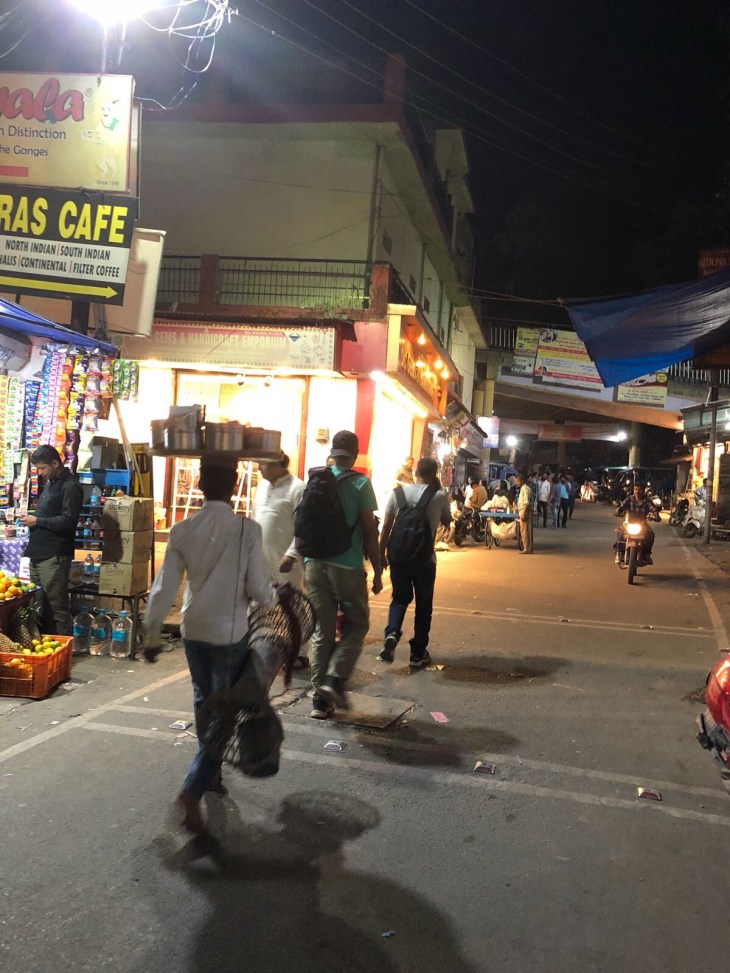
Soon it was time to go for dinner, and we were lucky enough to come across the Chotiwala Restaurant only two or three minutes away along the front. It was packed but they found us a spot. A feast was then conveyed to us. There is no meat, eggs nor alcohol served here, but you really don’t miss it. Staggering out with tummies full of kadai paneer, jeera rice, dahl, cucumber salad and garlic naan, 😱 we took a stroll down the streets, but it wasn’t easy. It is clearly a favoured rat run for the bikers, as they weave and hurtle picking off unsuspecting tourists, tooting wildly….but they missed us!

Back at the Yog Niketin we fell asleep to all the outside bustle and clatter still going on.

Seeing stars

Unusually for him, Jeremy had booked us into what he thought was an astrology class this morning at 8.15. It turned to be an astrology consultation. We arrived downstairs in a very pleasant room overlooking the strip of garden and river. It was the yoga room I noted guiltily. All these chapattis take their toll..

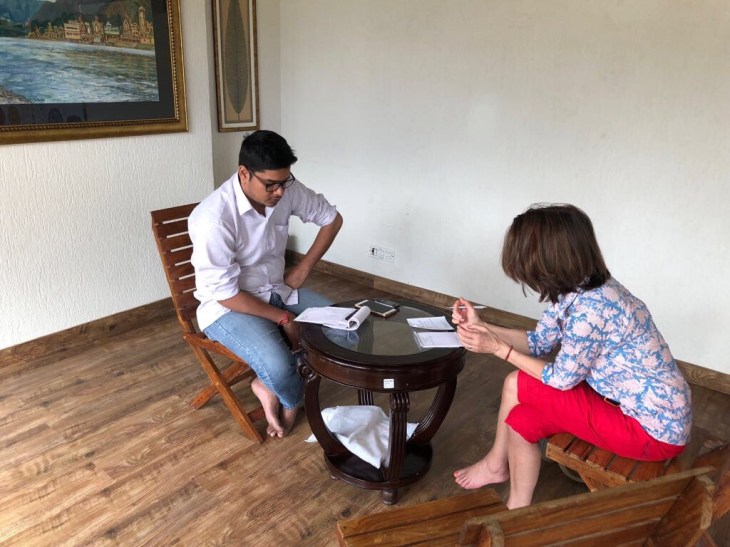
Our astrologer arrived, a young man called Prakesh, who began by asking ‘How can I help you?’ We were both a bit stumped (I could sense Jeremy wriggling sceptically!) until we realised what this was about. A mere look at astrological alignments. He then enquired of our birth dates and drew our up respective charts. There were long silences. I sat, motionless, determined to ‘stay in the moment’. Astonishingly, whatever truth lies behind it, he came out with some very interesting observations and comments about our personalities and direction. It’s not for discussion here, but we left feeling positive with some things new things to think about.

On tour

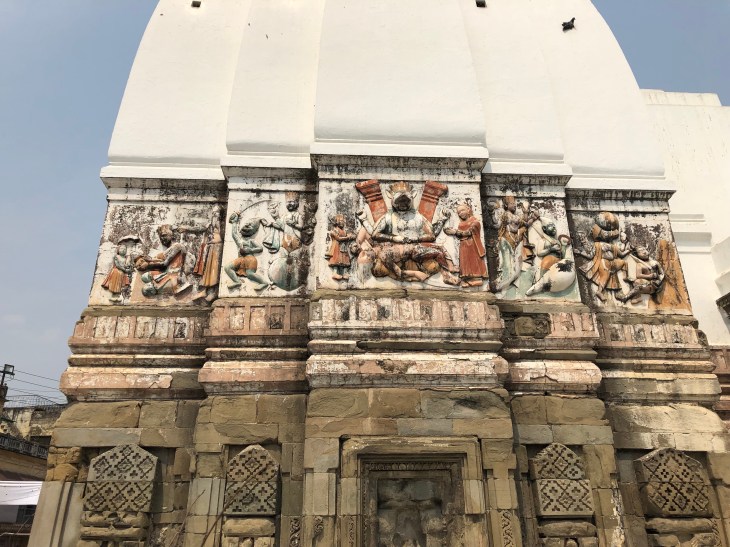
Our next tuk tuk, devoid of any suspension bar our own spinal columns, conveyed us to the Bharat Mandir Temple. It was closed until 1pm so we made our way down to the river.

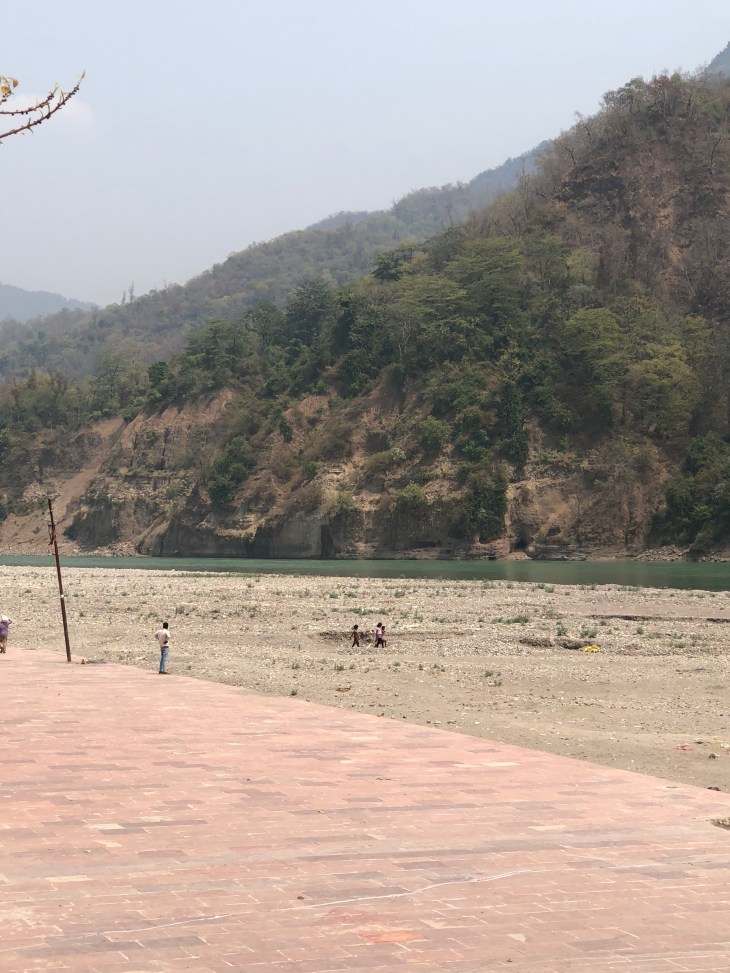
It felt rather desolate, with the barren rocks stretching far down to the Ganges which looked greener and thicker than yesterday. Children were playing by the water – some had even improvised some cricket.

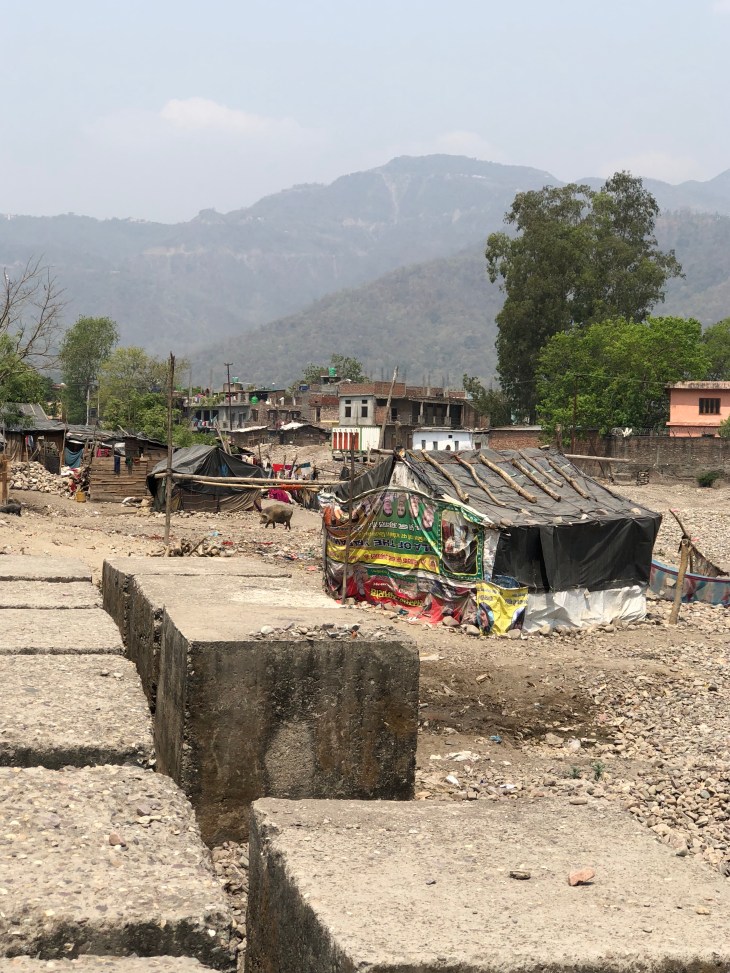
Some rough dwellings lined the shore.

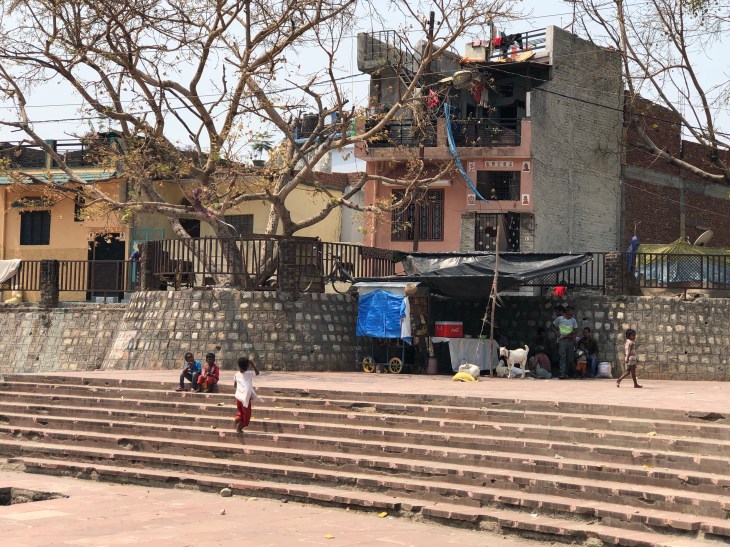
We continued down a paved front to the Triveni Ghat.
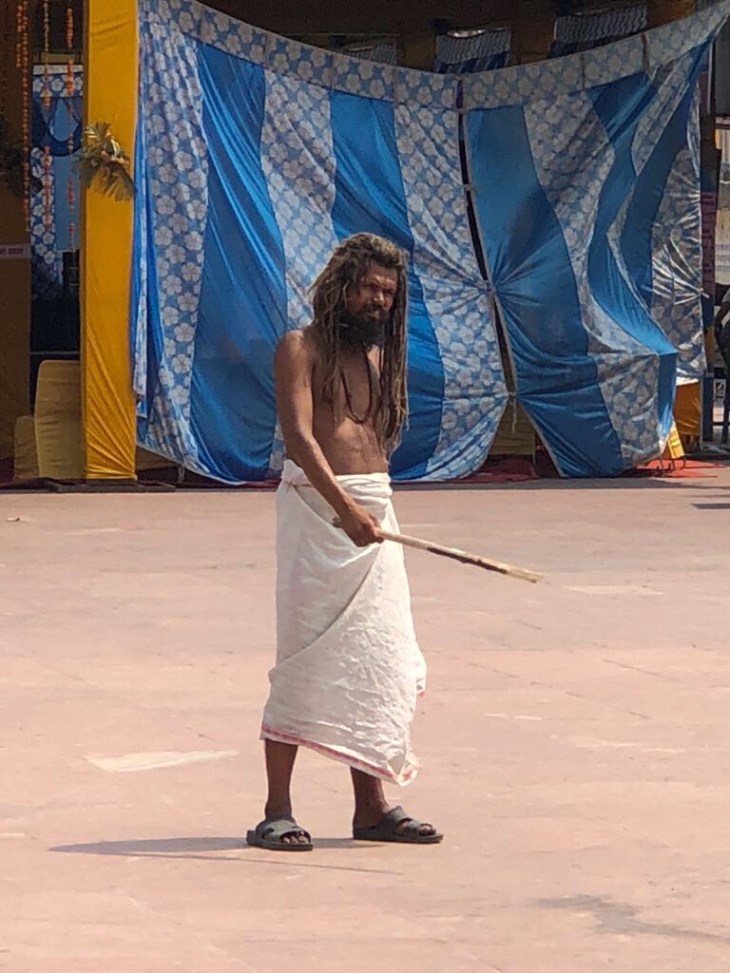
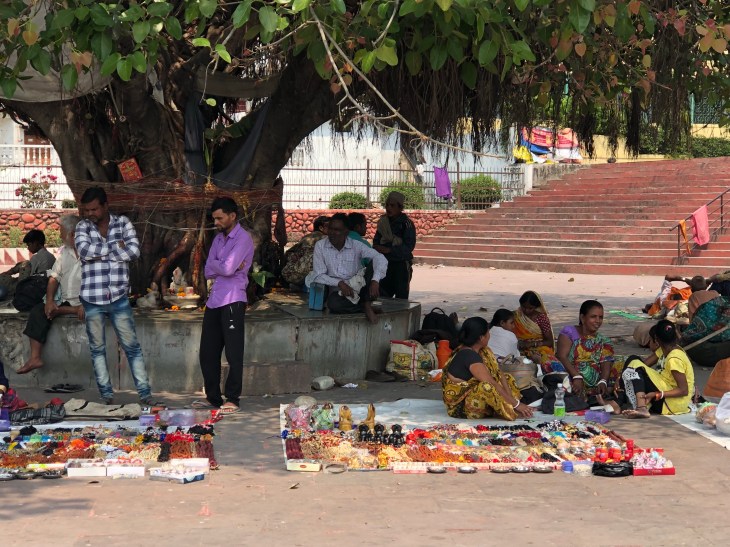
This too was a dismal spot populated by a few vendors of garish plastic bottles, for collecting river water, and statues of deities, but people were down there selling other wares too. An ascetic wandered around, lightly flagellating himself in a non committal sort of way.

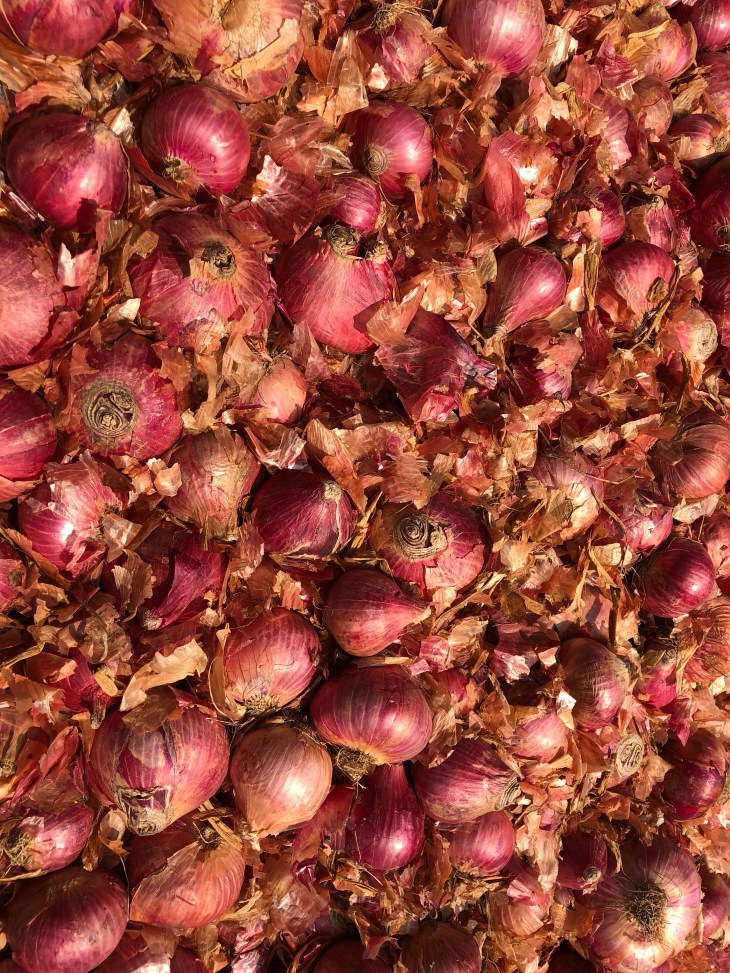
Then back we went through the mad streets towards the Bharat Mandir Temple, passing these fabulous bulbs of rosy garlic on the way.

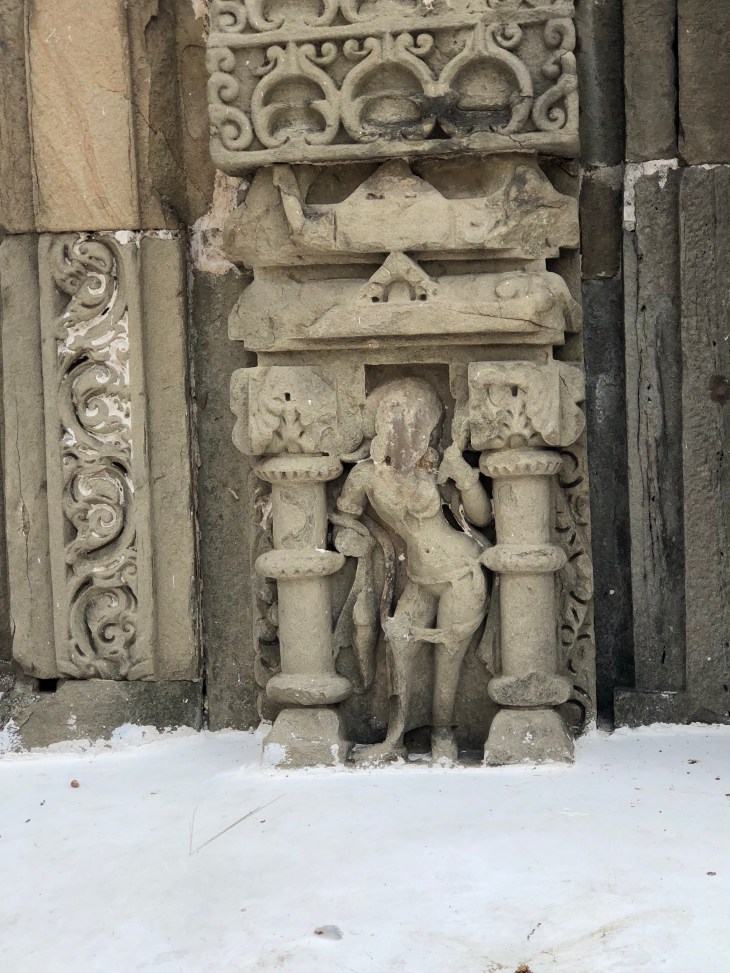
The Temple was very simple with some seventh century carvings on the outside. There was a touch of erotic physicality about them which one could sense even across the centuries.

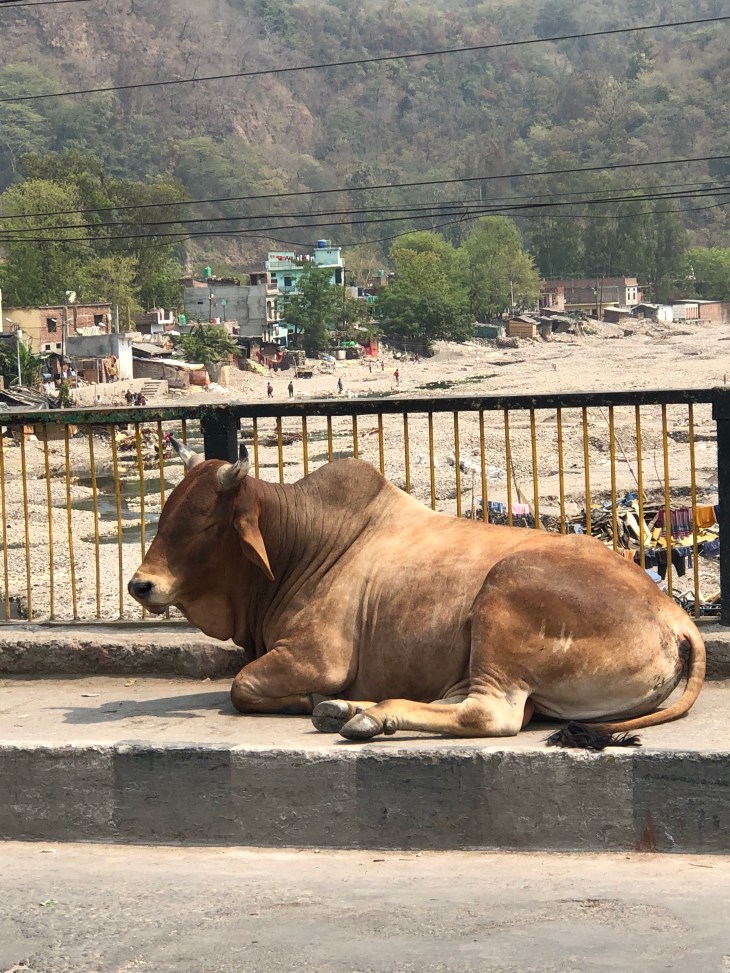
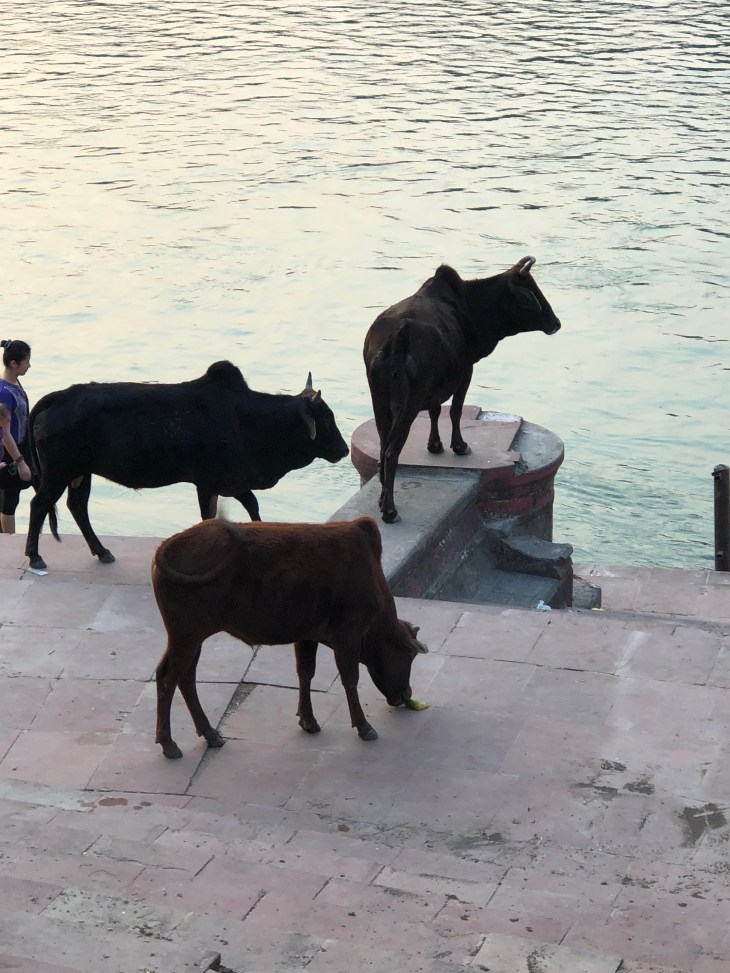
Following our visit we made our way back along through yet more traffic. A cow sat motionless on the bridge spanning a dried up river bed, strewn with litter.

Jeremy diced with death dashing across it to take a photograph but I lingered. Looking down my astonished gaze fell upon this family of wild boar. Pigs – possibly not in blankets, but definitely in the proverbial! Mud, mud, glorious mud…

We hailed a little bus like tuk tuk to get back this time, and were suddenly joined by several others until there were nine of us on board, each person getting out wherever they wanted. A system we could emulate! We bobbled back up town and alighted at the hotel.

Lunch at the Chotiwala again!

It took me all my will power to fight the urge for some ice cream afterwards. (Well known weakness).

Aarti again

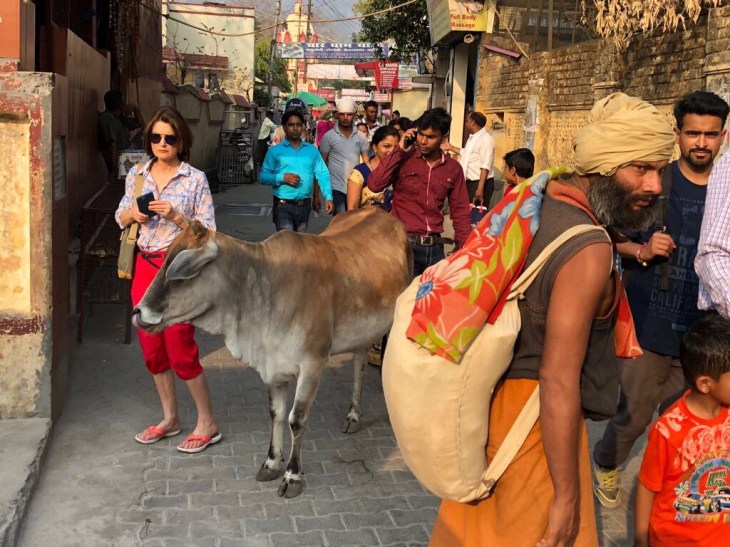
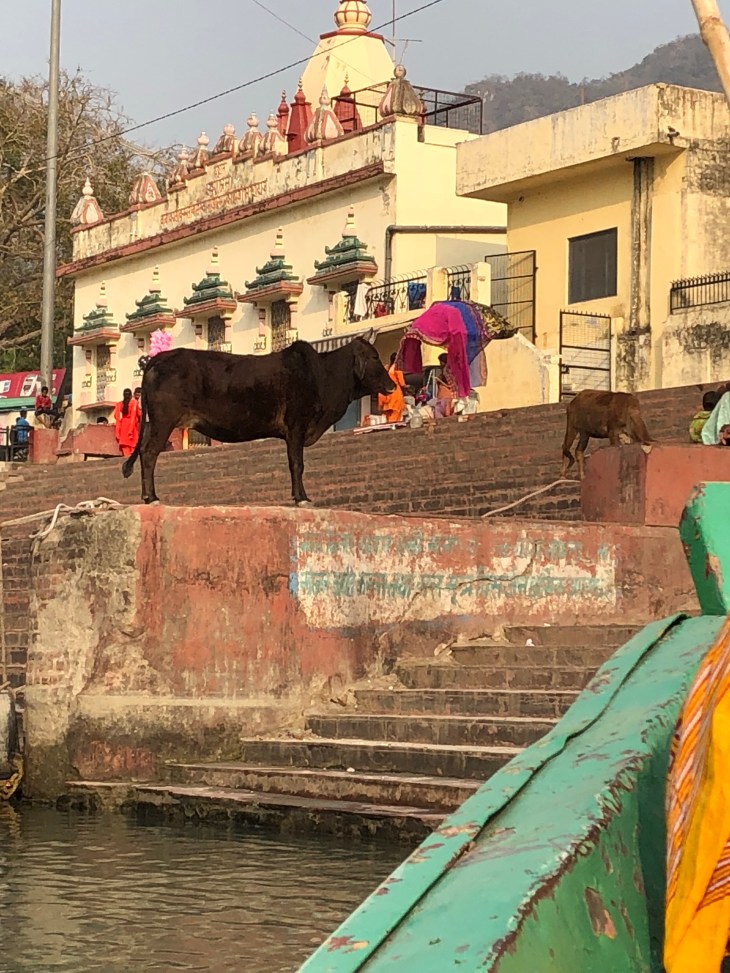
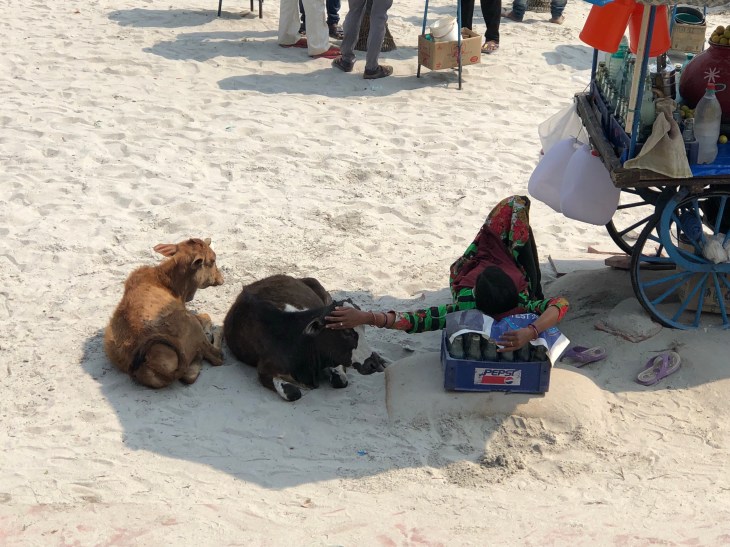
Catching the ferry across the river we took a stroll round another part of town, very close to the ashram where the Beatles famously hung out in 1968. This was far more touristy with many more hippy type western visitors in evidence. A long corridor of tiny shops selling trinkets and yogic books ran close to the river – with every enticement of incense and music to lure one in. Perhaps ‘stroll’ wasn’t quite the word as the usual issues of itinerant bovines and thrusting mopeds prevailed.

Sadly too, we were frequently accosted by beggars. The lower levels in this society actually sit and function at ground level: in a sort of visible socio geo stratification. Children as young as five with imploring little faces and softly spoken carefully learnt English begging phrases would often spirit into our path. It was horrible to ignore them and turn away.

There were many extraordinary sights.

We took a turn round the Parmath Ashram, where a lot of people stay to practise yoga and meditation. The public could enter and wander round. There were hedged courtyards bounded by cells, meeting halls, yoga rooms and a dimly lit canteen.

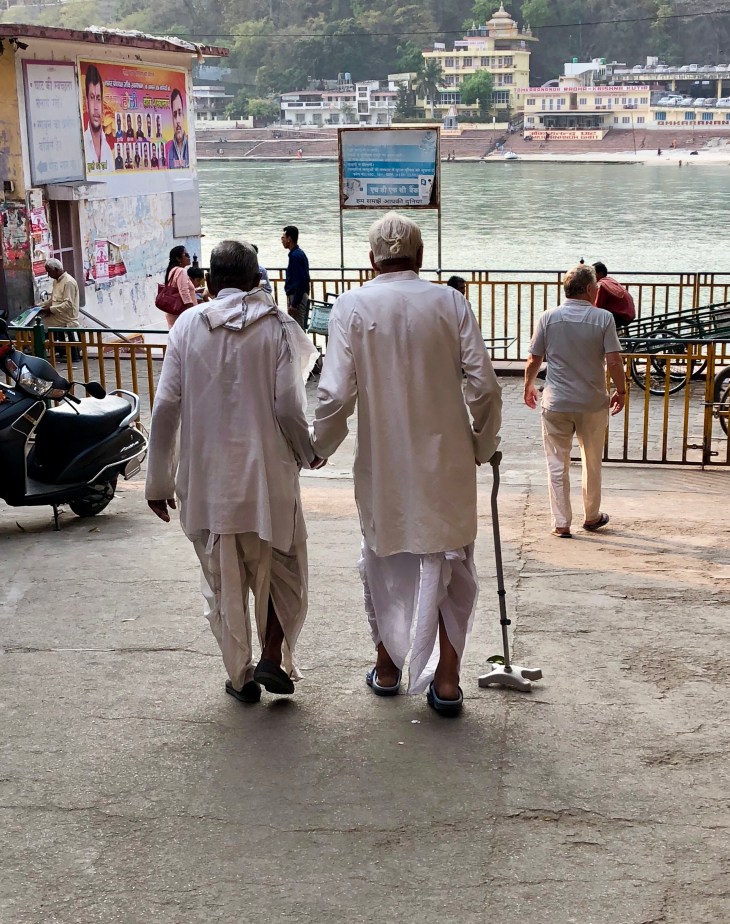
People lay around on the grass, chatted on their phones, and generally swarmed all over the place. It didn’t feel terribly spiritual! Then I caught sight of these two elderly gentlemen holding hands and coming out for a walk. It was heartening to see.

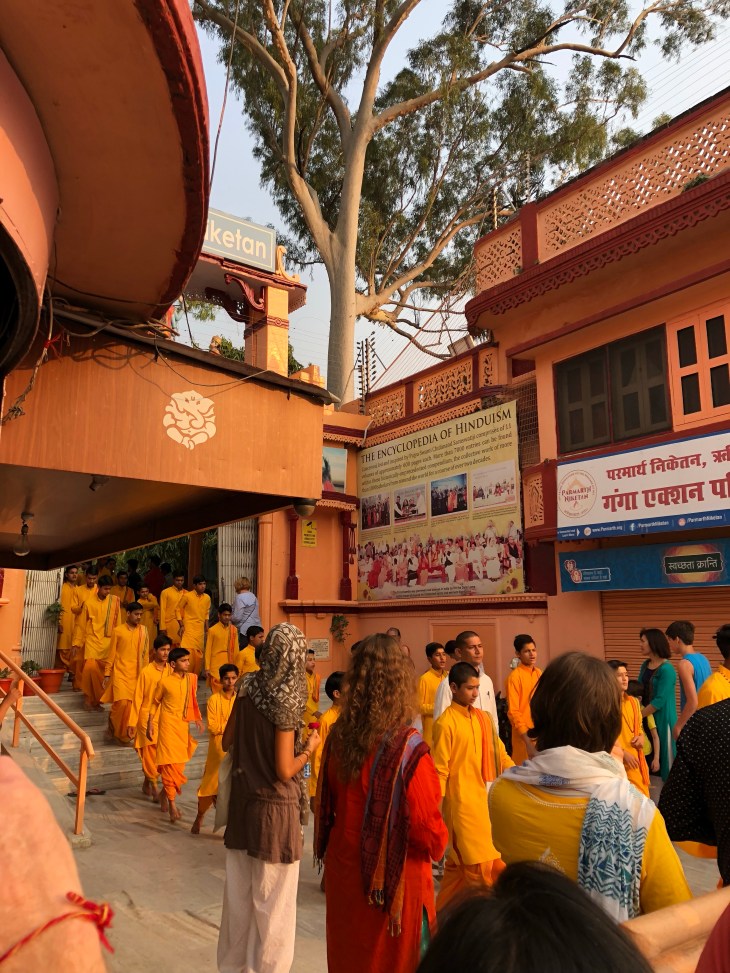
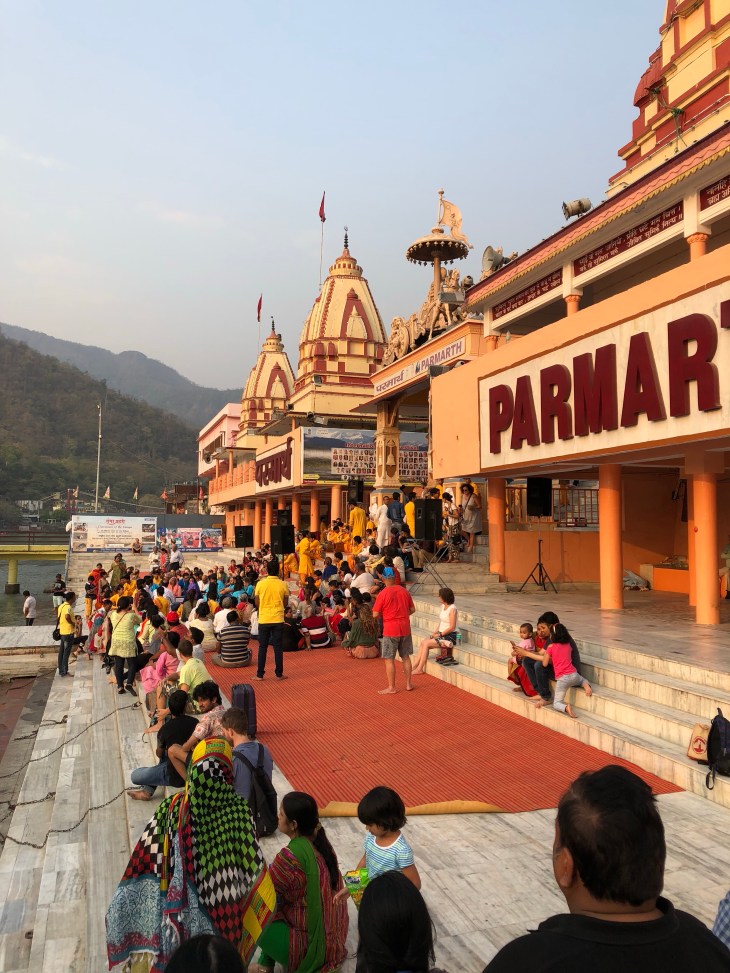
The afternoon wore on to the time of the Aarti. A parade of yellow robed boys emerged from the ashram and across to some stepped frontage by the water.

An enormous statue of Shiva presided over the scene.

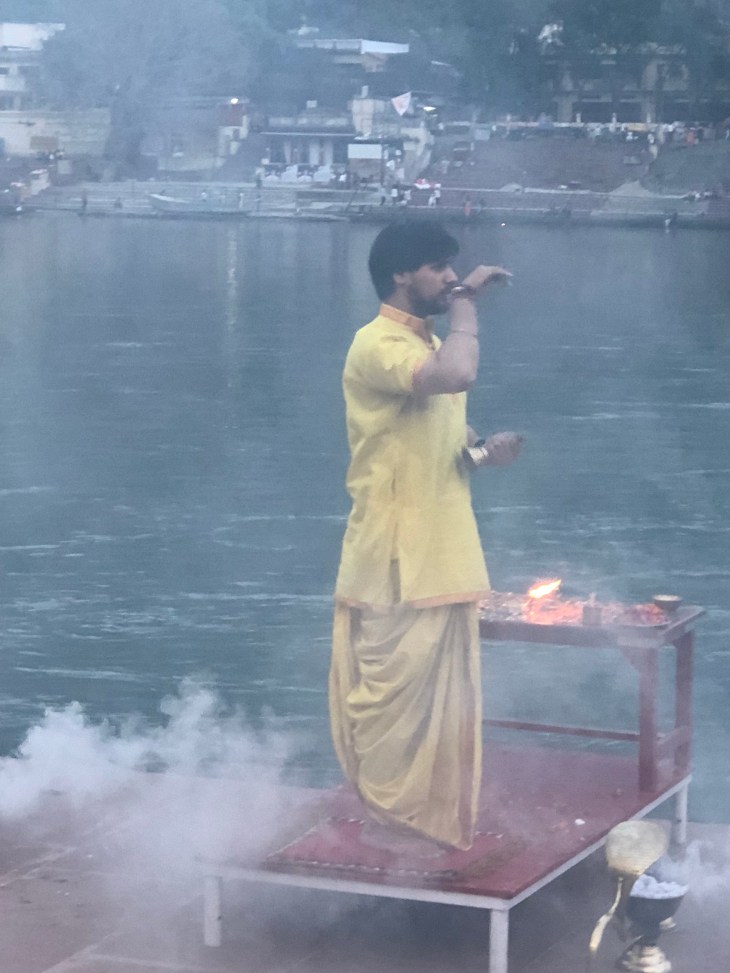
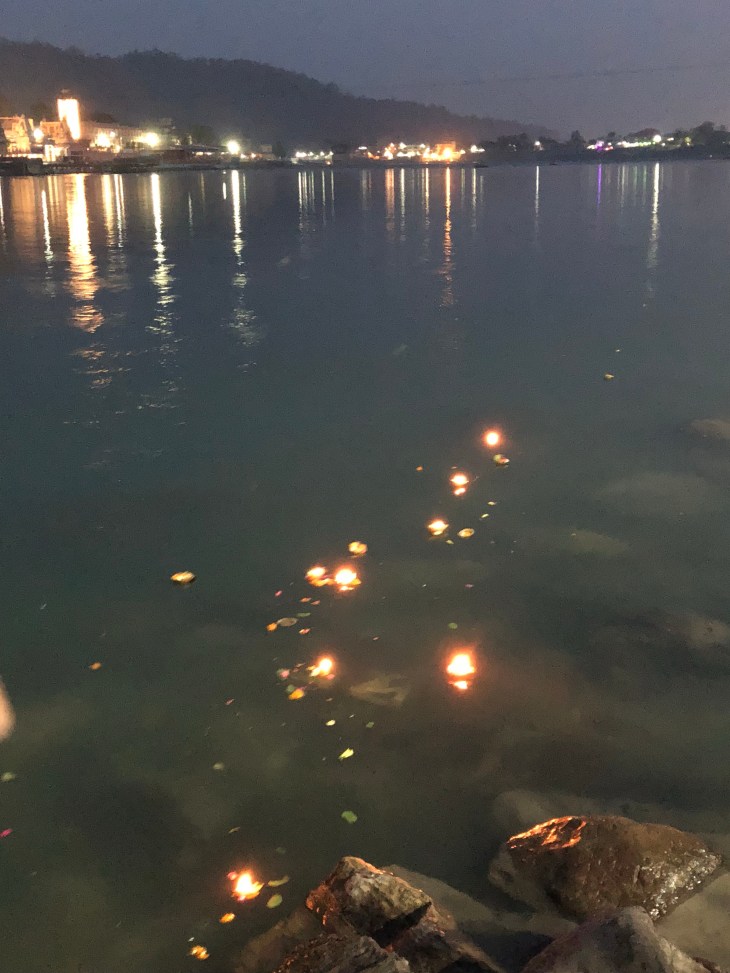
Little be-candled flower boats would once again be released onto the water after the usual singing and chanting rituals. We watched for a time.

Whether it was the heat or the occasion I suddenly felt impelled to paddle in the Ganges too. There were special steps down which you easily reach it. The water was icy but wonderful in contrast to the heavy hot air. It stopped feeling cold after a while. I wetted my hands and liberally dabbed my head and neck; then stood for a few moments, staring out away from the crowds; a little private baptism in the river.

The Aarti became more and more populated by spectators so we left after a time. It was a relief to re-board the ferry (effectively not much more than a canopied rowing boat with two large outboards) and feel close to the water.

By now I was feeling truly weary and grubby. But… there was one more Aarti about to take place near to our pad. So after a little persuasion and reserving the pleasure of a shower just a bit longer, I joined Jeremy on the steps. This one was undoubtedly the most beautiful and the best. An enchanting choreography of swinging light and smoke performed to atmospheric music made for magical viewing. We found ourselves joining in with the clapping and swaying in rhythm with the beat. The man next to me reverently joined his hands in prayer. This was a very different in atmosphere from the two previous Aartis we had witnessed. In conclusion, the officiates came round and offered us all the chance to wave the fiery snake mouthed lantern. This we did, then retired, glad to have stayed the course.

A fitting farewell to our time in Rishikesh.

.